
Pulp Fiction, 1922 · page 194 of 200
Adventure Magazine Cover — page 194: what you’re looking at
A restored page from Pulp Fiction, 1922. Page through the whole issue in the reader above.
📄 Transcribed text from this page (OCR, searchable)
Machine-transcribed from the original scan — historical spelling and the odd misread are preserved.
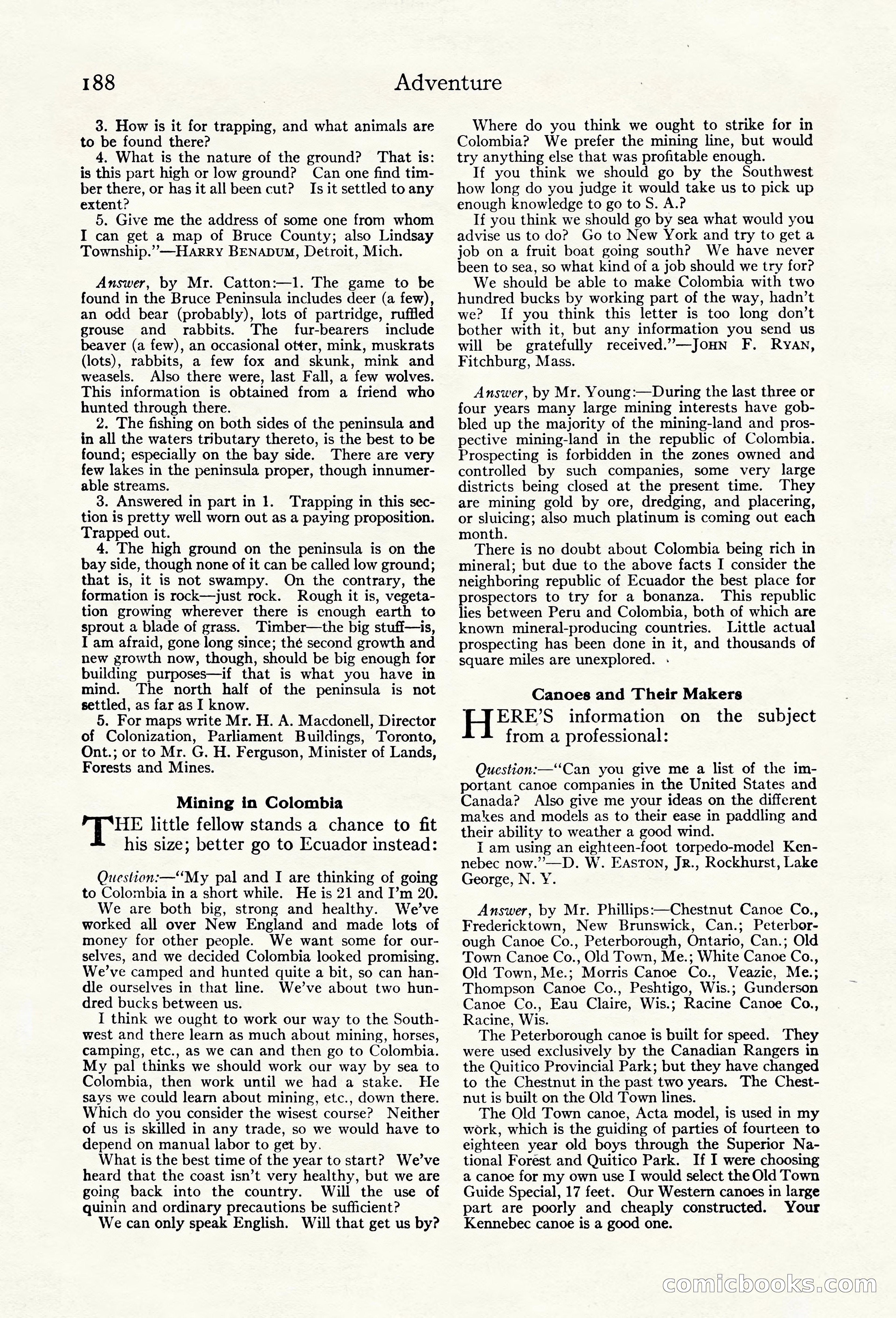
188 3. How is it for trapping, and what animals are to be found there? 4. What is the nature of the ground? That is: is this part high or low ground? Can one find tim- ber there, or has it all been cut? Is it settled to any extent? 5. Give me the address of some one from whom I can get a map of Bruce County; also Lindsay Township.’’—Harry BENADuM, Detroit, Mich. Answer, by Mr. Catton:—1. The game to be found in the Bruce Peninsula includes deer (a few), an odd bear (probably), lots of partridge, ruffled grouse and rabbits. The fur-bearers include beaver (a few), an occasional otter, mink, muskrats (lots), rabbits, a few fox and skunk, mink and weasels. Also there were, last Fall, a few wolves. This information is obtained from a friend who hunted through there. 2. The fishing on both sides of the peninsula and in all the waters tributary thereto, is the best to be found; especially on the bay side. There are very few lakes in the peninsula proper, though innumer- able streams. 3. Answered in part in 1. Trapping in this sec- tion is pretty well worn out as a paying proposition. Trapped out. 4. The high ground on the peninsula is on the bay side, though none of it can be called low ground; that is, it is not swampy. On the contrary, the formation is rock—just rock. Rough it is, vegeta- tion growing wherever there is enough earth to sprout a blade of grass. Timber—the big stuff—is, I am afraid, gone long since; thé second growth and new growth now, though, should be big enough for building purposes—if that is what you have in mind. The north half of the peninsula is not settled, as far as I know. 5. For maps write Mr. H. A. Macdonell, Director of Colonization, Parliament Buildings, Toronto, Ont.; or to Mr. G. H. Ferguson, Minister of Lands, Forests and Mines. Mining in Colombia HE little fellow stands a chance to fit his size; better go to Ecuador instead: Question: —“My pal and I are thinking of going to Colombia in a short while. He is 21 and I’m 20. We are both big, strong and healthy. We’ve worked all over New England and made lots of money for other people. We want some for our- selves, and we decided Colombia looked promising. We’ve camped and hunted quite a bit, so can han- dle ourselves in that line. We’ve about two hun- dred bucks between us. I think we ought to work our way to the South- west and there learn as much about mining, horses, camping, etc., as we can and then go to Colombia. My pal thinks we should work our way by sea to Colombia, then work until we had a stake. He says we could learn about mining, etc., down there. Which do you consider the wisest course? Neither of us is skilled in any trade, so we would have to depend on manual labor to get by. What is the best time of the year to start? We've heard that the coast isn’t very healthy, but we are going back into the country. Will the use of quinin and ordinary precautions be sufficient? We can only speak English. Will that get us by? Adventure Where do you think we ought to strike for in Colombia? We prefer the mining line, but would try anything else that was profitable enough. If you think we should go by the Southwest how long do you judge it would take us to pick up enough knowledge to go to S. A.? If you think we should go by sea what would you advise us to do? Go to New York and try to geta job on a fruit boat going south? We have never been to sea, so what kind of a job should we try for? We should be able to make Colombia with two hundred bucks by working part of the way, hadn’t we? If you think this letter is too long don’t bother with it, but any information you send us will be gratefully received.”—JoHN F. Ryan, Fitchburg, Mass. Answer, by Mr. Young:—During the last three or four years many large mining interests have gob- bled up the majority of the mining-land and pros- pective mining-land in the republic of Colombia. Prospecting is forbidden in the zones owned and controlled by such companies, some very large districts being closed at the present time. They are mining gold by ore, dredging, and placering, or sluicing; also much platinum is coming out each month. There is no doubt about Colombia being rich in mineral; but due to the above facts I consider the neighboring republic of Ecuador the best place for prospectors to try for a bonanza. This republic lies between Peru and Colombia, both of which are known mineral-producing countries. Little actual prospecting has been done in it, and thousands of square miles are unexplored. . Canoes and Their Makers ERE’S information on the subject from a professional: Question:—“Can you give me a list of the im- portant canoe companies in the United States and Canada? Also give me your ideas on the different makes and models as to their ease in paddling and their ability to weather a good wind. I am using an eighteen-foot torpedo-model Ken- nebec now.’’—D. W. EASTON, JR., Rockhurst, Lake George, N. Y. Answer, by Mr. Phillips:—Chestnut Canoe Co., Fredericktown, New Brunswick, Can.; Peterbor- ough Canoe Co., Peterborough, Ontario, Can.; Old Town Canoe Co., Old Town, Me.; White Canoe Co., Old Town, Me.; Morris Canoe Co., Veazic, Me.; Thompson Canoe Co., Peshtigo, Wis.; Gunderson Canoe Co., Eau Claire, Wis.; Racine Canoe Co., Racine, Wis. The Peterborough canoe is built for speed. They were used exclusively by the Canadian Rangers in the Quitico Provincial Park; but they have changed to the Chestnut in the past two years. The Chest- nut is built on the Old Town lines. The Old Town canoe, Acta model, is used in my work, which is the guiding of parties of fourteen to eighteen year old boys through the Superior Na- tional Forest and Quitico Park. If I were choosing a canoe for my own use I would select the Old Town Guide Special, 17 feet. Our Western canoes in large part are poorly and cheaply constructed. Your Kennebec canoe is a good one. DOOLK (C@