
Pulp Fiction, 1922 · page 192 of 200
Adventure Magazine Cover — page 192: what you’re looking at
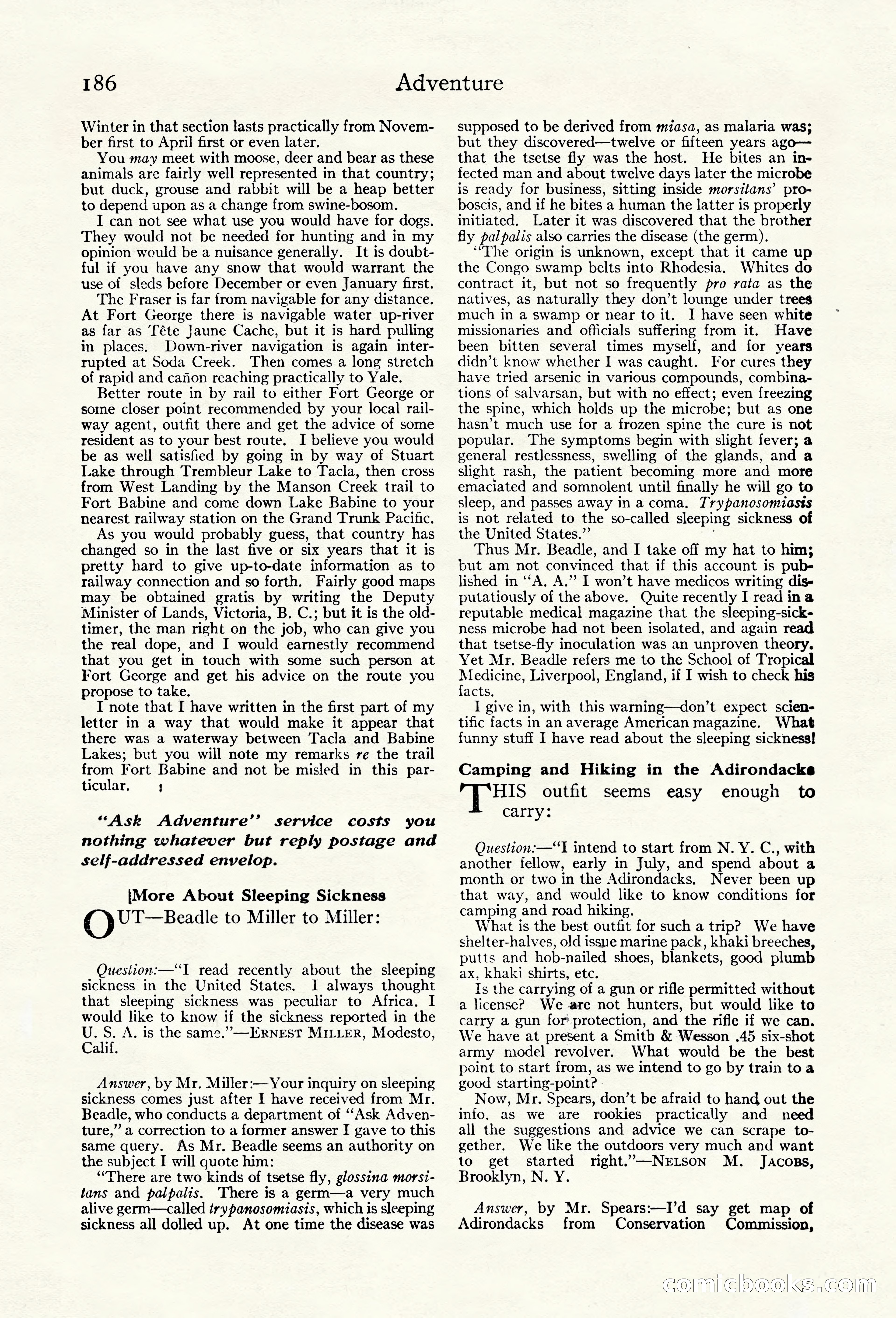
A restored page from Pulp Fiction, 1922. Page through the whole issue in the reader above.
📄 Transcribed text from this page (OCR, searchable)
Machine-transcribed from the original scan — historical spelling and the odd misread are preserved.
186 Winter in that section lasts practically from Novem- ber first to April first or even later. You may meet with moose, deer and bear as these animals are fairly well represented in that country; but duck, grouse and rabbit will be a heap better to depend upon as a change from swine-bosom. I can not see what use you would have for dogs. They would not be needed for hunting and in my opinion weuld be a nuisance generally. It is doubt- ful if you have any snow that would warrant the use of sleds before December or even January first. The Fraser is far from navigable for any distance. At Fort George there is navigable water up-river as far as Téte Jaune Cache, but it is hard pulling in places. Down-river navigation is again inter- rupted at Soda Creek. Then comes a long stretch of rapid and cafion reaching practically to Yale. Better route in by rail to either Fort George or some closer point recommended by your local rail- way agent, outfit there and get the advice of some resident as to your best route. I believe you would be as well satisfied by going in by way of Stuart Lake through Trembleur Lake to Tacla, then cross from West Landing by the Manson Creek trail to Fort Babine and come down Lake Babine to your nearest railway station on the Grand Trunk Pacific. As you would probably guess, that country has changed so in the last five or six years that it is pretty hard to give up-to-date information as to railway connection and so forth. Fairly good maps may be obtained gratis by wmnting the Deputy Minister of Lands, Victoria, B. C.; but it is the old- timer, the man right on the job, who can give you the real dope, and I would earnestly recommend that you get in touch with some such person at Fort George and get his advice on the route you propose to take. I note that I have written in the first part of my letter in a way that would make it appear that there was a waterway between Tacla and Babine Lakes; but you will note my remarks re the trail from Fort Babine and not be misled in this par- ticular. =; “Ask Adventure’’ service costs you nothing whatever but reply postage and self-addressed envelop. [More About Sleeping Sickness Gye aide to Miller to Miller: Question: —“I read recently about the sleeping sickness in the United States. I always thought that sleeping sickness was peculiar to Africa. I would like to know if the sickness reported in the U. S. A. is the same.”—ERNEST MILLER, Modesto, Calif. Answer, by Mr, Miller:—Your inquiry on sleeping sickness comes just after I have received from Mr. Beadle, who conducts a department of “‘Ask Adven- ture,” a correction to a former answer I gave to this same query. As Mr. Beadle seems an authority on the subject I will quote him: “There are two kinds of tsetse fly, glossina morsi- tans and palpalis. There is a germ—a very much alive germ—called trypanosomiasis, which is sleeping sickness all dolled up. At one time the disease was Adventure supposed to be derived from miasa, as malaria was; but they discovered—twelve or fifteen years ago— that the tsetse fly was the host. He bites an in- fected man and about twelve days later the microbe is ready for business, sitting inside morsitans’ pro- boscis, and if he bites a human the latter is properly initiated. Later it was discovered that the brother fly palpalis also carries the disease (the germ). ‘The origin is unknown, except that 1t came up the Congo swamp belts into Rhodesia. Whites do contract it, but not so frequently pro rata as the natives, as naturally they don’t lounge under trees much in a swamp or near to it. I have seen white missionaries and officials suffering from it. Have been bitten several times myself, and for years didn’t know whether I was caught. For cures they have tried arsenic in various compounds, combina- tions of salvarsan, but with no effect; even freezing the spine, which holds up the microbe; but as one hasn’t much use for a frozen spine the cure is not popular. The symptoms begin with slight fever; a general restlessness, swelling of the glands, and a slight rash, the patient becoming more and more emaciated and somnolent until finally he will go to sleep, and passes away in a coma. Trypanosomiasts is not related to the so-called sleeping sickness of the United States.” Thus Mr. Beadle, and I take off my hat to him; but am not convinced that if this account is pub- lished in ‘‘A. A.” I won’t have medicos writing dis putatiously of the above. Quite recently I read ina reputable medical magazine that the sleeping-sick- ness microbe had not been isolated, and again read that tsetse-fly inoculation was an unproven theory. Yet Mr. Beadle refers me to the School of Tropical Medicine, Liverpool, England, if I wish to check his facts. I give in, with this warning—don’t expect scien- tific facts in an average American magazine. What funny stuff I have read about the sleeping sickness! Camping and Hiking in the Adirondacks S pasuls outfit seems easy enough to carry: Question: —“T intend to start from N.Y. C., with another fellow, early in July, and spend about a month or two in the Adirondacks. Never been up that way, and would like to know conditions for camping and road hiking. What is the best outfit for such a trip? We have shelter-halves, old issue marine pack, khaki breeches, putts and hob-nailed shoes, blankets, good plumb ax, khaki shirts, etc. Is the carrying of a gun or rifle permitted without a license? We are not hunters, but would like to carry a gun for protection, and the rifle if we can. We have at present a Smith & Wesson .45 six-shot army model revolver. What would be the best point to start from, as we intend to go by train toa good starting-point? - Now, Mr. Spears, don’t be afraid to hand out the info. as we are rookies practically and need all the suggestions and advice we can scrape to- gether. We like the outdoors very much and want to get started mght.”—NELSON M. Jacoss, Brooklyn, N. Y. Answer, by Mr. Spears:—I’d say get map of Adirondacks from Conservation Commission, ANG NOOKS (C@