
Pulp Fiction, 1922 · page 158 of 200
Adventure Magazine Cover — page 158: what you’re looking at
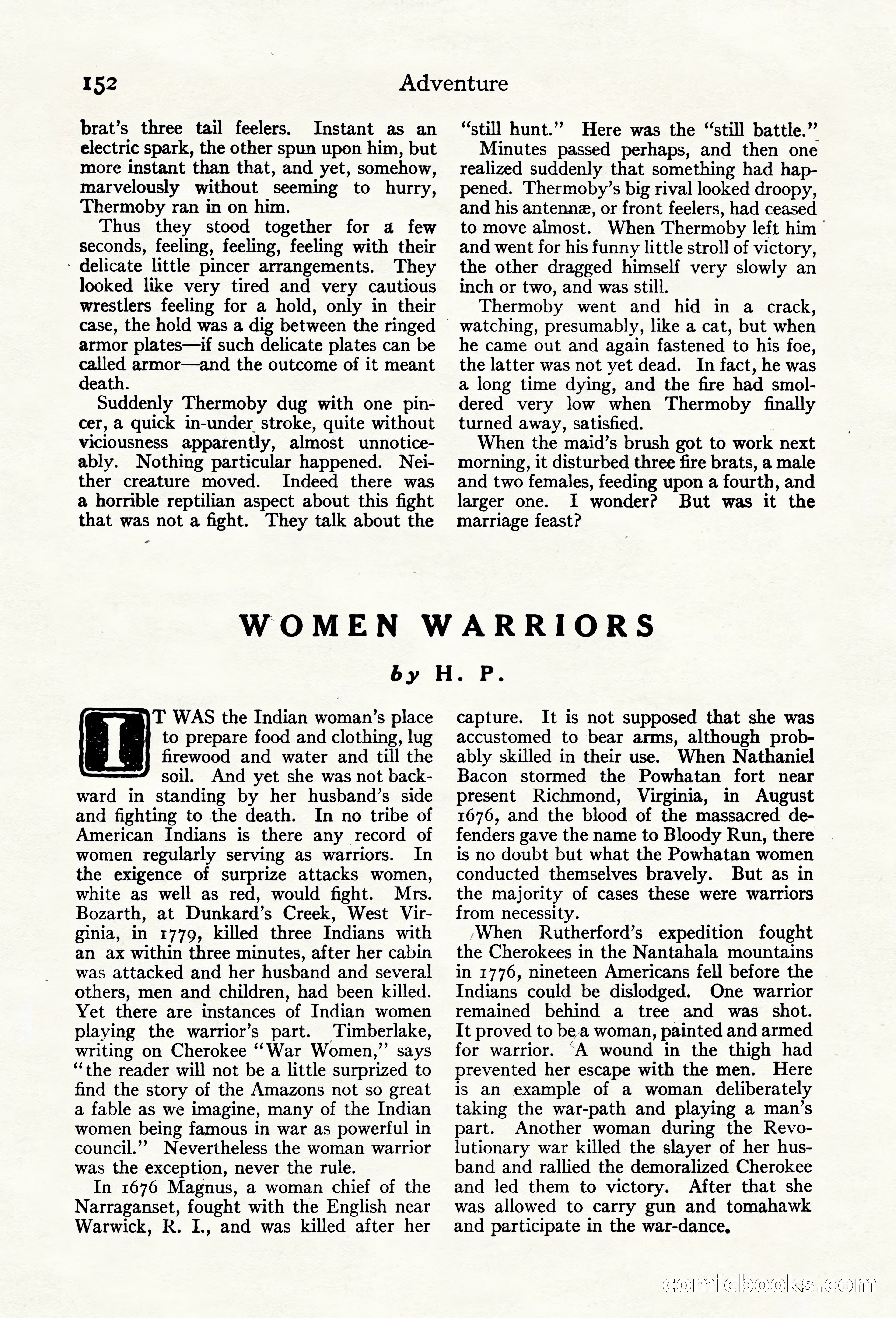
A restored page from Pulp Fiction, 1922. Page through the whole issue in the reader above.
📄 Transcribed text from this page (OCR, searchable)
Machine-transcribed from the original scan — historical spelling and the odd misread are preserved.
152 brat’s three tail feelers. Instant as an electric spark, the other spun upon him, but more instant than that, and yet, somehow, marvelously without seeming to hurry, Thermoby ran in on him. Thus they stood together for a few seconds, feeling, feeling, feeling with their - delicate little pincer arrangements. They looked like very tired and very cautious wrestlers feeling for a hold, only in their case, the hold was a dig between the ringed armor plates—if such delicate plates can be called armor—and the outcome of it meant death. Suddenly Thermoby dug with one pin- cer, a quick in-under stroke, quite without viciousness apparently, almost unnotice- ably. Nothing particular happened. Nei- ther creature moved. Indeed there was a horrible reptilian aspect about this fight that was not a fight. They talk about the Adventure “still hunt.’’ Here was the “still battle.” Minutes passed perhaps, and then one realized suddenly that something had hap- pened. Thermoby’s big rival looked droopy, and his antenne, or front feelers, had ceased to move almost. When Thermoby left him and went for his funny little stroll of victory, the other dragged himself very slowly an inch or two, and was still. Thermoby went and hid in a crack, _ watching, presumably, like a cat, but when he came out and again fastened to his foe, the latter was not yet dead. In fact, he was a long time dying, and the fire had smol- dered very low when Thermoby finally turned away, satisfied. When the maid’s brush got to work next morning, it disturbed three fire brats, a male and two females, feeding upon a fourth, and larger one. I wonder? But was it the marriage feast? WOMEN WARRIORS by H. P. T WAS the Indian woman’s place to prepare food and clothing, lug firewood and water and till the soil. And yet she was not back- ward in standing by her husband’s side and fighting to the death. In no tribe of American Indians is there any record of women regularly serving as warriors. In the exigence of surprize attacks women, white as well as red, would fight. Mrs. Bozarth, at Dunkard’s Creek, West Vir- ginia, in 1779, killed three Indians with an ax within three minutes, after her cabin was attacked and her husband and several others, men and children, had been killed. Yet there are instances of Indian women playing the warrior’s part. Timberlake, writing on Cherokee ‘‘War Women,”’ says “the reader will not be a little surprized to find the story of the Amazons not so great a fable as we imagine, many of the Indian women being famous in war as powerful in council.” Nevertheless the woman warrior was the exception, never the rule. In 1676 Magnus, a woman chief of the Narraganset, fought with the English near Warwick, R. I., and was killed after her capture. It is not supposed that she was accustomed to bear arms, although prob- ably skilled in their use. When Nathaniel Bacon stormed the Powhatan fort near present Richmond, Virginia, in August 1676, and the blood of the massacred de- fenders gave the name to Bloody Run, there is no doubt but what the Powhatan women conducted themselves bravely. But as in the majority of cases these were warriors from necessity. ‘When Rutherford’s expedition fought the Cherokees in the Nantahala mountains in 1776, nineteen Americans fell before the Indians could be dislodged. One warrior remained behind a tree and was shot. It proved to bea woman, painted and armed for warrior. “A wound in the thigh had prevented her escape with the men. Here is an example of a woman deliberately taking the war-path and playing a man’s part. Another woman during the Revo- lutionary war killed the slayer of her hus- band and rallied the demoralized Cherokee and led them to victory. After that she was allowed to carry gun and tomahawk and participate in the war-dance, CGomicivook (C©