
Pulp Fiction, 1922 · page 156 of 200
Adventure Magazine Cover — page 156: what you’re looking at
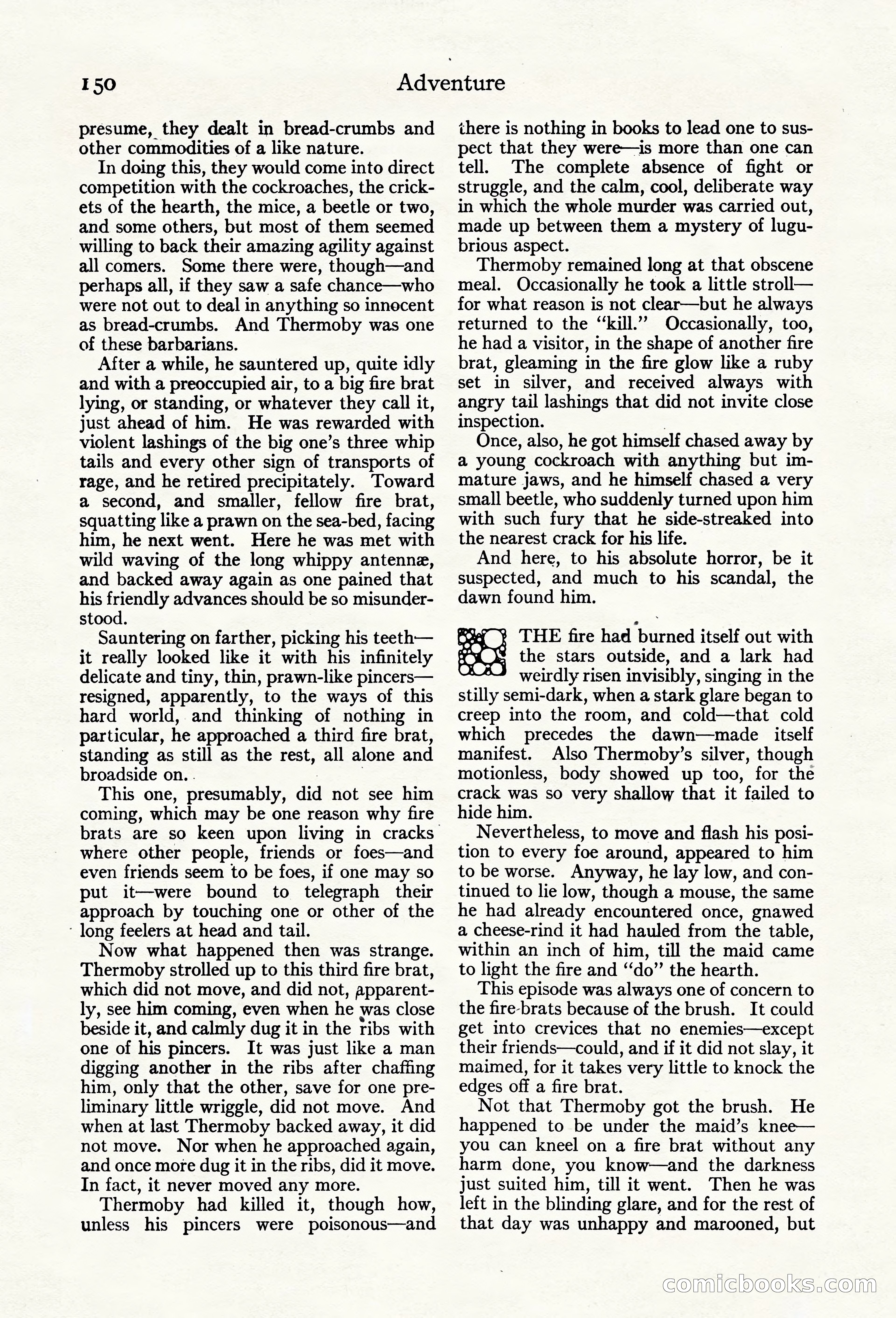
A restored page from Pulp Fiction, 1922. Page through the whole issue in the reader above.
📄 Transcribed text from this page (OCR, searchable)
Machine-transcribed from the original scan — historical spelling and the odd misread are preserved.
150 presume, they dealt in bread-crumbs and other commodities of a like nature. In doing this, they would come into direct competition with the cockroaches, the crick- ets of the hearth, the mice, a beetle or two, and some others, but most of them seemed willing to back their amazing agility against all comers. Some there were, though—and perhaps all, if they saw a safe chance—who were not out to deal in anything so innocent as bread-crumbs. And Thermoby was one of these barbarians. After a while, he sauntered up, quite idly and with a preoccupied air, to a big fire brat lying, or standing, or whatever they call it, just ahead of him. He was rewarded with violent lashings of the big one’s three whip tails and every other sign of transports of rage, and he retired precipitately. Toward a second, and smaller, fellow fire brat, squatting like a prawn on the sea-bed, facing him, he next went. Here he was met with wild waving of the long whippy antenna, and backed away again as one pained that his friendly advances should be so misunder- stood. Sauntering on farther, picking his teeth— it really looked like it with his infinitely delicate and tiny, thin, prawn-like pincers— resigned, apparently, to the ways of this hard world, and thinking of nothing in particular, he approached a third fire brat, _ standing as still as the rest, all alone and broadside on. This one, presumably, did not see him coming, which may be one reason why fire brats are so keen upon living in cracks where other people, friends or foes—and even friends seem to be foes, if one may so put it—were bound to telegraph their approach by touching one or other of the ‘ long feelers at head and tail. Now what happened then was strange. Thermoby strolled up to this third fire brat, which did not move, and did not, apparent- ly, see him coming, even when he was Close beside it, and calmly dug it in the ribs with one of his pincers. It was just like a man digging another in the ribs after chaffing him, only that the other, save for one pre- liminary little wriggle, did not move. And when at last Thermoby backed away, it did not move. Nor when he approached again, and once more dug it in the ribs, did it move. In fact, it never moved any more. Thermoby had killed it, though how, unless his pincers were poisonous—and Adventure there is nothing in books to lead one to sus- pect that they were—is more than one can tell. The complete absence of fight or struggle, and the calm, cool, deliberate way in which the whole murder was carried out, made up between them a mystery of lugu- brious aspect. Thermoby remained long at that obscene meal. Occasionally he took a little stroll— for what reason is not clear—but he always returned to the “‘kill.”” Occasionally, too, he had a visitor, in the shape of another fire brat, gleaming in the fire glow like a ruby set in silver, and received always with angry tail lashings that did not invite close inspection. Once, also, he got himself chased away by a young cockroach with anything but im- mature jaws, and he himself chased a very small beetle, who suddenly turned upon him with such fury that he side-streaked into the nearest crack for his life. And here, to his absolute horror, be it suspected, and much to his scandal, the dawn found him. ret the stars outside, and a lark had weirdly risen invisibly, singing in the stilly semi-dark, when a stark glare began to creep into the room, and cold—that cold which precedes the dawn—made itself manifest. Also Thermoby’s silver, though motionless, body showed up too, for the crack was so very shallow that it failed to hide him. Nevertheless, to move and flash his posi- tion to every foe around, appeared to him to be worse. Anyway, he lay low, and con- tinued to lie low, though a mouse, the same he had already encountered once, gnawed a cheese-rind it had hauled from the table, within an inch of him, till the maid came to light the fire and “do” the hearth. This episode was always one of concern to the fire-brats because of the brush. It could get into crevices that no enemies—except their friends—could, and if it did not slay, it maimed, for it takes very little to knock the edges off a fire brat. Not that Thermoby got the brush. He happened to be under the maid’s knee— you can kneel on a fire brat without any harm done, you know—and the darkness just suited him, till it went. Then he was left in the blinding glare, and for the rest of that day was unhappy and marooned, but THE fire had burned itself out with GCOMIGIOO S C@