
Pulp Fiction, 1922 · page 135 of 200
Adventure Magazine Cover — page 135: what you’re looking at
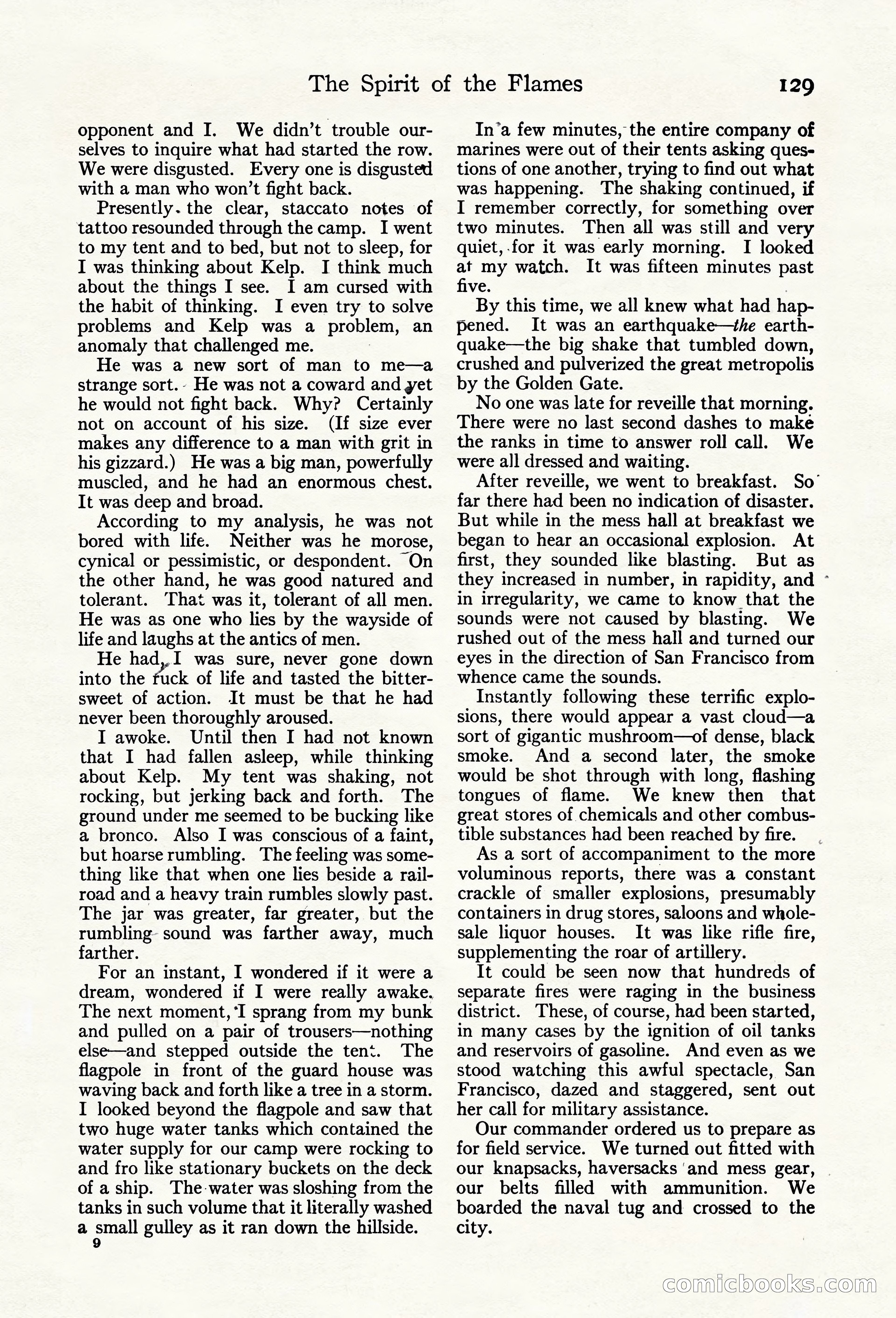
A restored page from Pulp Fiction, 1922. Page through the whole issue in the reader above.
📄 Transcribed text from this page (OCR, searchable)
Machine-transcribed from the original scan — historical spelling and the odd misread are preserved.
The Spirit of the Flames opponent and I. We didn’t trouble our- selves to inquire what had started the row. We were disgusted. Every one is disgusted with a man who won’t fight back. Presently. the clear, staccato notes of tattoo resounded through the camp. I went to my tent and to bed, but not to sleep, for I was thinking about Kelp. I think much about the things I see. I am cursed with the habit of thinking. I even try to solve problems and Kelp was a problem, an anomaly that challenged me. : He was a new sort of man to me—a strange sort.- He was not a coward and yet he would not fight back. Why? Certainly not on account of his size. (If size ever makes any difference to a man with grit in his gizzard.) He was a big man, powerfully muscled, and he had an enormous chest. It was deep and broad. According to my analysis, he was not bored with life. Neither was he morose, cynical or pessimistic, or despondent. On the other hand, he was good natured and tolerant. That was it, tolerant of all men. He was as one who lies by the wayside of life and laughs at the antics of men. He had,,I was sure, never gone down into the fuck of life and tasted the bitter- sweet of action. It must be that he had never been thoroughly aroused. I awoke. Until then I had not known that I had fallen asleep, while thinking about Kelp. My tent was shaking, not rocking, but jerking back and forth. The ground under me seemed to be bucking like a bronco. Also I was conscious of a faint, but hoarse rumbling. The feeling was some- thing like that when one lies beside a rail- road and a heavy train rumbles slowly past. The jar was greater, far greater, but the rumbling- sound was farther away, much farther. For an instant, I wondered if it were a dream, wondered if I were really awake. The next moment, ‘I sprang from my bunk and pulled on a pair of trousers—nothing else—and stepped outside the tent. The flagpole in front of the guard house was waving back and forth like a tree in a storm. I looked beyond the flagpole and saw that two huge water tanks which contained the water supply for our camp were rocking to and fro like stationary buckets on the deck of aship. The-water was sloshing from the tanks in such volume that it literally washed a small gulley as it ran down the hillside. 129 In’a few minutes, the entire company of marines were out of their tents asking ques- tions of one another, trying to find out what was happening. The shaking continued, if I remember correctly, for something over two minutes. Then all was still and very quiet, .for it was early morning. I looked at my watch. It was fifteen minutes past five. | By this time, we all knew what had hap- pened. It was an earthquake—the earth- quake—the big shake that tumbled down, crushed and pulverized the great metropolis by the Golden Gate. No one was late for reveille that morning. There were no last second dashes to make the ranks in time to answer roll call. We were all dressed and waiting. After reveille, we went to breakfast. So’ far there had been no indication of disaster. But while in the mess hall at breakfast we began to hear an occasional explosion. At first, they sounded like blasting. But as they increased in number, in rapidity, and ° in irregularity, we came to know that the sounds were not caused by blasting. We rushed out of the mess hall and turned our eyes in the direction of San Francisco from whence came the sounds. Instantly following these terrific explo- sions, there would appear a vast cloud—a sort of gigantic mushroom—of dense, black smoke. And a second later, the smoke would be shot through with long, flashing tongues of flame. We knew then that great stores of chemicals and other combus- tible substances had been reached by fire. As a sort of accompaniment to the more voluminous reports, there was a constant crackle of smaller explosions, presumably containers in drug stores, saloons and whole- sale liquor houses. It was like rifle fire, supplementing the roar of artillery. It could be seen now that hundreds of separate fires were raging in the business district. These, of course, had been started, In many cases by the ignition of oil tanks and reservoirs of gasoline. And even as we stood watching this awful spectacle, San Francisco, dazed and staggered, sent out her call for military assistance. Our commander ordered us to prepare as for field service. We turned out fitted with our knapsacks, haversacks ‘and mess gear, | our belts filled with ammunition. We boarded the naval tug and crossed to the city. DOOLK C@