
Pulp Fiction, 1922 · page 120 of 200
Adventure Magazine Cover — page 120: what you’re looking at
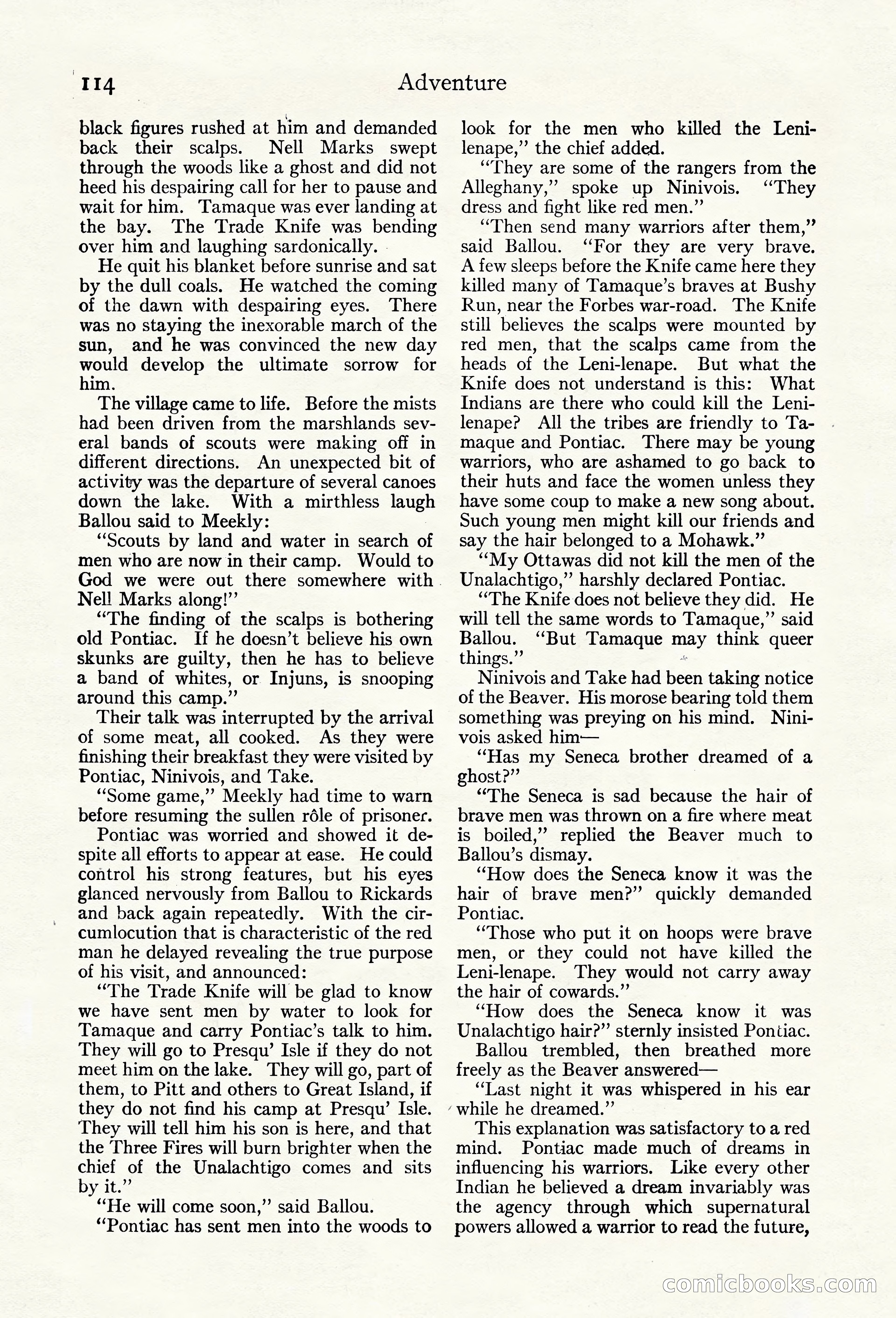
A restored page from Pulp Fiction, 1922. Page through the whole issue in the reader above.
📄 Transcribed text from this page (OCR, searchable)
Machine-transcribed from the original scan — historical spelling and the odd misread are preserved.
‘114 black figures rushed at him and demanded back their scalps. Nell Marks swept through the woods like a ghost and did not heed his despairing call for her to pause and wait for him. Tamaque was ever landing at the bay. The Trade Knife was bending over him and laughing sardonically. - He quit his blanket before sunrise and sat by the dull coals. He watched the coming of the dawn with despairing eyes. There was no staying the inexorable march of the sun, and he was convinced the new day would develop the ultimate sorrow for him. The village came to life. Before the mists had been driven from the marshlands sev- eral bands of scouts were making off in different directions. An unexpected bit of activity was the departure of several canoes down the lake. With a mirthless laugh Ballou said to Meekly: : “Scouts by land and water in search of men who are now in their camp. Would to God we were out there somewhere with. Nel! Marks along!”’ “The finding of the scalps is bothering old Pontiac. If he doesn’t believe his own skunks are guilty, then he has to believe a band of whites, or Injuns, is snooping around this camp.” Their talk was interrupted by the arrival of some meat, all cooked. As they were finishing their breakfast they were visited by Pontiac, Ninivois, and Take. “Some game,” Meekly had time to warn before resuming the sullen réle of prisoner. Pontiac was worried and showed it de- spite all efforts to appear at ease. He could control his strong features, but his eyes glanced nervously from Ballou to Rickards and back again repeatedly. With the cir- cumlocution that is characteristic of the red man he delayed revealing the true purpose of his visit, and announced: “The Trade Knife will be glad to know we have sent men by water to look for Tamaque and carry Pontiac’s talk to him. They will go to Presqu’ Isle if they do not meet him on the lake. They will go, part of them, to Pitt and others to Great Island, if they do not find his camp at Presqu’ Isle. They will tell him his son is here, and that the Three Fires will burn brighter when the chief of the Unalachtigo comes and sits by it.” “He will come soon,” said Ballou. “Pontiac has sent men into the woods to Adventure look for the men who killed the Leni- lenape,” the chief added. ‘They are some of the rangers from the Alleghany,” spoke up Ninivois. ‘‘They dress and fight like red men.” “Then send many warriors after them,” said Ballou. “For they are very brave. A few sleeps before the Knife came here they killed many of Tamaque’s braves at Bushy Run, near the Forbes war-road. The Knife still believes the scalps were mounted by red men, that the scalps came from the heads of the Leni-lenape. But what the Knife does not understand is this: What Indians are there who could kill the Leni- lenape? All the tribes are friendly to Ta- maque and Pontiac. There may be young warriors, who are ashamed to go back to their huts and face the women unless they have some coup to make a new song about. Such young men might kill our friends and say the hair belonged to a Mohawk.” “My Ottawas did not kill the men of the Unalachtigo,” harshly declared Pontiac. ‘‘The Knife does not believe they did. He will tell the same words to Tamaque,”’ said Ballou. “But Tamaque may think queer things.” “ Ninivois and Take had been taking notice of the Beaver. His morose bearing told them something was preying on his mind. Nini- vois asked him— “Has my Seneca brother dreamed of a ghost?” : “The Seneca is sad because the hair of brave men was thrown on a fire where meat is boiled,” replied the Beaver much to Ballou’s dismay. “How does the Seneca know it was the hair of brave men?” quickly demanded Pontiac. ‘Those who put it on hoops were brave men, or they could not have killed the Leni-lenape. They would not carry away the hair of cowards.” “How does the Seneca know it was Unalachtigo hair?” sternly insisted Pontiac. Ballou trembled, then breathed more freely as the Beaver answered— “Last night it was whispered in his ear ‘while he dreamed.” This explanation was satisfactory to a red mind. Pontiac made much of dreams in influencing his warriors. Like every other Indian he believed a dream invariably was the agency through which supernatural powers allowed a warrior to read the future, COnnicloo SS (©