
Pulp Fiction, 1922 · page 196 of 200
Adventure Magazine Cover — page 196: what you’re looking at
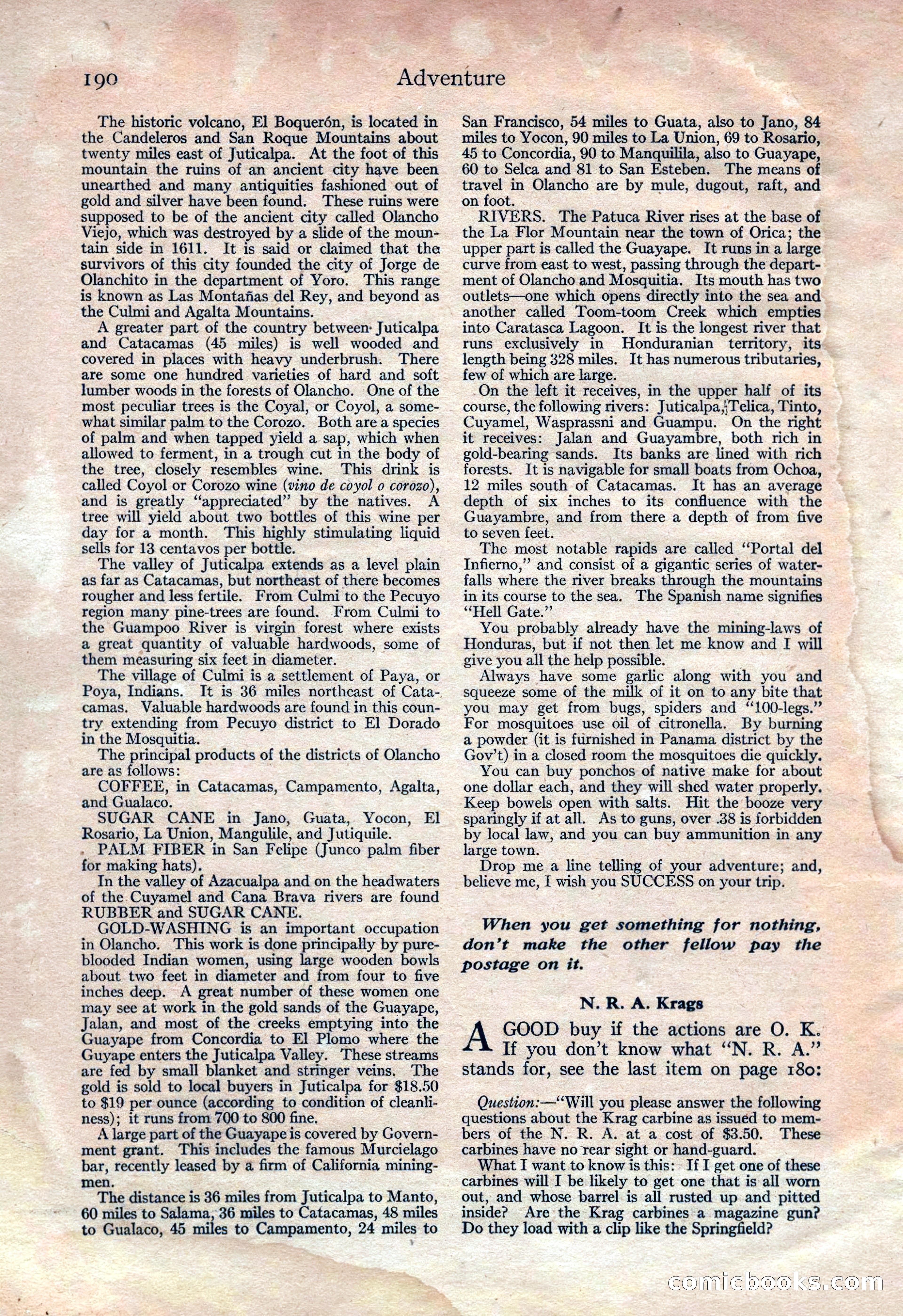
A restored page from Pulp Fiction, 1922. Page through the whole issue in the reader above.
📄 Transcribed text from this page (OCR, searchable)
Machine-transcribed from the original scan — historical spelling and the odd misread are preserved.
190 The historic volcano, El Boquerén, is located in the Candeleros and San Roque Mountains about twenty miles east of Juticalpa. At the foot of this mountain the ruins of an ancient city have been unearthed and many antiquities fashioned out of gold and silver have been found. These ruins were supposed to be of the ancient city called Olancho Viejo, which was destroyed by a slide of the moun- tain side in 1611. It is said or claimed that the survivors of this city founded the city of Jorge de Olanchito in the department of Yoro. This range is known as Las Montafias del Rey, and beyond as the Culmi and Agalta Mountains. A greater part of the country between: Juticalpa and Catacamas (45 miles) is well wooded and covered in places with heavy underbrush. There are some one hundred varieties of hard and soft lumber woods in the forests of Olancho. One of the most peculiar trees is the Coyal, or Coyol, a some- what similar palm to the Corozo. Both area species of palm and when tapped yield a sap, which when allowed to ferment, in a trough cut in the body of the tree, closely resembles wine. This drink is called Coyol or Corozo wine (vino de coyol o corozo), and is greatly “appreciated” by the natives. A tree will yield about two bottles of this wine per day for a month. This highly stimulating liquid sells for 13 centavos per bottle. The valley of Juticalpa extends as a level plain as far as Catacamas, but northeast of there becomes rougher and less fertile. From Culmi to the Pecuyo region many pine-trees are found. From Culmi to the Guampoo River is virgin forest where exists a great quantity of valuable hardwoods, some of them measuring six feet in diameter. The village of Culmi is a settlement of Paya, or Poya, Indians. camas. Valuable hardwoods are found in this coun- try extending from Pecuyo district to El Dorado in the Mosquitia. The principal products of the districts of Olancho are as follows: COFFEE, in Catacamas, Campamento, Agalta, and Gualaco. SUGAR CANE in Jano, Guata, Yocon, El Rosario, La Union, Mangulile, and Jutiquile. . PALM FIBER in San Felipe (Junco palm fiber for making hats). In the valley of Azacualpa and on the headwaters of the Cuyamel and Cana Brava rivers are found RUBBER and SUGAR CANE. GOLD-WASHING is an important occupation in Olancho. This work is done principally by pure- blooded Indian women, using large wooden bowls about two feet in diameter and from four to five inches deep. A great number of these women one may see at work in the gold sands of the Guayape, Jalan, and most of the creeks emptying into the Guayape from Concordia to El Plomo where the Guyape enters the Juticalpa Valley. These streams are fed by small blanket and stringer veins. The gold is sold to local buyers in Juticalpa for $18.50 to $19 per ounce (according to condition of cleanli- ness); it runs from 700 to 800 fine. A large part of the Guayape is covered by Govern- ment grant. This includes the famous Murcielago bar, recently leased by a firm of California mining- men. The distance is 36 miles from Juticalpa to Manto, 60 miles to Salama, 36 miles to Catacamas, 48 miles to Gualaco, 45 miles to Campamento, 24 miles to It is 36 miles northeast of Cata- Adventure San Francisco, 54 miles to Guata, also to Jano, 84 miles to Yocon, 90 miles to La Union, 69 to Rosario, 45 to Concordia, 90 to Manquilila, also to Guayape, 60 to Selca and 81 to San Esteben. The means of travel in Olancho are by mule, dugout, raft, and on foot. RIVERS. The Patuca River rises at the base of the La Flor Mountain near the town of Orica; the upper part is called the Guayape. It runs in a large curve from east to west, passing through the depart- ment of Olancho and Mosquitia. Its mouth has two outlets—one which opens directly into the sea and another called Toom-toom Creek which empties into Caratasca Lagoon. It is the longest river that runs exclusively in Honduranian territory, its length being 328 miles. It has numerous tributaries, few of which are large. On the left it receives, in the upper half of its course, the following rivers: Juticalpa,}Telica, Tinto, Cuyamel, Wasprassni and Guampu. On the right it receives: Jalan and Guayambre, both rich in gold-bearing sands. Its banks are lined with rich forests. It is navigable for small boats from Ochoa, 12 miles south of Catacamas. It has an average depth of six inches to its confluence with the Guayambre, and from there a depth of from five to seven feet. The most notable rapids are called ‘‘Portal del Infierno,” and consist of a gigantic series of water- falls where the river breaks through the mountains in its course to the sea. The Spanish name signifies “Hell Gate.” You probably already have the mining-laws of Honduras, but if not then let me know and I will give you all the help possible. Always have some garlic along with you and squeeze some of the milk of it on to any bite that you may get from bugs, spiders and “100-legs.” For mosquitoes use oil of citronella. By burning a powder (it is furnished in Panama district by the Gov’t) in a closed room the mosquitoes die quickly. You can buy ponchos of native make for about one dollar each, and they will shed water properly. Keep bowels open with salts. Hit the booze very sparingly if at all. As to guns, over .38 is forbidden by local law, and you can buy ammunition in any large town. Drop me a line telling of your adventure; and, believe me, I wish you SUCCESS on your trip. When you get something for nothing, don’t make the other fellow pay the postage on it. A If you don’t know what “‘N. R. A.” stands for, see the last item on page 180: N. R. A. Krags Question: —“Will you please answer the following questions about the Krag carbine as issued to mem- bers of the N. R. A. at a cost of $38.50. These carbines have no rear sight or hand-guard. What I want to know is this: If I get one of these carbines will I be likely to get one that is all worn out, and whose barrel is all rusted up and pitted inside? Are the Krag carbines a magazine gun? Do they load with a clip like the Springfield? MICLOOOLK GOOD buy if the actions are O. K. (C@)