
Pulp Fiction, 1922 · page 195 of 200
Adventure Magazine Cover — page 195: what you’re looking at
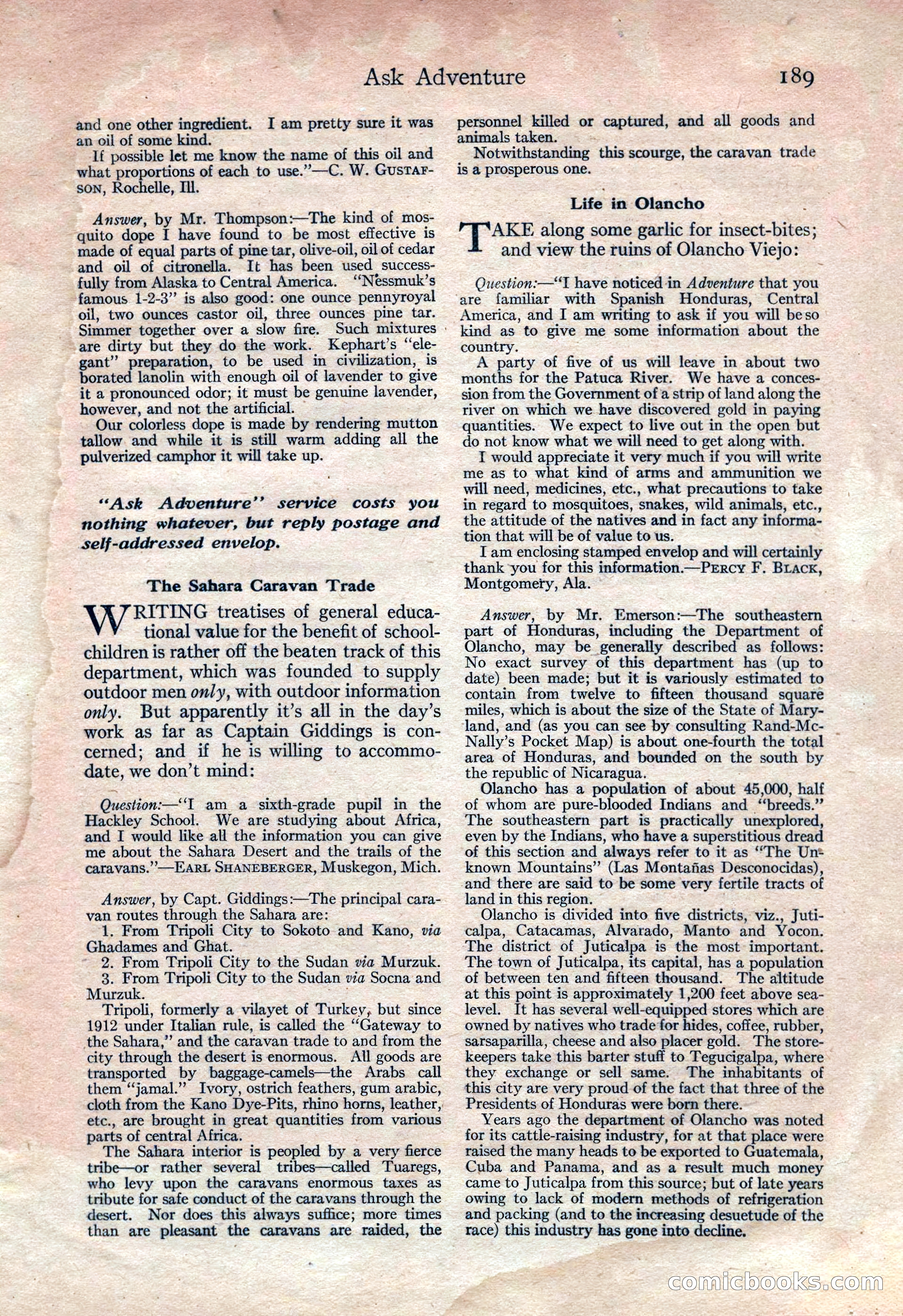
A restored page from Pulp Fiction, 1922. Page through the whole issue in the reader above.
📄 Transcribed text from this page (OCR, searchable)
Machine-transcribed from the original scan — historical spelling and the odd misread are preserved.
Ask Adventure and one other ingredient. I am pretty sure it was an oil of some kind. ; If possible let me know the name of this oil and what proportions of each to use.”—C. W. Gustar- son, Rochelle, Il. Answer, by Mr. Thompson:—The kind of mos- quito dope I have found to be most effective is made of equal parts of pine tar, olive-oil, oil of cedar and oil of citronella. It has been used success- fully from Alaska to Central America. ‘‘Nessmuk’s famous 1-2-3” is also good: one ounce pennyroyal oil, two ounces castor oil, three ounces pine tar. Simmer together over a slow fire. are dirty but they do the work. Kephart’s “ele- gant” preparation, to be used in civilization, is borated lanolin with enough oil of lavender to give it a pronounced odor; it must be genuine lavender, however, and not the artificial. © Our colorless dope is made by rendering mutton tallow and while it is still warm adding all the pulverized camphor it will take up. ‘““Ask Adventure’’ service costs you nothing whatever, but reply postage and self-addressed envelop. The Sahara Caravan Trade Vy Se treatises of general educa- tional value for the benefit of school- children is rather off the beaten track of this department, which was founded to supply outdoor men only, with outdoor information only. But apparently it’s all in the day’s work as far as Captain Giddings is con- cerned; and if he is willing to accommo- date, we don’t mind: Question:—‘‘I am a sixth-grade pupil in the Hackley School. We are studying about Africa, and I would like all the information you can give me about the Sahara Desert and the trails of the caravans.” —EARL SHANEBERGER, Muskegon, Mich. Answer, by Capt. Giddings:—The principal cara- van routes through the Sahara are: 1. From Tripoli City to Sokoto and Kano, via Ghadames and Ghat. , 2. From Tripoli City to the Sudan wa Murzuk. 3. From Tripoli City to the Sudan wa Socna and Murzuk. eo Tripoli, formerly a vilayet of Turkey, but since 1912 under Italian rule, is called the ‘‘Gateway to the Sahara,’ and the caravan trade to and from the city through the desert is enormous. All goods are transported by baggage-camels—the Arabs call them “jamal.” Ivory, ostrich feathers, gum arabic, cloth from the Kano Dye-Pits, rhino horns, leather, etc., are brought in great quantities from various parts of central Africa. | The Sahara interior is peopled by a very fierce tribe—or rather several tribes—called Tuaregs, who levy upon the caravans enormous taxes as tribute for safe conduct of the caravans through the desert. Nor does this always suffice; more times than are pleasant the caravans are raided, the ‘are familiar with Spanish Honduras, Such mixtures . 189 personnel killed or captured, and all goods and animals taken. 7 Notwithstanding this scourge, the caravan trade is a prosperous one. Life in Olancho AKE along some garlic for insect-bites; and view the ruins of Olancho Viejo: Ouestion:—“T have noticed in Adventure that you Central America, and I am writing to ask if you will beso kind as to give me some information about the country. A party of five of us will leave in about two months for the Patuca River. We have a conces- sion from the Government of a strip of land along the river on which we have discovered gold in paying quantities. We expect to live out in the open but do not know what we will need to get along with. I would appreciate it very much if you will write me as to what kind of arms and ammunition we will need, medicines, etc., what precautions to take in regard to mosquitoes, snakes, wild animals, etc., the attitude of the natives and in fact any informa- tion that will be of value to us. T am enclosing stamped envelop and will certainly thank ‘you for this information —PrErcy F. Brack, Montgomery, Ala. Answer, by Mr. Emerson:—The southeastern part of Honduras, including the Department of Olancho, may be generally described as follows: No exact survey of this department has (up to date) been made; but it is variously estimated to contain from twelve to fifteen thousand square miles, which is about the size of the State of Mary- land, and (as you can see by consulting Rand-Mc- Nally’s Pocket Map) is about one-fourth the total — area of Honduras, and bounded on the south by the republic of Nicaragua. : Olancho has a population of about 45,000, half of whom are pure-blooded Indians and “breeds.” The southeastern part is practically unexplored, even by the Indians, who have a superstitious dread of this section and always refer to it as “The Unt known Mountains” (Las Montaifias Desconocidas), -and there are said to be some very fertile tracts of land in this region. Olancho is divided into five districts, viz., Juti- calpa, Catacamas, Alvarado, Manto and Yocon. The district of Juticalpa is the most important. The town of Juticalpa, its capital, has a population of between ten and fifteen thousand. The altitude at this point is approximately 1,200 feet above sea- level. It has several well-equipped stores which are owned by natives who trade for hides, coffee, rubber, sarsaparilla, cheese and also placer gold. The store- keepers take this barter stuff to Tegucigalpa, where they exchange or sell same. The inhabitants of this city are very proud of the fact that three of the Presidents of Honduras were born there. Years ago the department of Olancho was noted for its cattle-raising industry, for at that place were raised the many heads to be exported to Guatemala, Cuba and Panama, and as a result much money came to Juticalpa from this source; but of late years owing to lack of modern methods of refrigeration and packing (and to the increasing desuetude of the race) this industry has gone into decline. (EO) JOO AAG S (C@