
Pulp Fiction, 1922 · page 76 of 200
Adventure Magazine Cover — page 76: what you’re looking at
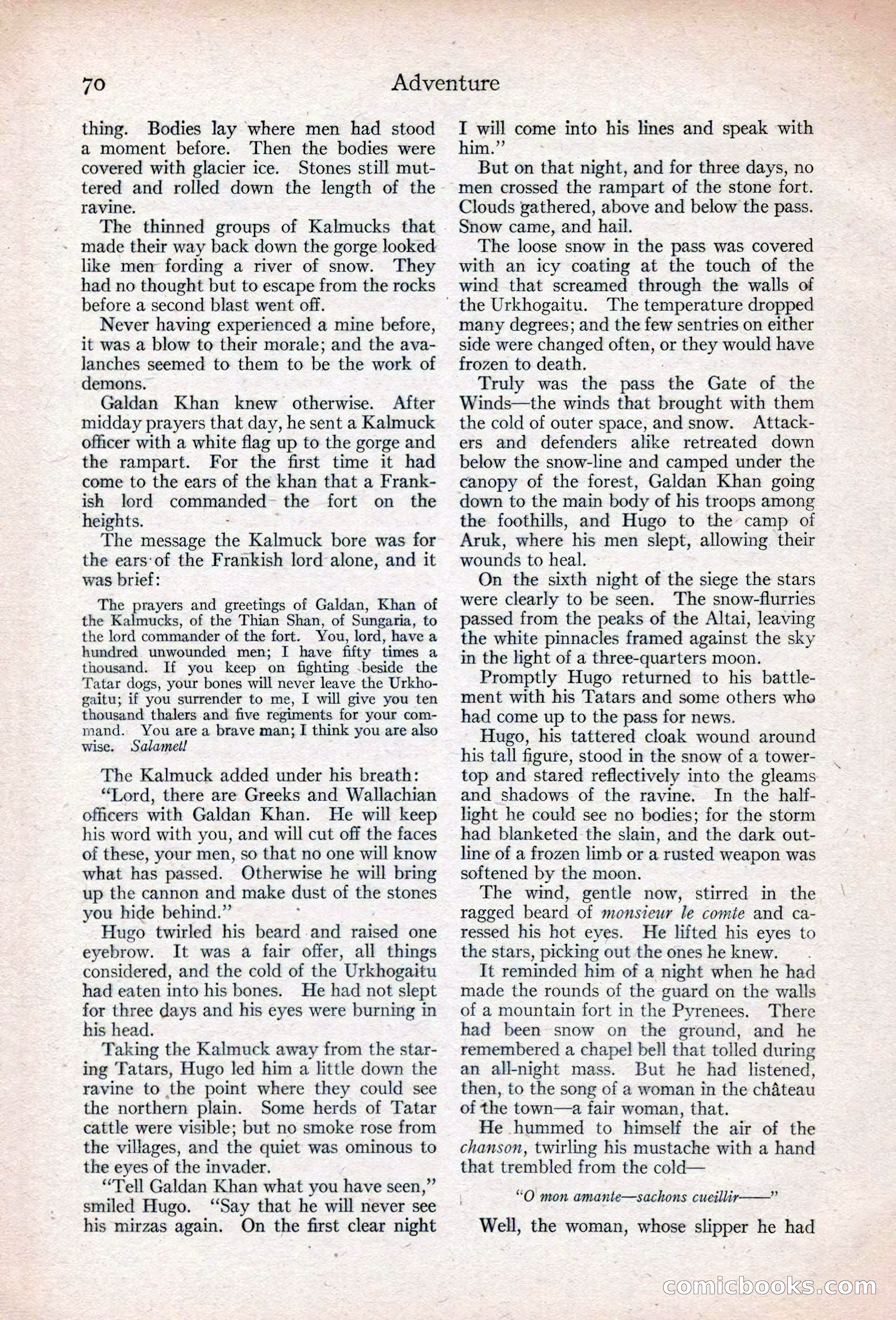
A restored page from Pulp Fiction, 1922. Page through the whole issue in the reader above.
📄 Transcribed text from this page (OCR, searchable)
Machine-transcribed from the original scan — historical spelling and the odd misread are preserved.
70 thing. Bodies lay where men had stood a moment before. ‘Then the bodies were covered with glacier ice. Stones still mut- tered and rolled down the length of the ravine. The thinned groups of Kalmucks that - made their way back down the gorge looked like men fording a river of snow. They had no thought but to escape from the rocks before a second blast went off. Never having experienced a mine before, it was a blow to their morale; and the ava- lanches seemed to them to be the work of demons. Galdan Khan knew otherwise. After midday prayers that day, he sent a Kalmuck officer with a white flag up to the gorge and the rampart. For the first time it had come to the ears of the khan that a Frank- ish lord commanded the fort on the heights. The message the Kalmuck bore was for the ears‘of the Frankish lord alone, and it was brief: The prayers and greetings of Galdan, Khan of the Kalmucks, of the Thian Shan, of Sungaria, to the lord commander of the fort. You, lord, have a hundred unwounded men; I have fifty times a thousand. If you keep on fighting -beside the Tatar dogs, your bones will never leave the Urkho- gaitu; if you surrender to me, I will give you ten thousand thalers and five regiments for your com- mand. You area brave man; I think you are also wise. Salamell The Kalmuck added under his breath: “Lord, there are Greeks and Wallachian officers with Galdan Khan. He will keep his word with you, and will cut off the faces of these, your men, so that no one will know what has passed. Otherwise he will bring up the cannon and make dust of the stones you hide behind.” : Hugo twirled his beard and raised one eyebrow. It was a fair offer, all things considered, and the cold of the Urkhogaitu had eaten into his bones. He had not slept for three days and his eyes were burning in his head. Taking the Kalmuck away from the star- ing Tatars, Hugo led him a little down the ravine to the point where they could see the northern plain. Some herds of Tatar cattle were visible; but no smoke rose from the villages, and the quiet was ominous to the eyes of the invader. “Tell Galdan Khan what you have seen,” smiled Hugo. ‘Say that he will never see his mirzas again. On the first clear night - the Urkhogaitu. Adventure T will come into his lines and speak with him.” But on that night, and for three days, no men crossed the rampart of the stone fort. Clouds gathered, above and below the pass. Snow came, and hail. The loose snow in the pass was covered with an icy coating at the touch of the wind that screamed through the walls of The temperature dropped many degrees; and the few sentries on either side were changed often, or they would have frozen to death. Truly was the pass ‘the Gate of the Winds—the winds that brought with them the cold of outer space, and snow. Attack- ers and defenders alike retreated down below the snow-line and camped under the canopy of the forest, Galdan Khan going down to the main body of his troops among the foothills, and Hugo to the camp oi Aruk, where his men slept, allowing their wounds to heal. On the sixth night of the siege the stars were clearly to be seen. The snow-flurries passed from the peaks of the Altai, leaving the white pinnacles framed against the sky in the light of a three-quarters moon. Promptly Hugo returned to his battle- ment with his Tatars and some others whe had come up to the pass for news. Hugo, his tattered cloak wound around his tall figure, stood in the snow of a tower- top and stared reflectively into the gleams and shadows of the ravine. In the half- light he could see no bodies; for the storm had blanketed the slain, and the dark out- line of a frozen limb or a rusted weapon was softened by the moon. The wind, gentle now, stirred in the ragged beard of monsieur le comte and ca- ressed his hot eyes. He lifted his eyes to the stars, picking out the ones he knew. It reminded him of a night when he had made the rounds of the guard on the walls of a mountain fort in the Pyrenees. There had been snow on the ground, and he remembered a chapel bell that tolled during an all-night mass. But he had listened, then, to the song of a woman in the chateau of the town—a fair woman, that. He hummed to himself the air of the chanson, twirling his mustache with a hand that trembled from the cold— “O mon amante—sachons cueillir 5 Well, the woman, whose slipper he had S CORNICGLOO© (C@