
Pulp Fiction, 1922 · page 75 of 200
Adventure Magazine Cover — page 75: what you’re looking at
A restored page from Pulp Fiction, 1922. Page through the whole issue in the reader above.
📄 Transcribed text from this page (OCR, searchable)
Machine-transcribed from the original scan — historical spelling and the odd misread are preserved.
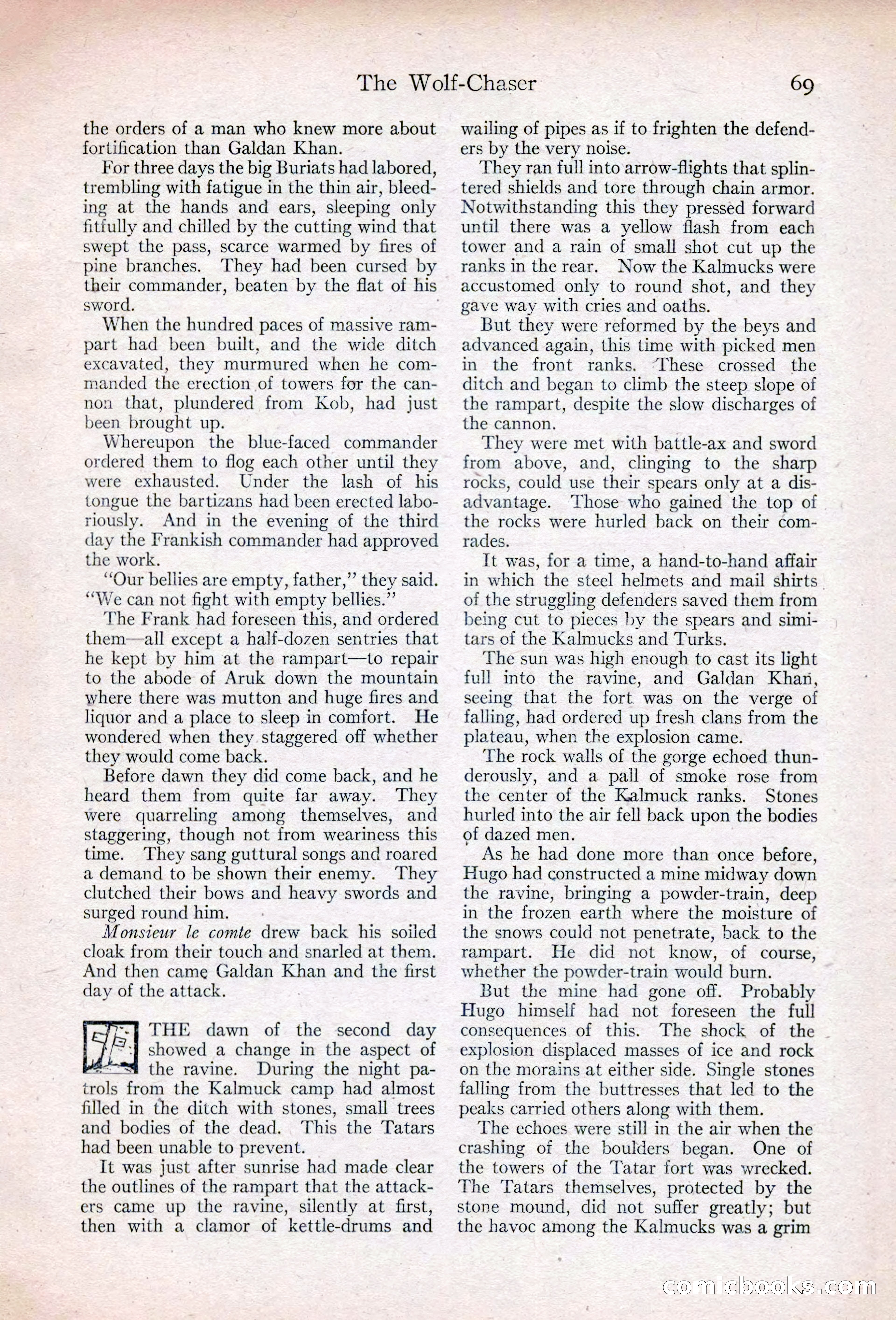
The Wolf-Chaser the orders of a man who knew more about fortification than Galdan Khan. For three days the big Buriats had labored, trembling with fatigue in the thin air, bleed- ing at the hands and ears, sleeping only fitfully and chilled by the cutting wind that swept the pass, scarce warmed by fires of pine branches. They had been cursed by their commander, beaten by the flat of his sword. When the hundred paces of massive ram- part had been built, and the wide ditch excavated, they murmured when he com- manded the erection of towers for the can- non that, plundered from Kob, had just been brought up. Whereupon the blue-faced commander ordered them to flog each other until they were exhausted. Under the lash of his tongue the bartizans had been erected labo- riously. And in the evening of the third day the Frankish commander had approved the work. “Our bellies are empty, father,” they said. “We can not fight with empty bellies.”’ The Frank had foreseen this, and ordered them—all except a half-dozen sentries that he kept by him at the rampart—to repair to the abode of Aruk down the mountain where there was mutton and huge fires and liquor and a place to sleep in comfort. He wondered when they staggered off whether they would come back. Before dawn they did come back, and he heard them from quite far away. They were quarreling among themselves, and staggering, though not from weariness this time. They sang guttural songs and roared a demand to be shown their enemy. ‘They clutched their bows and heavy swords and surged round him. Monsieur le comte drew back his soiled cloak from their touch and snarled at them. And then came Galdan Khan and the first day of the attack. THE dawn of the second day showed a change in the aspect of “--"4 the ravine. During the night pa- trols from the Kalmuck camp had almost filled in the ditch with stones, small trees and bodies of the dead. This the Tatars had been unable to prevent. It was just after sunrise had made clear the outlines of the rampart that the attack- ers came up the ravine, silently at first, then with a clamor of kettle-drums and 69 wailing of pipes as if to frighten the defend- ers by the very noise. They ran full into arrow-flights that splin- tered shields and tore through chain armor. Notwithstanding this they pressed forward until there was a yellow flash from each tower and a rain of small shot cut up the ranks in the rear. Now the Kalmucks were accustomed only to round shot, and they gave way with cries and oaths. But they were reformed by the beys and advanced again, this time with picked men in the front ranks. “These crossed the ditch and began to climb the steep slope of the rampart, despite the slow discharges of the cannon. They were met with battle-ax and sword from above, and, clinging to the sharp rocks, could use their spears only at a dis- advantage. Those who gained the top of the rocks were hurled back on their com- rades. It was, for a time, a hand-to-hand affair in which the steel helmets and mail shirts of the struggling defenders saved them from being cut to pieces by the spears and simi- tars of the Kalmucks and Turks. The sun was high enough to cast its light full into the ravine, and Galdan Khan, seeing that the fort was on the verge of falling, had ordered up fresh clans from the plateau, when the explosion came. The rock walls of the gorge echoed thun- derously, and a pail of smoke rose from the center of the Kalmuck ranks. Stones hurled into the air fell back upon the bodies of dazed men. As he had done more than once before, Hugo had constructed a mine midway down the ravine, bringing a powder-train, deep in the frozen earth where the moisture of the snows could not penetrate, back to the rampart. He did not know, of course, whether the powder-train would burn. But the mine had gone off. Probably Hugo himself had not foreseen the full consequences of this. The shock of the explosion displaced masses of ice and rock on the morains at either side. Single stones falling from the buttresses that led to the peaks carried others along with them. The echoes were still in the air when the crashing of the boulders began. One of the towers of the Tatar fort was wrecked. The Tatars themselves, protected by the stone mound, did not suffer greatly; but the havoc among the Kalmucks was a grim COmicloooks (C@