
Pulp Fiction, 1922 · page 69 of 200
Adventure Magazine Cover — page 69: what you’re looking at
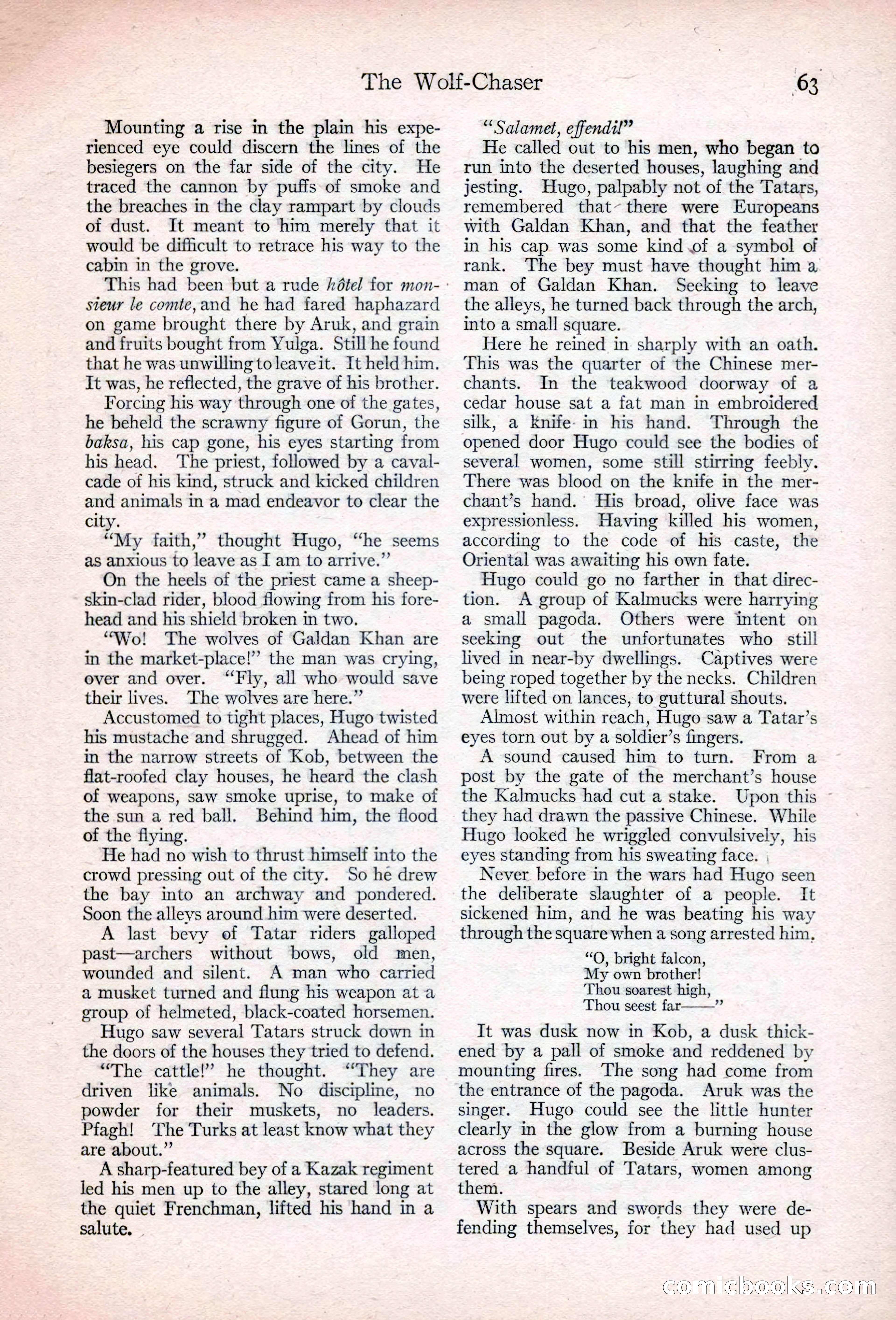
A restored page from Pulp Fiction, 1922. Page through the whole issue in the reader above.
📄 Transcribed text from this page (OCR, searchable)
Machine-transcribed from the original scan — historical spelling and the odd misread are preserved.
The Wolf-Chaser Mounting a rise in the plain his expe- rienced eye could discern the lines of the besiegers on the far side of the city. He traced the cannon by pufis of smoke and the breaches in the clay rampart by clouds of dust. It meant to him merely that it would be difficult to retrace his way to the cabin in the grove. This had been but a rude /étel for mon- : sieur le comte,and he had fared haphazard on game brought there by Aruk, and grain and fruits bought from Yulga. Still he found that he was unwilling toleaveit. It held him. It was, he reflected, the grave of his brother. Forcing his way through one of the gates, he beheld the scrawny figure of Gorun, the baksa, his cap gone, his eyes starting from his head. The priest, followed by a caval- cade of his kind, struck and kicked children and animals in a mad endeavor to clear the city. “My faith,” thought Hugo, “he seems as anxious to leave as I am to arrive.” On the heels of the priest came a sheep- skin-clad rider, blood flowing from his fore- head and his shield broken in two. “Wo! The wolves of Galdan Khan are in the market-place!” the man was crying, over and over. “Fly, all who would save their lives. The wolves are here.” Accustomed to tight places, Hugo twisted his mustache and shrugged. Ahead of him in the narrow streets of Kob, between the flat-roofed clay houses, he heard the clash of weapons, saw smoke uprise, to make of the sun a red ball. Behind him, the flood of the flying. He had no wish to thrust himself into the crowd pressing out of the city. So he drew the bay into an archway and pondered. Soon the alleys around him were deserted. A last bevy of Tatar riders galloped past—archers without bows, old men, wounded and silent. A man who carried a musket turned and flung his weapon at a group of helmeted, black-coated horsemen. Hugo saw several Tatars struck down in the doors of the houses they tried to defend. “The cattle!” he thought. “They are driven like animals. No discipline, no powder for their muskets, no _ leaders. Pfagh! The Turks at least know what they are about.” A sharp-featured bey of a Kazak regiment led his men up to the alley, stared long at the quiet Frenchman, lifted his hand in a salute. _ “Salamet, effendil” He called out to his men, who began to run into the deserted houses, laughing and jesting. Hugo, palpably not of the Tatars, remembered that~ there were Europeans with Galdan Khan, and that the feather in his cap was some kind of a symbol of rank. The bey must have thought him a man of Galdan Khan. Seeking to leave the alleys, he turned back through the arch, into a small square. Here he reined in sharply with an oath. This was the quarter of the Chinese mer- chants. In the teakwood doorway of a cedar house sat a fat man in embroidered silk, a Knife-in his hand. Through the opened door Hugo could see the bodies of several women, some still stirring feebly. There was blood on the knife in the mer- chant’s hand. His broad, olive face was expressionless. Having killed his women, according to the code of his caste, the Oriental was awaiting his own fate. Hugo could go no farther in that direc- tion. A group of Kalmucks were harrying a small pagoda. Others were intent on seeking out the unfortunates who still lived in near-by dwellings. Captives were being roped together by the necks. Children were lifted on lances, to guttural shouts. Almost within reach, Hugo saw a Tatar’s eyes torn out by a soldier’s fingers. A sound caused him to turn. From a post by the gate of the merchant’s house the Kalmucks had cut a stake. they had drawn the passive Chinese. While Hugo looked he wriggled convulsively, his eyes standing from his sweating face. | Never before in the wars had Hugo seen the deliberate slaughter of a people. It sickened him, and he was beating his way through the square when a song arrested him. “O, bright falcon, My own brother! Thou soarest high, Thou seest far——” It was dusk now in Kob, a dusk thick- ened by a pall of smoke and reddened by mounting fires. The song had come from the entrance of the pagoda. Aruk was the singer. Hugo could see the little hunter clearly in the glow from a burning house across the square. Beside Aruk were clus- tered a handful of Tatars, women among them. With spears and swords they were de- fending themselves, for they had used up COMMICLMOOoks 63 Upon this ~ (C@