
Pulp Fiction, 1922 · page 68 of 200
Adventure Magazine Cover — page 68: what you’re looking at
A restored page from Pulp Fiction, 1922. Page through the whole issue in the reader above.
📄 Transcribed text from this page (OCR, searchable)
Machine-transcribed from the original scan — historical spelling and the odd misread are preserved.
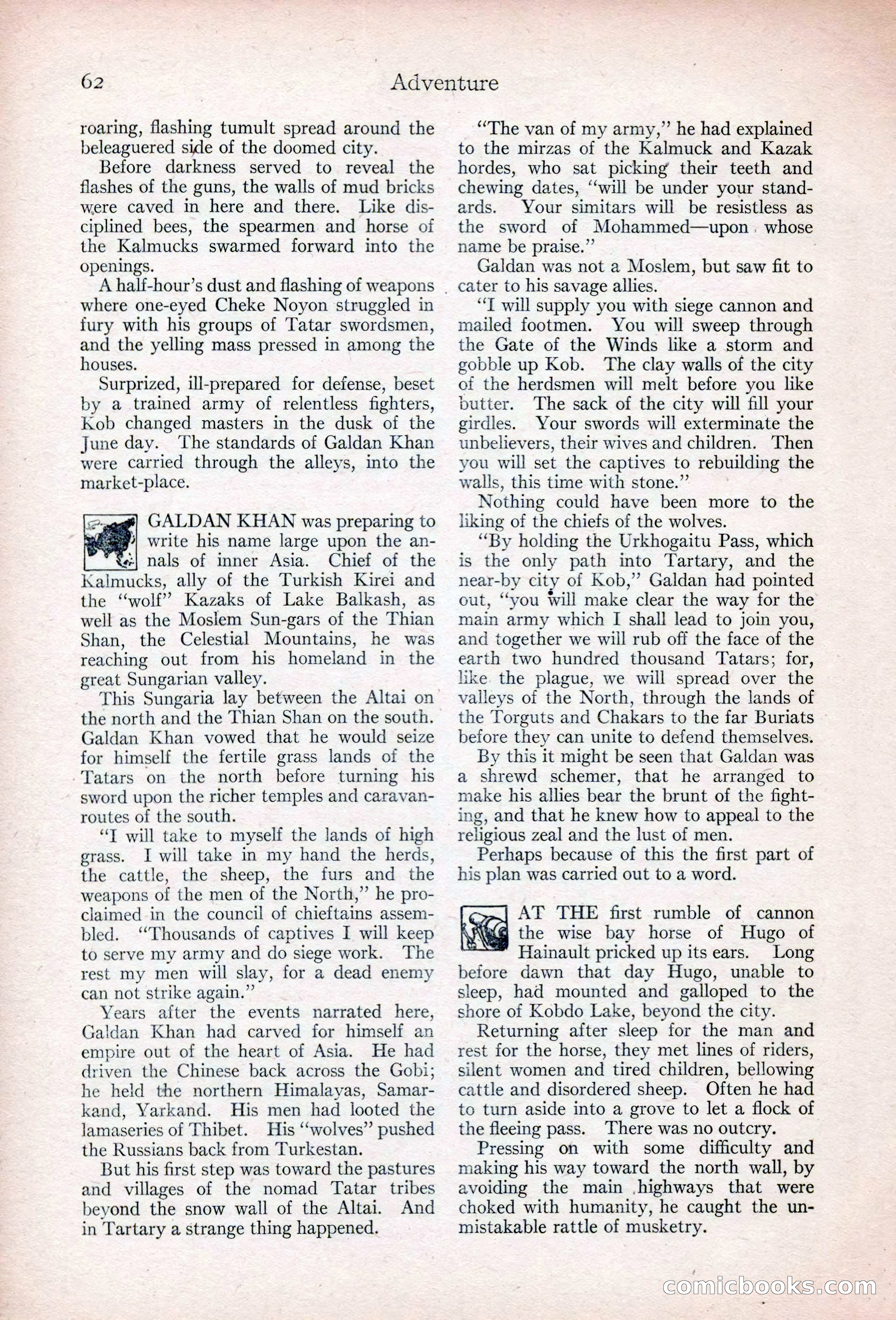
62 roaring, flashing tumult spread around the beleaguered side of the doomed city. Before darkness served to reveal the flashes of the guns, the walls of mud bricks were caved in here and there. Like dis- ciplined bees, the spearmen and horse of the Kalmucks swarmed forward into the openings. A half-hour’s dust and flashing of weapons | where one-eyed Cheke Noyon struggled in fury with his groups of Tatar swordsmen, and the yelling mass pressed in among the houses. Surprized, ill-prepared for defense, beset by a trained army of relentless fighters, Kob changed masters in the dusk of the June day. ‘The standards of Galdan Khan were carried through the alleys, into the market-place. GALDAN KHAN was preparing to write his name large upon the an- Xe] nals of inner Asia. Chief of the Kalmucks, ally of the Turkish Kirei and the “wolf” Kazaks of Lake Balkash, as well as the Moslem Sun-gars of the Thian Shan, the Celestial Mountains, he was reaching out from his homeland in the great Sungarian valley. This Sungaria lay between the Altai on the north and the Thian Shan on the south. Galdan Khan vowed that he would seize for himself the fertile grass lands of the Tatars on the north before turning his sword upon the richer temples and caravan- routes of the south. “T will take to myself the lands of high grass. I will take in my hand the herds, the cattle, the sheep, the furs and the weapons of the men of the North,” he pro- claimed in the council of chieftains assem- bled. ‘Thousands of captives I will keep to serve my army and do siege work. The rest my men will slay, for a dead enemy can not strike again.” Years after the events narrated here, Galdan Khan had carved for himself an empire out of the heart of Asia. He had driven the Chinese back across the Gobi; he held the northern Himalayas, Samar- kand, Yarkand. His men had looted the lamaseries of Thibet. His “‘wolves” pushed the Russians back from Turkestan. But his first step was toward the pastures and villages of the nomad Tatar tribes beyond the snow wall of the Altai. And in Tartary a strange thing happened. Adventure “The van of my army,” he had explained to the mirzas of the Kalmuck and Kazak hordes, who sat picking their teeth and chewing dates, “will be under your stand- ards. Your simitars will be resistless as the sword of Mohammed—upon . whose name be praise.’ Galdan was not a Moslem, but saw fit to cater to his savage allies. “Tt will supply you with siege cannon and mailed footmen. You will sweep through the Gate of the Winds like a storm and gobble up Kob. The clay walls of the city of the herdsmen will melt before you like butter. The sack of the city will fill your girdles. Your swords will exterminate the unbelievers, their wives and children. Then you will set the captives to rebuilding the walls, this time with stone.” Nothing could have been more to the liking of the chiefs of the wolves. “By holding the Urkhogaitu Pass, which is the only path into Tartary, and the near- -by city of Kob,” Galdan had pointed out, “you Will make clear the way for the main army which [I shall lead to join you, and together we will rub off the face of the earth two hundred thousand Tatars; for, hike the plague, we will spread over the valleys of the North, through the lands of the Torguts and Chakars to the far Buriats before they can unite to defend themselves. By this it might be seen that Galdan was a shrewd schemer, that he arranged to make his allies bear the brunt of the fight- ing, and that he knew how to appeal to the religious zeal and the lust of men. Perhaps because of this the first part of his plan was carried out to a word. AT THE first rumble of cannon @ the wise bay horse of Hugo of Hainault pricked up its ears. Long before dawn that day Hugo, unable to sleep, had mounted and galloped to the shore of Kobdo Lake, beyond the city. Returning after sleep for the man and rest for the horse, they met lines of riders, silent women and tired children, bellowing cattle and disordered sheep. Often he had to turn aside into a grove to let a flock of the fleeing pass. There was no outcry. Pressing on with some difficulty and making his way toward the north wall, by avoiding the main highways that were choked with humanity, he caught the un- mistakable rattle of musketry. eomnicboolk (C@