
Pulp Fiction, 1922 · page 66 of 200
Adventure Magazine Cover — page 66: what you’re looking at
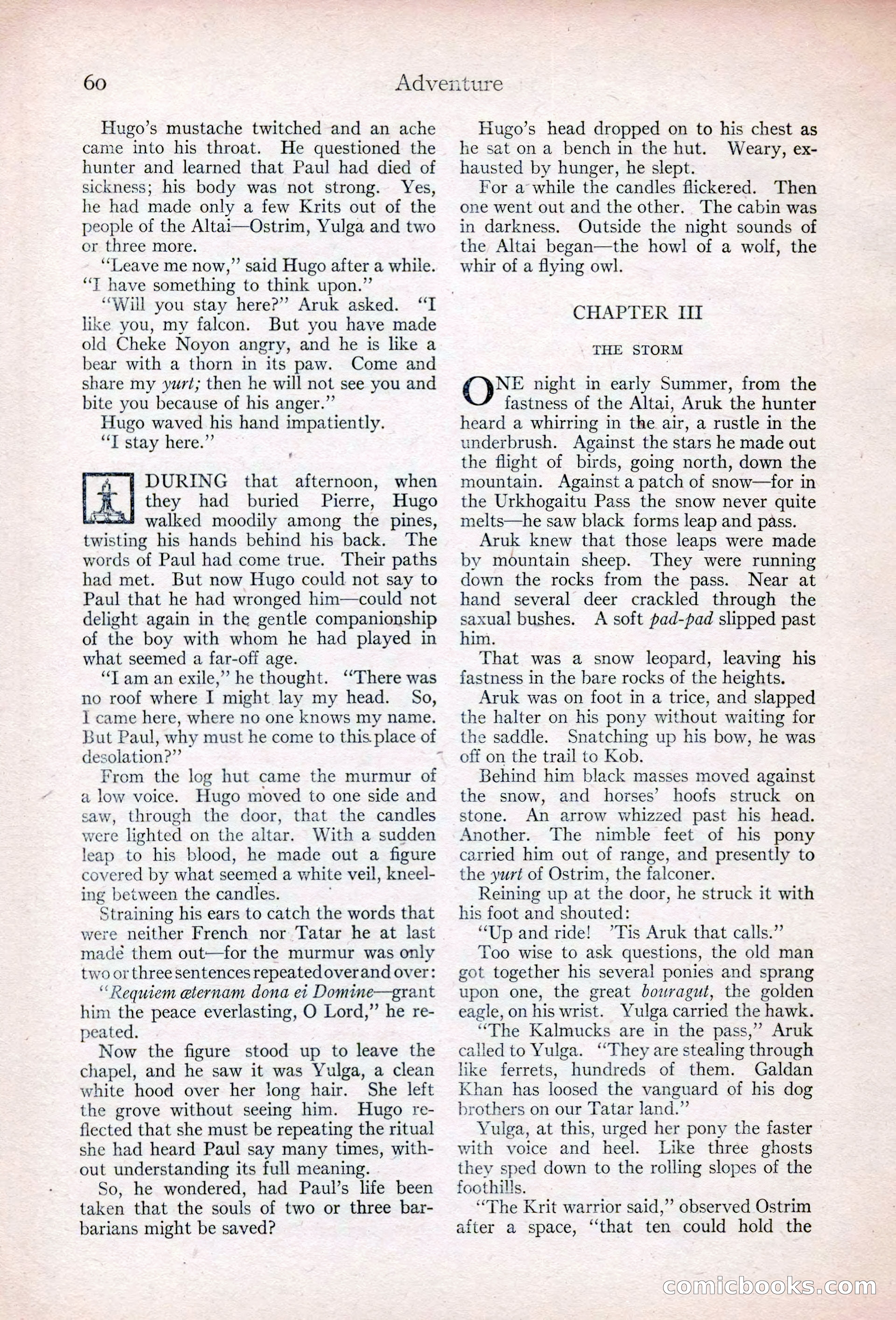
A restored page from Pulp Fiction, 1922. Page through the whole issue in the reader above.
📄 Transcribed text from this page (OCR, searchable)
Machine-transcribed from the original scan — historical spelling and the odd misread are preserved.
60 Hugo’s mustache twitched and an ache came into his throat. He questioned the hunter and learned that Paul had died of sickness; his body was not strong. Yes, he had made only a few Krits out of the people of the Altai—Ostrim, Yulga and two or three more. ‘“Leave me now,’ said Hugo after a while. “Tt have something to think upon.” ‘Will you stay here?” Aruk asked. “I like you, my falcon. But you have made old Cheke Noyon angry, and he is like a bear with a thorn in its paw. Come and share my yurt; then he will not see you and bite you because of his anger.”’ Hugo waved his hand impatiently. “T stay here.”’ DURING that afternoon, when they had buried Pierre, Hugo - walked moodily among the pines, twisting his hands behind his back. The words of Paul had come true. Their paths had met. But now Hugo could not say to Paul that he had wronged him—could not delight again in the gentle companionship of the boy with whom he had played in what seemed a far-off age. “T am an exile,” he thought. ‘““There was no roof where I might lay my head. So, 1 came here, where no one knows my name. But Paul, why must he come to this. place of desolation?” From the log hut came the murmur of a low voice. Hugo moved to one side and saw, through the door, that the candles were lighted on the altar. With a sudden leap to his blood, he made out a figure covered by what seemed a white veil, kneel- ing between the candles. Straining his ears to catch the words that were neither French nor Tatar he at last made them out—for the murmur was only two or three sentences repeated over and over: “Requiem eternam dona et Domine—grant him the peace everlasting, O Lord,” he re- peated. Now the figure stood up to leave the chapel, and he saw it was Yulga, a clean white hood over her long hair. She left the grove without seeing him. Hugo re- flected that she must be repeating the ritual she had heard Paul say many times, with- out understanding its full meaning. So, he wondered, had Paul’s life been taken that the souls of two or three bar- barians might be saved? Adventure Hugo’s head dropped on to his chest as he sat on a bench in the hut. Weary, ex- hausted by hunger, he slept. For a while the candles flickered. Then one went out and the other. The cabin was in darkness. Outside the night sounds of the Altai began—the howl of a wolf, the whir of a flying owl. CHAPTER III THE STORM Q)NE night in early Summer, from the fastness of the Altai, Aruk the hunter heard a whirring in the air, a rustle in the underbrush. Against the stars he made out the flight of birds, going north, down the mountain. Against a patch of snow—for in the Urkhogaitu Pass the snow never quite melts—he saw black forms leap and pass. Aruk knew that those leaps were made by mountain sheep. They were running down the rocks from the pass. Near at hand several deer crackled through the saxual bushes. <A soft pad-pad slipped past him. That was a snow leopard, leaving his fastness in the bare rocks of the heights. Aruk was on foot in a trice, and slapped the halter on his pony without waiting for the saddle. Snatching up his bow, he was off on the trail to Kob. Behind him black masses moved against the snow, and horses’ hoofs struck on stone. An arrow whizzed past his head. Another. The nimble feet of his pony carried him out of range, and presently to the yurt of Ostrim, the falconer. Reining up at the door, he struck it with his foot and shouted: “Up and ride! ’Tis Aruk that calls.” Too wise to ask questions, the old man got together his several ponies and sprang upon one, the great bouragut, the golden eagle, on his wrist. Yulga carried the hawk. “The Kalmucks are in the pass,” Aruk called to Yulga. “They are stealing through like ferrets, hundreds of them. Galdan Khan has loosed the vanguard of his dog brothers on our Tatar land.” Yulga, at this, urged her pony the faster with voice and heel. Like three ghosts they sped down to the rolling slopes of the foothills. “The Krit warrior said,”’ observed Ostrim after a space, “that ten could hold the COnNiICLOOokKs (C@)