
Pulp Fiction, 1922 · page 65 of 200
Adventure Magazine Cover — page 65: what you’re looking at
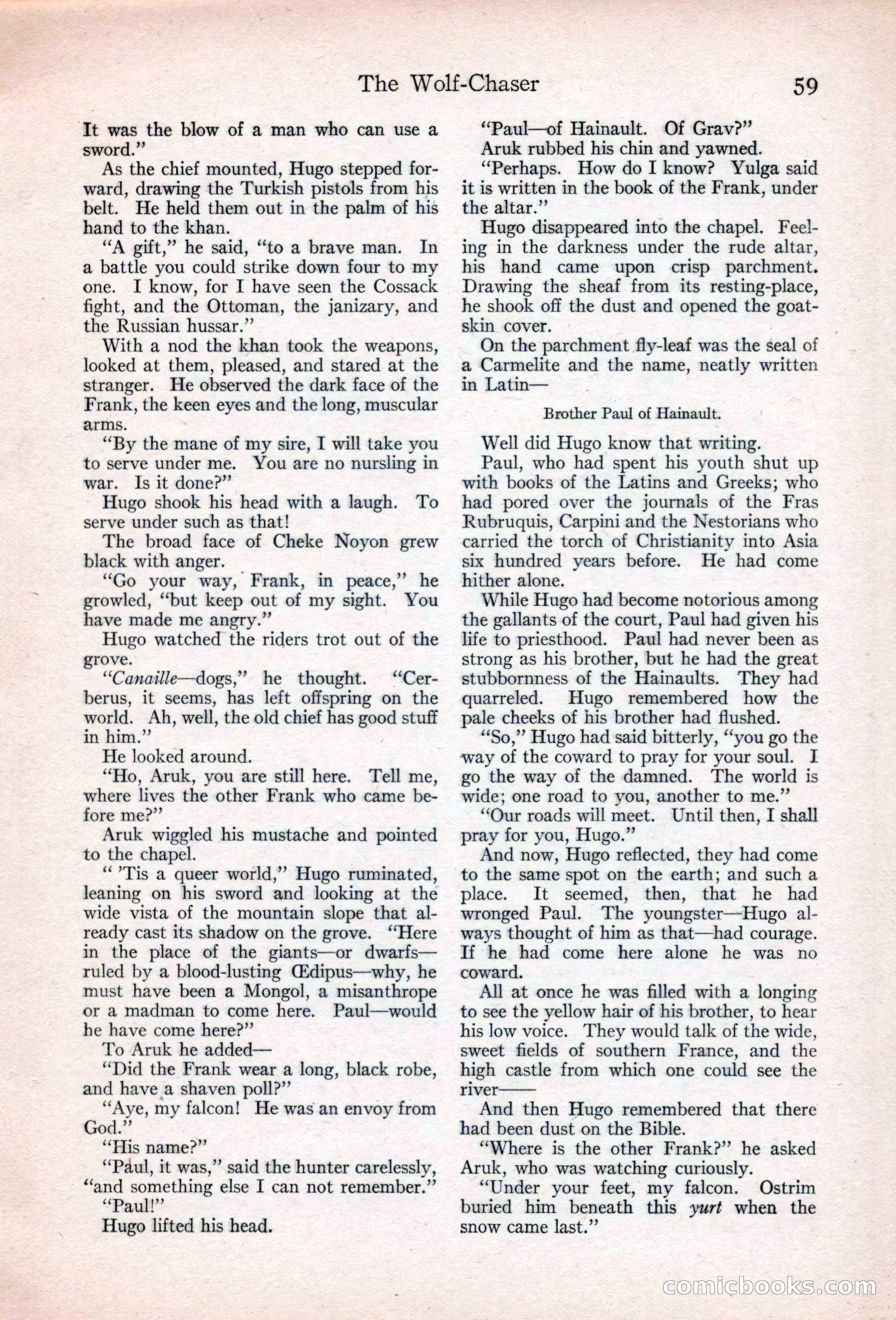
A restored page from Pulp Fiction, 1922. Page through the whole issue in the reader above.
📄 Transcribed text from this page (OCR, searchable)
Machine-transcribed from the original scan — historical spelling and the odd misread are preserved.
The Wolf-Chaser ‘It was the blow of a man who can use a sword.” As the chief mounted, Hugo stepped for- ward, drawing the Turkish pistols from his belt. He held them out in the palm of his hand to the khan. “A gift,” he said, “to a brave man. In a battle you could strike down four to my one. I know, for I have seen the Cossack fight, and the Ottoman, the janizary, and the Russian hussar.” With a nod the khan took the weapons, looked at them, pleased, and stared at the stranger. He observed the dark face of the Frank, the keen eyes and the long, muscular arms. “By the mane of my sire, I will take you to serve under me. You are no nursling in war. Is it done?” Hugo shook his head with a laugh. To serve under such as that! The broad face of Cheke Noyon grew black with anger. “Go your way, Frank, in peace,” he growled, “but keep out of my sight. You have made me angry.” Hugo watched the riders trot out of the grove. “Canaille—dogs,” he thought. ‘‘Cer- berus, it seems, has left offspring on the world. Ah, well, the old chief has good stuff in him.” He looked around. “Ho, Aruk, you are still here. Tell me, where lives the other Frank who came be- fore me?” Aruk wiggled his mustache and pointed to the chapel. “Tis a queer world,’”? Hugo ruminated, leaning on his sword and looking at the wide vista of the mountain slope that al- ready cast its shadow on the grove. “Here in the place of the giants—or dwarfs— ruled by a blood-lusting Cidipus—why, he must have been a Mongol, a misanthrope or a madman to come here. Paul—would he have come here?” To Aruk he added— “Did the Frank wear a long, black robe, and have a shaven poll?” ‘““Aye, my falcon! He was an envoy from God.” “Fis name?” “Paul, it was,” said the hunter carelessly, ‘“‘and something else I can not remember.”’ “Paul!” Hugo lifted his head. o9 “Paul—of Hainault. Of Grav?” Aruk rubbed his chin and yawned. “Perhaps. How do I know? Yulga said it is written in the book of the Frank, under the altar.” Hugo disappeared into the chapel. Feel- ing in the darkness under the rude altar, his hand came upon crisp parchment. Drawing the sheaf from its resting-place, he shook off the dust and opened the goat- skin cover. On the parchment fly-leaf was the seal of a Carmelite and the name, neatly written in Latin— Brother Paul of Hainault. Well did Hugo know that writing. Paul, who had spent his youth shut up with books of the Latins and Greeks; who had pored over the journals of the Fras Rubruquis, Carpini and the Nestorians who carried the torch of Christianity into Asia six hundred years before. He had come hither alone. While Hugo had become notorious among the gallants of the court, Paul had given his life to priesthood. Paul had never been as strong as his brother, but he had the great stubbornness of the Hainaults. They had quarreled. Hugo remembered how the pale cheeks of his brother had flushed. ““So,”’ Hugo had said bitterly, “you go the way of the coward to pray for your soul. J go the way of the damned. The world is wide; one road to you, another to me.” “Our roads will meet. Until then, I shall pray for you, Hugo.” And now, Hugo reflected, they had come to the same spot on the earth; and such a place. It seemed, then, that he had wronged Paul. The youngster—Hugo al- ways thought of him as that—had courage. If he had come here alone he was no coward. All at once he was filled with a longing to see the yellow hair of his brother, to hear his low voice. They would talk of the wide, sweet fields of southern France, and the high castle from which one could see the river And then Hugo remembered that there had been dust on the Bible. “Where is the other Frank?” he asked Aruk, who was watching curiously. “Under your feet, my falcon. Ostrim buried him beneath this yurt when the snow came last.” Gomicvook (C@