
Pulp Fiction, 1922 · page 48 of 200
Adventure Magazine Cover — page 48: what you’re looking at
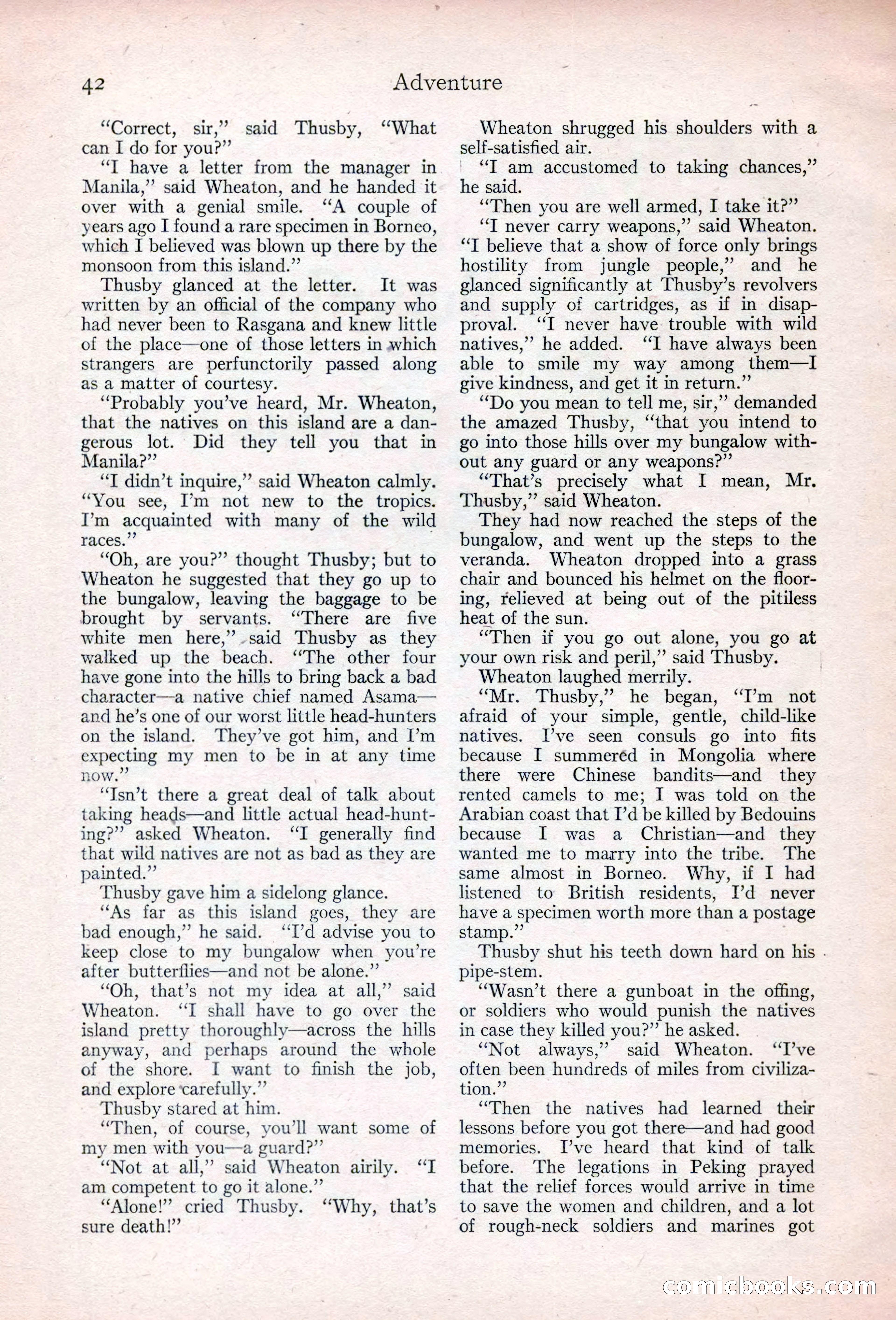
A restored page from Pulp Fiction, 1922. Page through the whole issue in the reader above.
📄 Transcribed text from this page (OCR, searchable)
Machine-transcribed from the original scan — historical spelling and the odd misread are preserved.
A2 “Correct, sir,” said Thusby, can I do for you?” “T have a letter from the manager in Manila,” said Wheaton, and he handed it over with a genial smile. “A couple of years ago I found a rare specimen in Borneo, which I believed was blown up there by the monsoon from this island.”’ Thusby glanced at the letter. It was written by an official of the company who had never been to Rasgana and knew little of the place—one of those letters in which strangers are perfunctorily passed along as a matter of courtesy. “Probably you’ve heard, Mr. Wheaton, that the natives on this island are a dan- gerous lot. Did they tell you that in Manila?”’ “T didn’t inquire,” said Wheaton calmly. “You see, I’m not new to the tropics. I’m acquainted with many of the wild races.” : “Oh, are you?” thought Thusby; but to Wheaton he suggested that they go up to the bungalow, leaving the baggage to be brought by servants. ‘There are five white men here,’’-said Thusby as they walked up the beach. ‘‘The other four have gone into the hills to bring back a bad character—a native chief named Asama— and he’s one of our worst little head-hunters on the island. They’ve got him, and I’m expecting my men to be in at any time now.” “Tsn’t there a great deal of talk about taking heads—and little actual head-hunt- ing?’ asked Wheaton. “I generally find that wild natives are not as bad as they are painted.”’ Thusby gave him a sidelong glance. “As far as this island goes, they are bad enough,” he said. ‘I’d advise you to keep close to my bungalow when you're after butterflies—and not be alone.”’ “Oh, that’s not my idea at all,” said Wheaton. ‘I shall have to go over the island pretty thoroughly—across the hills anyway, and perhaps around the whole of the shore. I want to finish the job, and explore ‘carefully.”’ Thusby stared at him. “Then, of course, you'll want some of my men with you—a guard?” “What “Not at all,’ said Wheaton airily. “I am competent to go it alone.” “Alone!” cried Thusby. ‘‘Why, that’s sure death!”’ Adventure Wheaton shrugged his shoulders with a self-satisfied air. “T am accustomed to taking chances,” he said. “Then you are well armed, I take it?” ‘“‘T never carry weapons,” said Wheaton. “T believe that a show of force only brings hostility from jungle people,” and he glanced significantly at Thusby’s revolvers and supply of cartridges, as if in: disap- proval. “TI never have trouble with wild natives,” he added. ‘I have always been able to smile my way among them—I give kindness, and get it in return.”’ “Do you mean to tell me, sir,” demanded the amazed Thusby, “that you intend to go into those hills over my bungalow with- out any guard or any weapons?” “That’s precisely what I mean, Mr. Thusby,” said Wheaton. They had now reached the steps of the bungalow, and went up the steps to the veranda. Wheaton dropped into a grass chair and bounced his helmet on the floor- ing, relieved at being out of the pitiless heat of the sun. “Then if you go out alone, you go at your own risk and peril,” said Thusby. Wheaton laughed merrily. “Mr. Thusby,” he began, “I’m not afraid of your simple, gentle, child-like natives. I’ve seen consuls go into fits because I summeréd in Mongolia where there were Chinese bandits—and _ they rented camels to me; I was told on the Arabian coast that I’d be killed by Bedouins because I was a Christian—and they wanted me to marry into the tribe. The same almost in Borneo. Why, if I had listened to British residents, I’d never have a specimen worth more than a postage stamp.”’ Thusby shut his teeth down hard on his . pipe-stem. “Wasn’t there a gunboat in the offing, or soldiers who would punish the natives in case they killed you?” he asked. | “Not always,” said Wheaton. “I’ve often been hundreds of miles from civiliza- tion.” “Then the natives had learned their lessons before you got there—and had good memories. I’ve heard that kind of talk before. The legations in Peking prayed that the relief forces would arrive in time to save the women and children, and a lot of rough-neck soldiers and marines got COmmicloooks (C@