
Pulp Fiction, 1922 · page 168 of 202
Adventure Magazine Cover — page 168: what you’re looking at
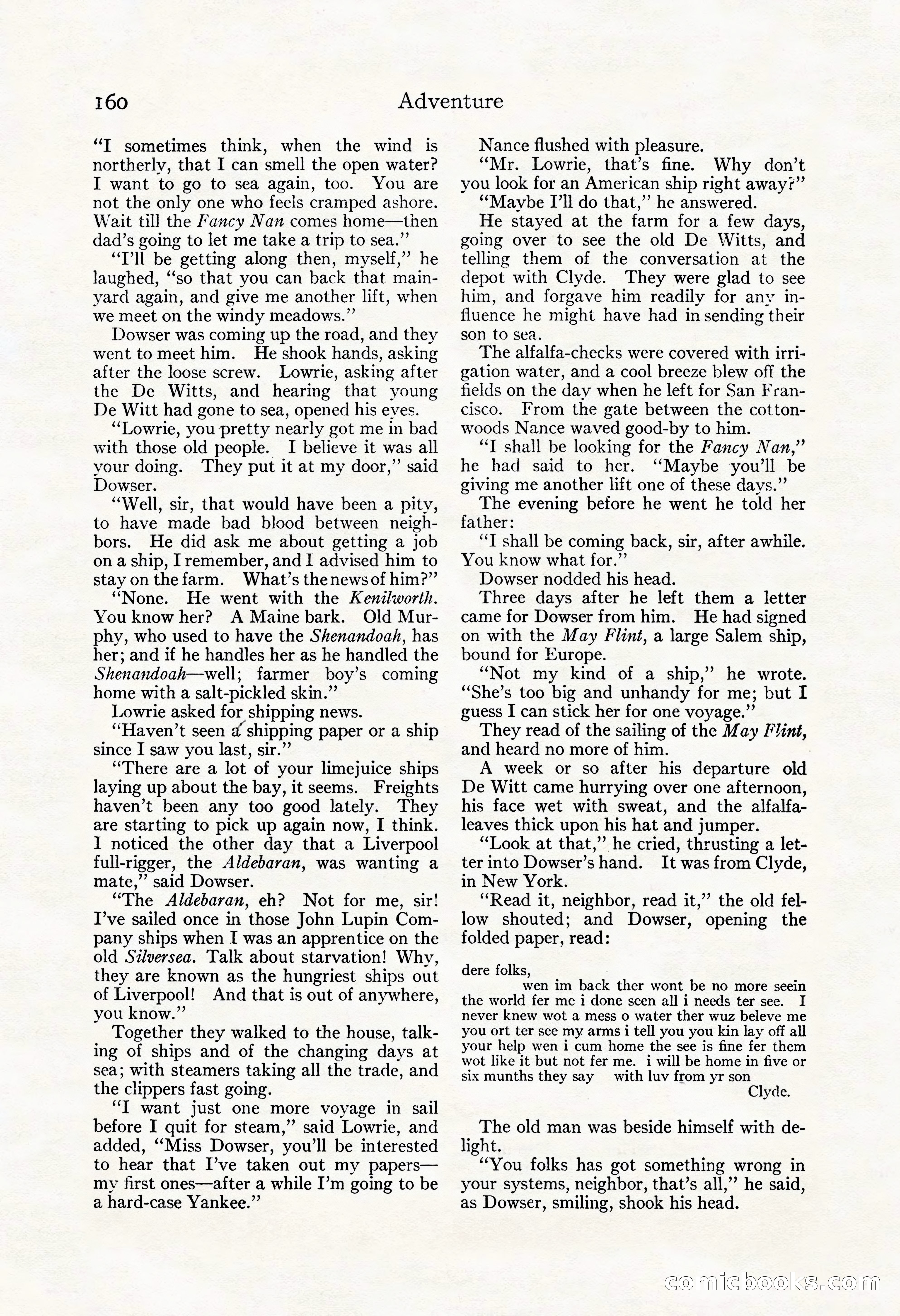
A restored page from Pulp Fiction, 1922. Page through the whole issue in the reader above.
📄 Transcribed text from this page (OCR, searchable)
Machine-transcribed from the original scan — historical spelling and the odd misread are preserved.
160 “T sometimes think, when the wind is northerly, that I can smell the open water? I want to go to sea again, too. You are not the only one who feeis cramped ashore. Wait till the Fancy Nan comes home—then dad’s going to let me take a trip to sea.” “ll be getting along then, myself,” he laughed, ‘‘so that you can back that main- yard again, and give me another lift, when we meet on the windy meadows.”’ Dowser was coming up the road, and they went to meet him. He shook hands, asking after the loose screw. Lowrie, asking after the De Witts, and hearing that young De Witt had gone to sea, opened his eves. “Lowrie, you pretty nearly got me in bad with those old people. I believe it was all vour doing. They put it at my door,” said Dowser. “Well, sir, that would have been a pity, to have made bad blood between neigh- bors. He did ask me about getting a job on a ship, J remember, and I advised him to stay on thefarm. What’s thenewsof him?” “None. He went with the Kenilworth. You know her? A Maine bark. Old Mur- phy, who used to have the Shenandoah, has her; and if he handles her as he handled the Shenandoah—well; farmer boy’s coming home with a salt-pickled skin.” Lowrie asked for shipping news. ““Haven’t seen @ shipping paper or a ship since I saw you last, sir.” “There are a lot of your limejuice ships laying up about the bay, it seems. Freights haven’t been any too good lately. They are starting to pick up again now, I think. I noticed the other day that a Liverpool full-rigger, the Aldebaran, was wanting a mate,”’ said Dowser. “The Aldebaran, eh? Not for me, sir! I’ve sailed once in those John Lupin Com- pany ships when I was an apprentice on the old Silversea. Talk about starvation! Why, they are known as the hungriest ships out of Liverpool! And that is out of anywhere, you know.” Together they walked to the house, talk- ing of ships and of the changing days at sea; with steamers taking all the trade, and the clippers fast going. “T want just one more voyage in sail before I quit for steam,” said Lowrie, and added, “‘Miss Dowser, you'll be interested to hear that I’ve taken out my papers— mv first ones—after a while I’m going to be a hard-case Yankee.” Adventure Nance flushed with pleasure. “Mr. Lowrie, that’s fine. Why don’t you look for an American ship right away?r”’ ““Mavbe I’ll do that,”’ he answered. He stayed at the farm for a few days, going over to see the old De Witts, and telling them of the conversation at the depot with Clyde. They were glad to see him, and forgave him readily for any in- fluence he might have had in sending their son to sea. The alfalfa-checks were covered with irri- gation water, and a cool breeze blew off the fields on the day when he left for San Fran- cisco. From the gate between the cotton- woods Nance waved good-by to him. “T shall be looking for the Fancy Nan,” he had said to her. “‘Maybe you'll be giving me another lift one of these days.” The evening before he went he told her father: “TI shall be coming back, sir, after awhile. You know what for.” Dowser nodded his head. Three days after he left them a letter came for Dowser from him. He had signed on with the May Flint, a large Salem ship, bound for Europe. “Not my kind of a ship,” he wrote. ‘‘She’s too big and unhandy for me; but I guess I can stick her for one voyage.” They read of the sailing of the May Flint, and heard no more of him. A week or so after his departure old De Witt came hurrying over one afternoon, his face wet with sweat, and the alfalfa- leaves thick upon his hat and jumper. “Look at that,” he cried, thrusting a let- ter into Dowser’s hand. It was from Clyde, in New York. “Read it, neighbor, read it,”’ the old fel- low shouted; and Dowser, opening the folded paper, read: dere folks, wen im back ther wont be no more seein the world fer me i done seen all i needs ter see. I never knew wot a mess 0 water ther wuz beleve me you ort ter see my arms i tell you you kin lay off all your help wen i cum home the see is fine fer them wot like it but not fer me. i will be home in five or six munths they say with luv from yr son Clyde. The old man was beside himself with de- light. “You folks has got something wrong in your systems, neighbor, that’s all,” he said, as Dowser, smiling, shook his head. COIN Clooolkks C@