
Pulp Fiction, 1922 · page 167 of 202
Adventure Magazine Cover — page 167: what you’re looking at
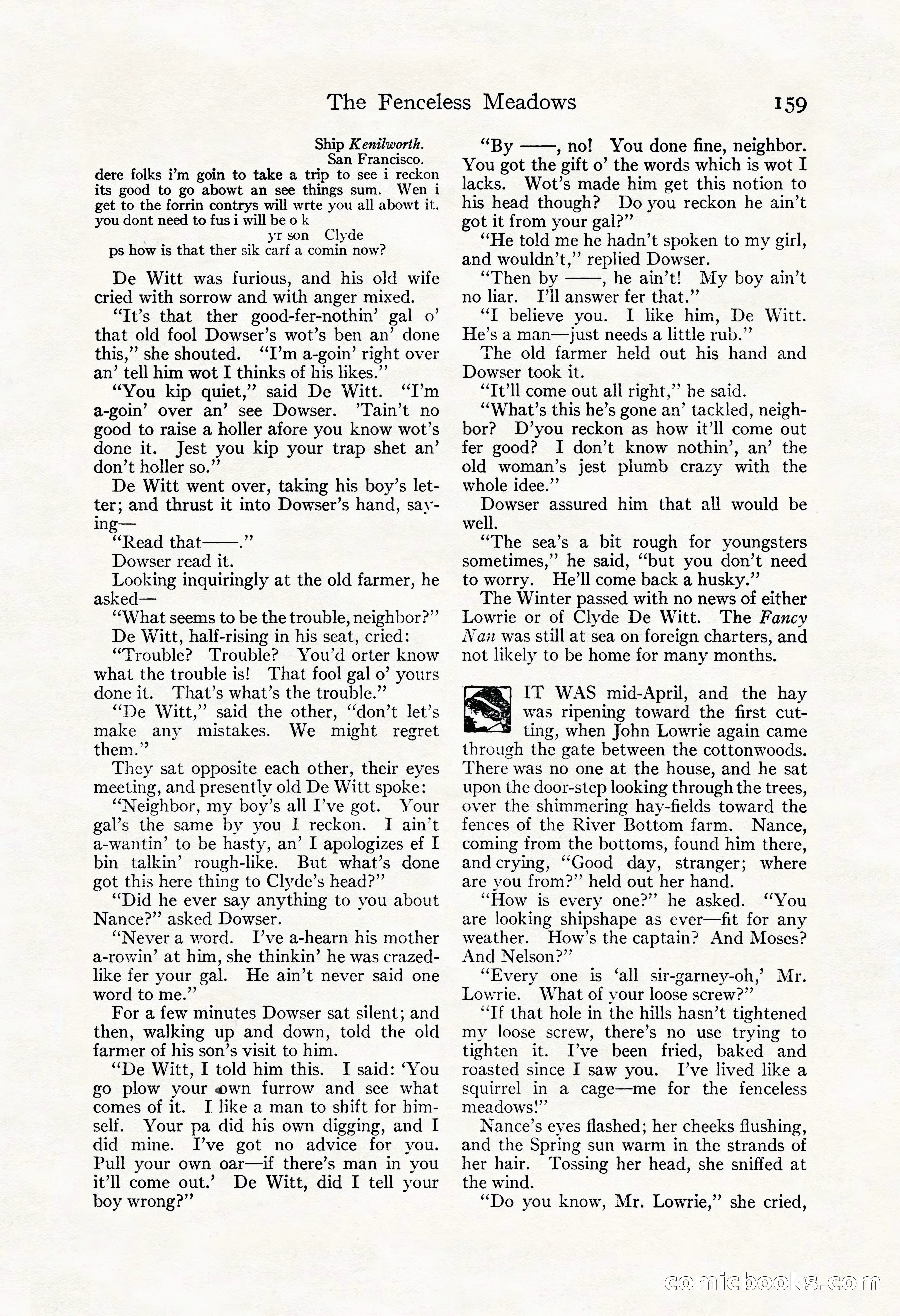
A restored page from Pulp Fiction, 1922. Page through the whole issue in the reader above.
📄 Transcribed text from this page (OCR, searchable)
Machine-transcribed from the original scan — historical spelling and the odd misread are preserved.
The Fenceless Meadows Ship Kenilworth. San Francisco. dere folks i’m goin to take a trip to see i reckon its good to go abowt an see things sum. Wen i get to the forrin contrys will wrte you all abowt it. you dont need to fus i will beo k yrson Clyde ps how is that ther sik carf a comin now? De Witt was furious, and his old wife cried with sorrow and with anger mixed. “Tt’s that ther good-fer-nothin’ gal o’ that old fool Dowser’s wot’s ben an’ done this,” she shouted. “I’m a-goin’ right over an’ tell him wot I thinks of his likes.”’ “You kip quiet,” said De Witt. “I’m a-goin’ over an’ see Dowser. *Tain’t no good to raise a holler afore you know wot’s done it. Jest you kip your trap shet an’ don’t holler so.”’ De Witt went over, taking his boy’s let- ter; and thrust it into Dowser’s hand, say- ing— “Read that Dowser read it. Looking inquiringly at the old farmer, he asked— ‘““What seems to be the trouble, neighbor?” De Witt, half-rising in his seat, cried: “Trouble? Trouble? You’d orter know what the trouble is! That fool gal 0’ yours done it. That’s what’s the trouble.” “De Witt,” said the other, ‘don’t let’s make any mistakes. We might regret them.” They sat opposite each other, their eyes meeting, and presently old De Witt spoke: “Neighbor, my boy’s all I’ve got. Your gal’s the same by you I reckon. I ain’t a-wantin’ to be hasty, an’ I apologizes ef I bin talkin’ rough-like. But what’s done got this here thing to Clyde’s head?” “Did he ever say anything to vou about Nance?”’ asked Dowser. “Never a word. I’ve a-hearn his mother a-rowin’ at him, she thinkin’ he was crazed- like fer your gal. He ain’t never said one word to me.”’ For a few minutes Dowser sat silent; and then, walking up and down, told the old farmer of his son’s visit to him. “De Witt, I told him this. I said: ‘You go plow your own furrow and see what comes of it. I like a man to shift for him- self. Your pa did his own digging, and I did mine. I’ve got no advice for you. Pull your own oar—if there’s man in you it’ll come out.’ De Witt, did I tell your boy wrong?” 2 159 “By ——, no! You done fine, neighbor. You got the gift o’ the words which is wot I lacks. Wot’s made him get this notion to his head though? Do you reckon he ain’t got it from your gal?” “He told me he hadn’t spoken to my girl, and wouldn’t,” replied Dowser. “Then by , he ain’t! My boy ain’t no liar. Jil answer fer that.” “T believe you. I like him, De Witt. He’s a man—yjust needs a little rub.” The old farmer held out his hand and Dowser took it. “Tt’ll come out all right,’’ he said. ‘“‘What’s this he’s gone an’ tackled, neigh- bor? D’you reckon as how it’ll come out fer good? I don’t know nothin’, an’ the old woman’s jest piumb crazy with the whole idee.”’ Dowser assured him that all would be well. “The sea’s a bit rough for youngsters sometimes,” he said, ‘‘but you don’t need to worry. He’ll come back a husky.”’ The Winter passed with no news of either Lowrie or of Clyde De Witt. The Fancy Nan was still at sea on foreign charters, and not likely to be home for many months. me) (T WAS mid-April, and the hay Sz was ripening toward the first cut- <—% ting, when John Lowrie again came through the gate between the cottonwoods. There was no one at the house, and he sat upon the door-step looking through the trees, over the shimmering hay-fields toward the fences of the River Bottom farm. Nance, coming from the bottoms, found him there, and crying, ‘‘Good day, stranger; where are you from?” held out her hand. “How is every one?” he asked. ‘‘You are looking shipshape as ever—fit for any weather. How’s the captain? And Moses? And Nelson?”’ “Every one is ‘all sir-garney-oh,’ Mr. Lowrie. What of your loose screw?” “Tf that hole in the hills hasn’t tightened my loose screw, there’s no use trying to tighten it. I’ve been fried, baked and roasted since I saw you. I’ve lived like a squirrel in a cage—me for the fenceless meadows!”’ Nance’s eves flashed; her cheeks flushing, and the Spring sun warm in the strands of her hair. Tossing her head, she sniffed at the wind. “Do you know, Mr. Lowrie,’ ) she cried, COIN Clooolkks C@