
Pulp Fiction, 1921 · page 190 of 204
Adventure Magazine Cover — page 190: what you’re looking at
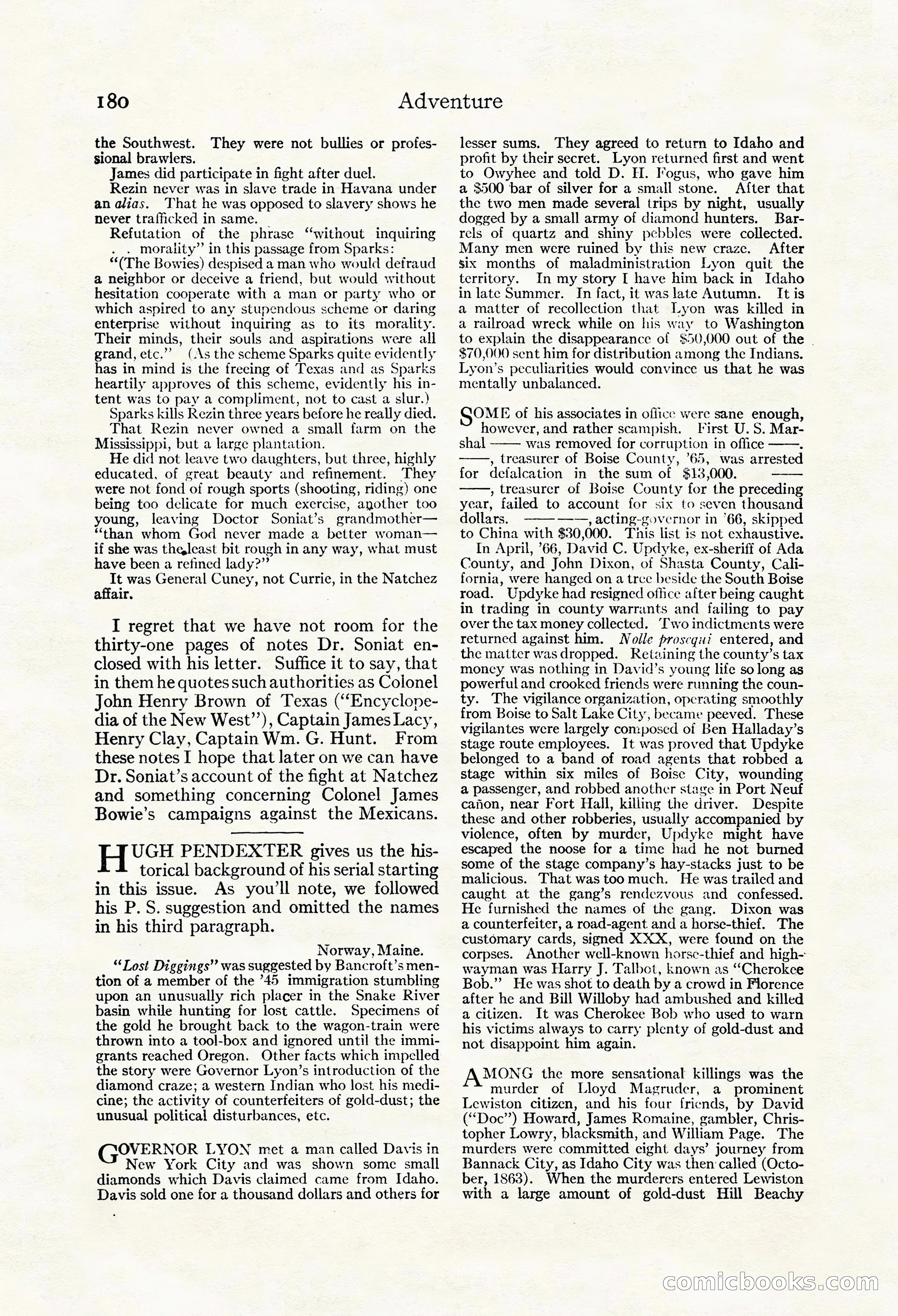
A restored page from Pulp Fiction, 1921. Page through the whole issue in the reader above.
📄 Transcribed text from this page (OCR, searchable)
Machine-transcribed from the original scan — historical spelling and the odd misread are preserved.
180 the Southwest. sional brawlers. James did participate in fight after duel. Rezin never was in slave trade in Havana under an alias. That he was opposed to slavery shows he never trafficked in same. _ Refutation of the phrase “without inquiring . morality” in this passage from Sparks: “(The Bowies) despised a man who would defraud a neighbor or deceive a friend, but would without hesitation cooperate with a man or party who or which aspired to any stupendous scheme or daring enterprise without inquiring as to its morality”. Their minds, their souls and aspirations were all grand, etc.’’ (.\s the scheme Sparks quite evidently has in mind is the freeing of Texas and as Sparks heartily approves of this scheme, evidently his in- tent was to pay a compliment, not to cast a slur.) Sparks kills Rezin three years before he really died. That Rezin never owned a small farm on the Mississippi, but a large plantation. He did not leave two daughters, but three, highly educated, of great beauty and refinement. They were not fond of rough sports (shooting, riding) one being too delicate for much exercise, another too young, leaving Doctor Soniat’s grandmother— “than whom God never made a better woman— if she was the,least bit rough in any way, what must have been a refined lady?” It was General Cuney, not Currie, in the Natchez affair. They were not bullies or profes- I regret that we have not room for the thirty-one pages of notes Dr. Soniat en- closed with his letter. Suffice it to say, that in them he quotes such authorities as Colonel John Henry Brown of Texas (“Encyclone- dia of the New West’’), Captain James Lacy, Henry Clay, CaptainWm. G. Hunt. From these notes I hope that later on we can have Dr. Soniat’s account of the fight at Natchez and something concerning Colonel James Bowie’s campaigns against the Mexicans. Five PENDEXTER gives us the his- torical background of his serial starting in this issue. As you’ll note, we followed his P. S. suggestion and omitted the names in his third paragraph. Norway, Maine. “Lost Diggings” was suggested by Bancroft’s men- tion of a member of the ’45 immigration stumbling upon an unusually rich placer in the Snake River basin while hunting for lost cattle. Specimens of the gold he brought back to the wagon-train were thrown into a tool-box and ignored until the immi- grants reached Oregon. Other facts which impelled the story were Governor Lyon’s introduction of the diamond craze; a western Indian who lost his medi- cine; the activity of counterfeiters of gold-dust; the unusual political disturbances, etc. GOVERNOR LYON met a man called Davis in New York City and was shown some small diamonds which Davis claimed came from Idaho. Davis sold one for a thousand dollars and others for Adventure lesser sums. They agreed to return to Idaho and profit by their secret. Lyon returned first and went to Owyhee and told D. H. Fogus, who gave him a 3500 bar of silver for a small stone. After that the two men made several trips by night, usually dogged by a small army of diamond hunters. Bar- rels of quartz and shiny pebbles were collected. Many men were ruined by this new craze. After six months of maladministration Lyon quit the territory. In my story I have him back in Idaho in late Summer. In fact, it waslate Autumn. It is a matter of recollection that Lyon was killed in a railroad wreck while on his way to Washington to explain the disappearance of $50,000 out of the | $70,000 sent him for distribution among the Indians. Lyon’s peculiarities would convince us that he was mentally unbalanced. SOME of his associates in office were sane enough, however, and rather scampish. First U.S. Mar- shal was removed for corruption in office ——., treasurer of Boise County, ’65, was arrested for defalcation in the sum of $13,000. , treasurer of Boise County for the preceding year, failed to account for six to seven thousand dollars. —~—, acting-governor in 66, skipped to China with $30,000. This list is not exhaustive. In April, 66, David C. Updyke, ex-sheriff of Ada County, and John Dixon, of Shasta County, Cali- fornia, were hanged on a tree beside the South Boise road. Updyke had resigned office after being caught in trading in county warrants and failing to pay over the tax money collected. ‘Two indictments were returned against him. WNolle proscqui entered, and the matter was dropped. Retaining the county’s tax money was nothing in David’s young life so long as powerful and crooked friends were running the coun- ty. The vigilance organization, operating smoothly from Boise to Salt Lake City, became peeved. These vigilantes were largely composed of Ben Halladay’s stage route employees. It was proved that Updyke belonged to a band of road agents that robbed a stage within six miles of Boise City, wounding a passenger, and robbed another stage in Port Neuf canon, near Fort Hall, killing the driver. Despite these and other robberies, usually accompanied by violence, often by murder, Updyke might have escaped the noose for a time had he not burned some of the stage company’s hay-stacks just to be malicious. That was too much. He was trailed and caught at the gang’s rendezvous and confessed. He furnished the names of the gang. Dixon was a counterfeiter, a road-agent and a horse-thief. The customary cards, signed XXX, were found on the corpses. Another well-known horsc-thief and high- wayman was Harry J. Talbot, known as “‘Cherokee Bob.” He was shot to death by a crowd in Florence after he and Bill Willoby had ambushed and killed a citizen. It was Cherokee Bob who used to warn his victims always to carry plenty of gold-dust and not disappoint him again. AMONG the more sensational killings was the murder of Lloyd Magruder, a prominent Lewiston citizen, and his four friends, by David (““Doc’’) Howard, James Romaine, gambler, Chris- topher Lowry, blacksmith, and William Page. The murders were committed eight days’ journey from Bannack City, as Idaho City was then calied (Octo- ber, 1863). When the murderers entered Lewiston with a large amount of gold-dust Hill Beachy CONMUC DOOKS (©