
Pulp Fiction, 1921 · page 189 of 204
Adventure Magazine Cover — page 189: what you’re looking at
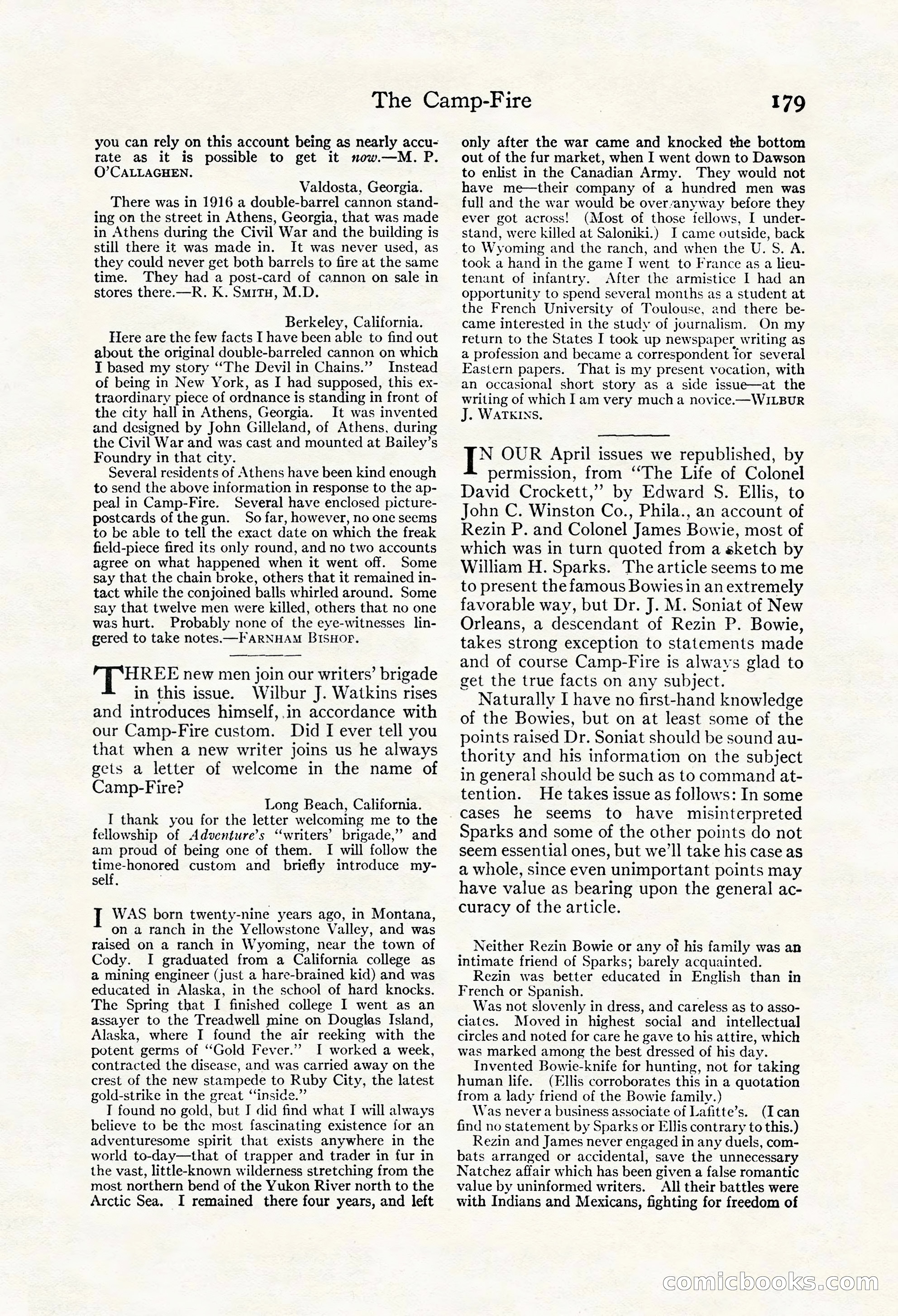
A restored page from Pulp Fiction, 1921. Page through the whole issue in the reader above.
📄 Transcribed text from this page (OCR, searchable)
Machine-transcribed from the original scan — historical spelling and the odd misread are preserved.
The Camp-Fire you can rely on this account being as nearly accu- rate as it is possible to get it now.—M. P. O’CALLAGHEN. Valdosta, Georgia. There was in 1916 a double-barrel cannon stand- ing on the street in Athens, Georgia, that was made in Athens during the Civil War and the building is still there it was made in. It was never used, as they could never get both barrels to fire at the same time. They had a post-card of cannon on sale in stores there.—R. K. Smitu, M.D. Berkeley, California. Here are the few facts I have been able to find out about the original double-barreled cannon on which I based my story “‘The Devil in Chains.”’ Instead of being in New York, as I had supposed, this ex- traordinary piece of ordnance is standing in front of the city hall in Athens, Georgia. It was invented and designed by John Gilleland, of Athens, during the Civil War and was cast and mounted at Bailey’s Foundry in that city. Several residents of Athens have been kind enough to send the above information in response to the ap- peal in Camp-Fire. Several have enclosed picture- postcards of the gun. So far, however, no one seems to be able to tell the exact date on which the freak field-piece fired its only round, and no two accounts agree on what happened when it went off. Some say that the chain broke, others that it remained in- tact while the conjoined balls whirled around. Some say that twelve men were killed, others that no one was hurt. Probably none of the eye-witnesses lin- gered to take notes.—FARNHAM BISHOP. oP UEEE new men join our writers’ brigade in this issue. Wilbur J. Watkins rises and introduces himself,.in accordance with our Camp-Fire custom. Did I ever tell you that when a new writer joins us he always gets a letter of welcome in the name of Camp-Fire? Long Beach, California. I thank you for the letter welcoming me to the fellowship of Adventure’s ‘writers’ brigade,’ and am proud of being one of them. I will follow the Wie honored custom and briefly introduce my- self. WAS born twenty-nine years ago, in Montana, on a ranch in the Yellowstone Valley, and was raised on a ranch in Wyoming, near the town of Cody. I graduated from a California college as a mining engineer (just a hare-brained kid) and was educated in Alaska, in the school of hard knocks. The Spring that I finished college I went as an assayer to the Treadwell mine on Douglas Island, Alaska, where I found the air reeking with the potent germs of “Gold Fever.” I worked a week, contracted the disease, and was carried away on the crest of the new stampede to Ruby City, the latest gold-strike in the great “‘inside.” T found no gold, but I did find what TI will always believe to be the most fascinating existence for an adventuresome spirit that exists anywhere in the world to-day—that of trapper and trader in fur in the vast, little-known wilderness stretching from the most northern bend of the Yukon River north to the Arctic Sea. I remained there four years, and left 179 only after the war came and knocked the bottom out of the fur market, when I went down to Dawson to enlist in the Canadian Army. They would not have me—their company of a hundred men was full and the war would be over/anyway before they ever got across! (Most of those fellows, I under- stand, were killed at Saloniki.) I came outside, back to Wyoming and the ranch, and when the U. S. A. took a hand in the game I went to France as a lieu- tenant of infantry. After the armistice I had an opportunity to spend several months as a student at the French University of Toulouse, and there be- came interested in the study of journalism. On my return to the States I took up newspaper writing as a profession and became a correspondent for several Eastern papers. That is my present vocation, with an occasional short story as a side issue—at the writing of which Iam very mucha novice.—WILBUR J. WATKINS. 1 OUR April issues we republished, by permission, from ‘The Life of Colonel David Crockett,” by Edward S. Ellis, to John C. Winston Co., Phila., an account of Rezin P. and Colonel James Bowie, most of which was in turn quoted from a sketch by William H. Sparks. The article seems to me to present the famous Bowies in an extremely favorable way, but Dr. J. M. Soniat of New Orleans, a descendant of Rezin P. Bowie, takes strong exception to statements made and of course Camp-Fire is always glad to get the true facts on any subject. Naturally I have no first-hand knowledge of the Bowies, but on at least some of the points raised Dr. Soniat should be sound au- thority and his information on the subject in general should be such as to command at- tention. He takes issue as follows: In some cases he seems to have misinterpreted Sparks and some of the other points do not seem essential ones, but we’ll take his case as a whole, since even unimportant points may have value as bearing upon the general ac- curacy of the article. Neither Rezin Bowie or any of his family was an intimate friend of Sparks; barely acquainted. Rezin was better educated in English than in French or Spanish. Was not slovenly in dress, and careless as to asso- ciates. Moved in highest social and intellectual circles and noted for care he gave to his attire, which was marked among the best dressed of his day. Invented Bowie-knife for hunting, not for taking human life. (Ellis corroborates this in a quotation from a lady friend of the Bowie family.) Was never a business associate of Lafitte’s. (Ican find no statement by Sparks or Ellis contrary to this.) Rezin and James never engaged in any duels, com- bats arranged or accidental, save the unnecessary Natchez affair which has been given a false romantic value by uninformed writers. All their battles were with Indians and Mexicans, fighting for freedom of CONMUG (@) DOOKS (© iin