
Pulp Fiction, 1921 · page 186 of 204
Adventure Magazine Cover — page 186: what you’re looking at
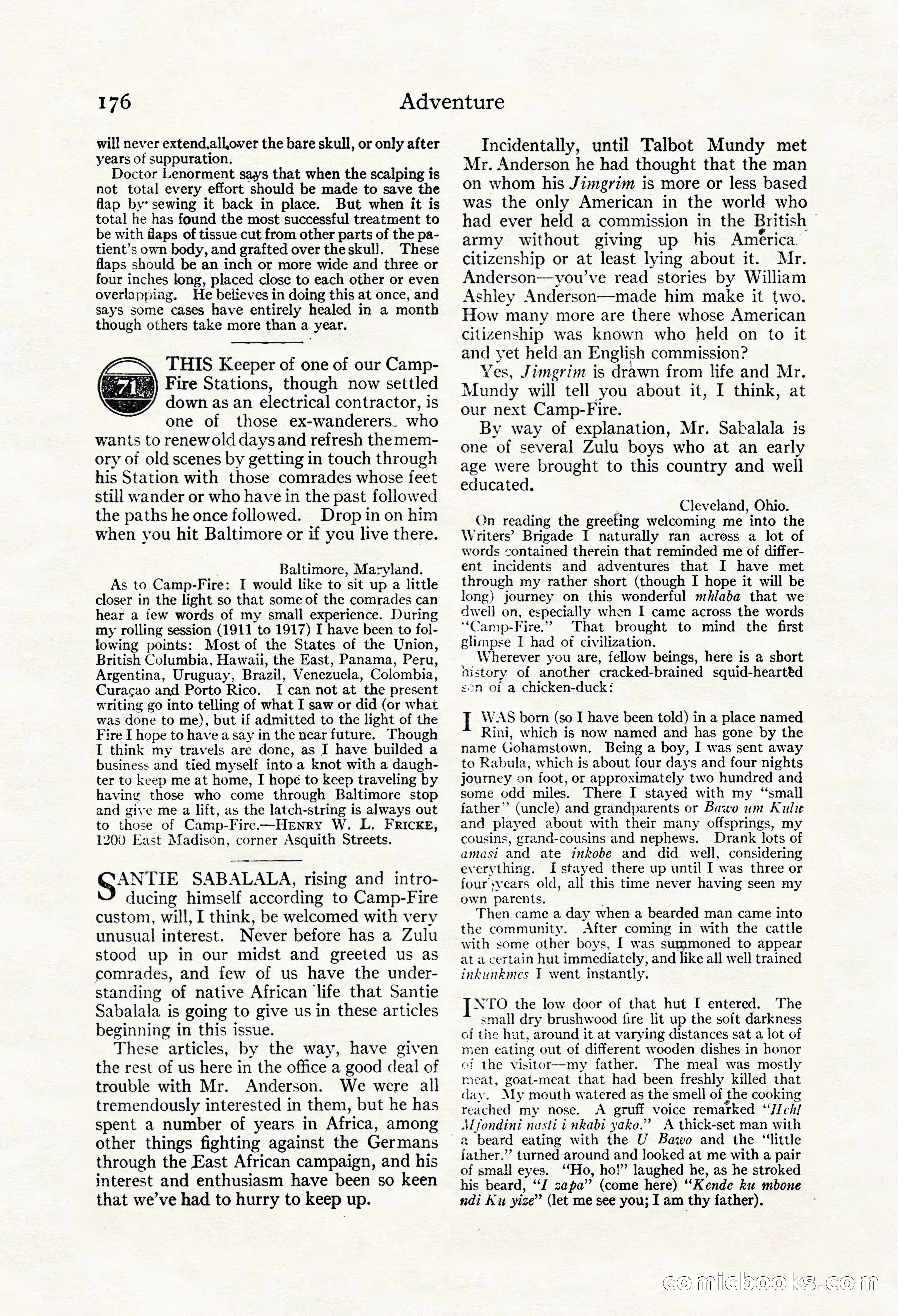
A restored page from Pulp Fiction, 1921. Page through the whole issue in the reader above.
📄 Transcribed text from this page (OCR, searchable)
Machine-transcribed from the original scan — historical spelling and the odd misread are preserved.
176 will never extend,allover the bare skull, or only after years of suppuration. Doctor Lenorment says that when the scalping is not total every effort should be made to save the flap by’ sewing it back in place. But when it is total he has found the most successful treatment to be with flaps of tissue cut from other parts of the pa- tient’s own body, and grafted over theskull. These flaps should be an inch or more wide and three or four inches long, placed close to each other or even overlapping. He believes in doing this at once, and says some cases have entirely healed in a month though others take more than a year. (~~. THIS Keeper of one of our Camp- Yeake\ Fire Stations, though now settled down as an electrical contractor, is one of those ex-wanderers. who wants to renewold daysand refresh themem- ory of old scenes by getting in touch through his Station with those comrades whose feet still wander or who have in the past followed the paths he once followed. Drop inon him when vou hit Baltimore or if you live there. Baltimore, Maryland. As to Camp-Fire: I would like to sit up a little closer in the light so that some of the comrades can hear a tew words of my small experience. During my rolling session (1911 to 1917) I have been to fol- lowing points: Most of the States of the Union, British Columbia, Hawaii, the East, Panama, Peru, Argentina, Uruguay, Brazil, Venezuela, Colombia, Curacao and Porto Rico. I can not at the present writing go into telling of what I saw or did (or what was done to me), but if admitted to the light of the Fire I hope to have a say in the near future. Though I think my travels are done, as I have builded a business and tied myself into a knot with a daugh- ter to keep me at home, I hope to keep traveling by having those who come through Baltimore stop and give me a lift, as the latch-string is always out to those of Camp-Fire—HrENry W. L. FRICKE, 1209 East Madison, corner Asquith Streets. aes SABALALA, rising and intro- ducing himself according to Camp-Fire custom, will, I think, be welcomed with very unusual interest. Never before has a Zulu stood up in our midst and greeted us as comrades, and few of us have the under- standing of native African life that Santie Sabalala is going to give us in these articles beginning in this issue. These articles, by the way, have given the rest of us here in the office a good deal of trouble with Mr. Anderson. We were all tremendously interested in them, but he has spent a number of years in Africa, among other things fighting against the Germans through the East African campaign, and his interest and enthusiasm have been so keen that we’ve had to hurry to keep up. Adventure Incidentally, until Talbot Mundy met Mr. Anderson he had thought that the man on whom his Jimgrim is more or less based was the only American in the world who had ever held a commission in the British army without giving up his America. citizenship or at least lying about it. Mr. Anderson—you’ve read stories by William Ashley Anderson—made him make it two. How many more are there whose American citizenship was known who held on to it and yet held an English commission? Yes, Jimgrim is drawn from life and Mr. Mundy will tell you about it, I think, at our next Camp-Fire. By way of explanation, Mr. Sabalala is one of several Zulu boys who at an early age were brought to this country and well educated. Cleveland, Ohio. On reading the greeting welcoming me into the Writers’ Brigade I naturally ran across a lot of words contained therein that reminded me of differ- ent incidents and adventures that I have met through my rather short (though I hope it will be long) journey on this wonderful milaba that we dwell on, especially when I came across the words “‘Camp-Fire.” That brought to mind the first glimpse I had of civilization. Wherever you are, fellow beings, here is a short nistory of another cracked-brained squid-hearttd son of a chicken-duck: I WAS born (so I have been told) in a place named Rini, which is now named and has gone by the name Gohamstown. Being a boy, I was sent away to Rabula, which is about four days and four nights journey on foot, or approximately two hundred and some odd miles. There I stayed with my “small father” (uncle) and grandparents or Bawo um Kulu and played about with their many offsprings, my cousins, grand-cousins and nephews. Drank lots of amasi and ate inkobe and did well, considering everything. Istayed there up until I was three or four svears old, all this time never having seen my own parents. Then came a day when a bearded man came into the community. After coming in with the cattle with some other boys, I was summoned to appear at a certain hut immediately, and like all well trained inkunkmes I went instantly. [NTO the low door of that hut I entered. The small dry brushwood fire lit up the soft darkness of the hut, around it at varying distances sat a lot of men eating out of different wooden dishes in honor ef the visitor—my father. The meal was mostly meat, goat-meat that had been freshly killed that day. My mouth watered as the smell of the cooking reached my nose. A gruff voice remarked “Heh! AMyondini nasti i nkabi yako.” A thick-set man with a beard eating with the U Bawo and the “‘little father.”’ turned around and looked at me with a pair of small eyes. ‘“‘Ho, ho!’’ laughed he, as he stroked his beard, “J sapa’”’ (come here) “‘Kende ku mbone ndi Ku yize’” (let me see you; I am thy father). DOOKS C@ iin