
Pulp Fiction, 1921 · page 185 of 204
Adventure Magazine Cover — page 185: what you’re looking at
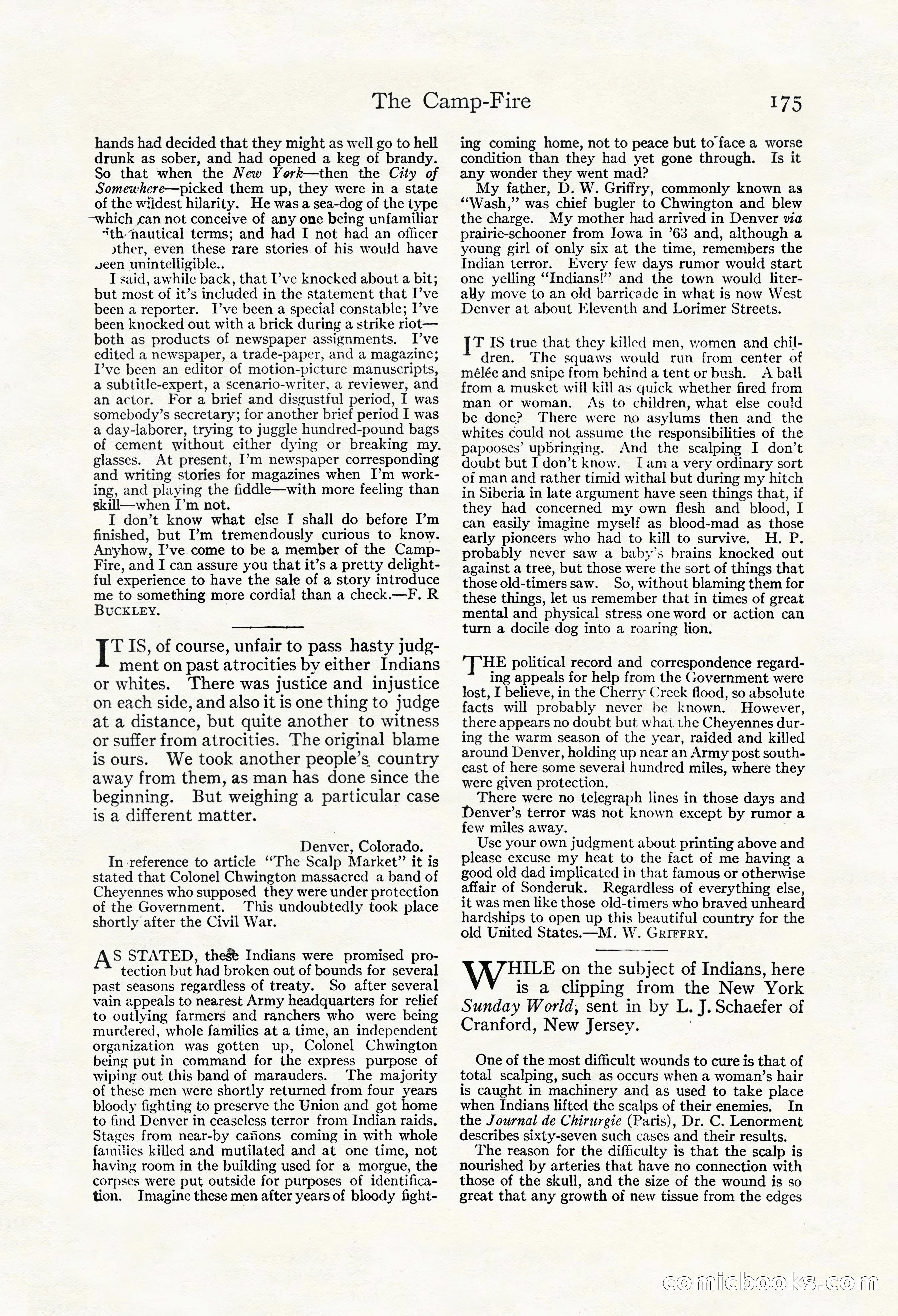
A restored page from Pulp Fiction, 1921. Page through the whole issue in the reader above.
📄 Transcribed text from this page (OCR, searchable)
Machine-transcribed from the original scan — historical spelling and the odd misread are preserved.
The Camp-Fire hands had decided that they might as well go to hell drunk as sober, and had opened a keg of brandy. So that when the New York—then the City of Somewhere—picked them up, they were in a state of the wildest hilarity. He was a sea-dog of the type ~which can not conceive of any one being unfamiliar *th nautical terms; and had I not had an officer other, even these rare stories of his would have vyeen unintelligible.. I said, awhile back, that I’ve knocked about a bit; but most of it’s included in the statement that I’ve been a reporter. I’ve been a special constable; I’ve been knocked out with a brick during a strike riot— both as products of newspaper assignments. I’ve edited a newspaper, a trade-paper, and a magazine; I’ve been an editor of motion-picture manuscripts, a subtitle-expert, a scenario-writer, a reviewer, and an actor. For a brief and disgustful period, I was somebody’s secretary; for another brief period I was a day-laborer, trying to juggle hundred-pound bags of cement without either dying or breaking my. glasses. At present, I’m newspaper corresponding and writing stories for magazines when I’m work- ing, and playing the fiddle—with more feeling than skill—when I’m not. I don’t know what else I shall do before I’m finished, but I’m tremendously curious to know. Anyhow, I’ve. come to be a member of the Camp- Fire, and I can assure you that it’s a pretty delight- ful experience to have the sale of a story introduce me to something more cordial than a check.—F. R BUCKLEY. TIS, of course, unfair to pass hasty judg- ment on past atrocities by either Indians or whites. There was justice and injustice on each side, and also it is one thing to judge at a distance, but quite another to witness or suffer from atrocities. The original blame is ours. We took another people’s country away from them, as man has done since the beginning. But weighing a particular case is a different matter. Denver, Colorado. In reference to article ‘“The Scalp Market”’ it is stated that Colonel Chwington massacred a band of Cheyennes who supposed they were under protection of the Government. This undoubtedly took place shortly after the Civil War. AS STATED, thest Indians were promised pro- tection but had broken out of bounds for several past seasons regardless of treaty. So after several vain appeals to nearest Army headquarters for relief to outlying farmers and ranchers who were being murdered, whole families at a time, an independent organization was gotten up, Colonel Chwington being put in command for the express purpose of wiping out this band of marauders. The majority of these men were shortly returned from four years bloody fighting to preserve the Union and got home to find Denver in ceaseless terror from Indian raids, Stages from near-by cafions coming in with whole families killed and mutilated and at one time, not having room in the building used for a morgue, the corpses were put outside for purposes of identifica- tion. Imagine these men after years of bloody fight- 175 ing coming home, not to peace but to face a worse condition than they had yet gone through. Is it any wonder they went mad? My father, D. W. Griffry, commonly known as ‘“‘Wash,”’ was chief bugler to Chwington and blew the charge. My mother had arrived in Denver va prairie-schooner from Iowa in ’63 and, although a young girl of only six at the time, remembers the Indian terror. Every few days rumor would start one yelling “Indians!” and the town would liter- ally move to an old barricade in what is now West Denver at about Eleventh and Lorimer Streets. [t IS true that they killed men, women and chil- dren. The squaws would run from center of mélée and snipe from behind a tent or bush. A ball from a musket will kill as quick whether fired from man or woman. As to children, what else could be done? There were no asylums then and the whites could not assume the responsibilities of the papooses’ upbringing. And the scalping I don’t doubt but I don’t know. [ama very ordinary sort of man and rather timid withal but during my hitch in Siberia in late argument have seen things that, if they had concerned my own flesh and blood, I can easily imagine myself as blood-mad as those early pioneers who had to kill to survive. H. P. probably never saw a baby’s brains knocked out against a tree, but those were the sort of things that those old-timers saw. So, without blaming them for these things, let us remember that in times of great mental and physical stress one word or action can turn a docile dog into a roaring lion. HE political record and correspondence regard- ing appeals for help from the Government were lost, I believe, in the Cherry Creek flood, so absolute facts will probably never be known. However, there appears no doubt but what the Cheyennes dur- ing the warm season of the year, raided and killed around Denver, holding up near an Army post south- east of here some several hundred miles, where they were given protection. There were no telegraph lines in those days and Denver’s terror was not known except by rumor a few miles away. Use your own judgment about printing above and please excuse my heat to the fact of me having a good old dad implicated in that famous or otherwise affair of Sonderuk. Regardless of everything else, it was men like those old-timers who braved unheard hardships to open up this beautiful country for the old United States.—M. W. Grirrry. ILE on the subject of Indians, here is a clipping from the New York Sunday World, sent in by L. J. Schaefer of Cranford, New Jersey. : One of the most difficult wounds to cure is that of total scalping, such as occurs when a woman’s hair is caught in machinery and as used to take place when Indians lifted the scalps of their enemies. In the Journal de Chirurgie (Paris), Dr. C. Lenorment describes sixty-seven such cases and their results. The reason for the difficulty is that the scalp is nourished by arteries that have no connection with those of the skull, and the size of the wound is so great that any growth of new tissue from the edges CONMUG LO) DOOKS © iin