
Pulp Fiction, 1921 · page 17 of 204
Adventure Magazine Cover — page 17: what you’re looking at
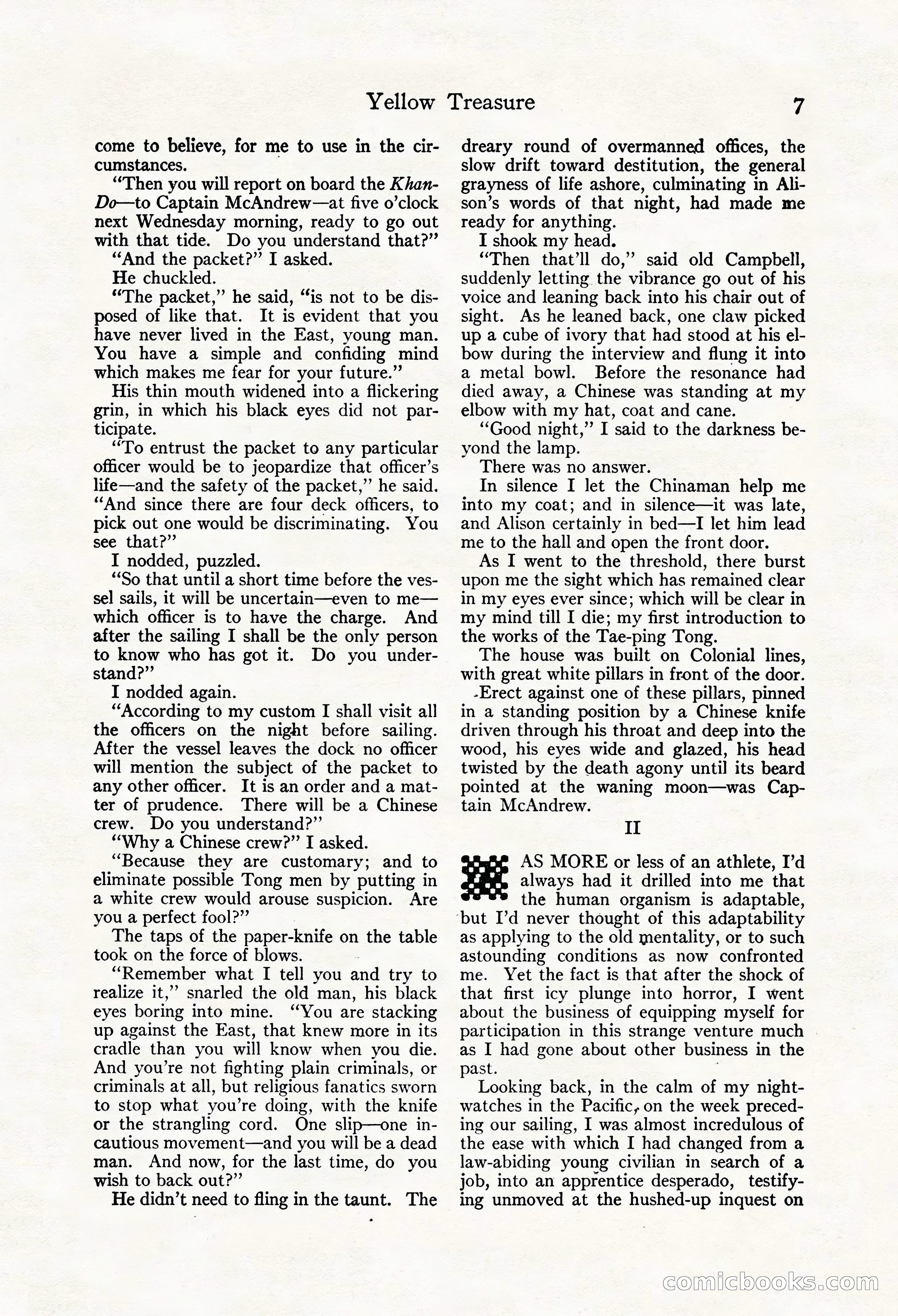
A restored page from Pulp Fiction, 1921. Page through the whole issue in the reader above.
📄 Transcribed text from this page (OCR, searchable)
Machine-transcribed from the original scan — historical spelling and the odd misread are preserved.
Yellow Treasure Fs come to believe, for me to use in the cir- cumstances. “Then you will report on board the Khan- Do—to Captain McAndrew—at five o’clock next Wednesday morning, ready to go out with that tide. Do you understand that?” “And the packet?” I asked. He chuckled. “The packet,” he said, “is not to be dis- posed of like that. It is evident that you have never lived in the East, young man. You have a simple and confiding mind which makes me fear for your future.” His thin mouth widened into a flickering grin, in which his black eyes did not par- ticipate. ‘“‘To entrust the packet to any particular officer would be to jeopardize that officer’s life—and the safety of the packet,’’ he said. “And since there are four deck officers, to pick out one would be discriminating. You see that?” I nodded, puzzled. “So that until a short time before the ves- sel sails, it will be uncertain—even to me— which officer is to have the charge. And after the sailing I shall be the only person to know who has got it. Do you under- stand?” I nodded again. “According to my custom I shall visit all the officers on the night before sailing. After the vessel leaves the dock no officer will mention the subject of the packet to any other officer. It is an order and a mat- ter of prudence. There will be a Chinese crew. Do you understand?”’ “Why a Chinese crew?”’ I asked. “Because they are customary; and to eliminate possible Tong men by putting in a white crew would arouse suspicion. Are you a perfect fool?” The taps of the paper-knife on the table took on the force of blows. “‘Remember what I tell you and try to realize it,’ snarled the old man, his black eyes boring into mine. ‘You are stacking up against the East, that knew more in its cradle than you will know when you die. And you're not fighting plain criminals, or criminals at all, but religious fanatics sworn to stop what you’re doing, with the knife or the strangling cord. One slip—one in- cautious movement—and you will be a dead man. And now, for the last time, do you wish to back out?” He didn’t need to fling in the taunt. The dreary round of overmanned offices, the slow drift toward destitution, the general grayness of life ashore, culminating in Ali- son’s words of that night, had made me ready for anything. I shook my head. “Then that’ll do,” said old Campbell, suddenly letting. the vibrance go out of his voice and leaning back into his chair out of sight. As he leaned back, one claw picked up a cube of ivory that had stood at his el- bow during the interview and flung it into a metal bowl. Before the resonance had died away, a Chinese was standing at my elbow with my hat, coat and cane. “Good night,” I said to the darkness be- yond the lamp. There was no answer. In silence I let the Chinaman help me into my coat; and in silence—it was late, and Alison certainly in bed—TI let him lead me to the hall and open the front door. As I went to the threshold, there burst upon me the sight which has remained clear in my eyes ever since; which will be clear in my mind till I die; my first introduction to the works of the Tae-ping Tong. The house was built on Colonial lines, with great white pillars in front of the door. -Erect against one of these pillars, pinned in a standing position by a Chinese knife driven through his throat and deep into the wood, his eyes wide and glazed, his head twisted by the death agony until its beard pointed at the waning moon—was Cap- tain McAndrew. fe II AS MORE or less of an athlete, I’d always had it drilled into me that the human organism is adaptable, ‘but I’d never thought of this adaptability as applying to the old mentality, or to such astounding conditions as now confronted me. Yet the fact is that after the shock of that first icy plunge into horror, I went about the business of equipping myself for participation in this strange venture much | as I had gone about other business in the past. Looking back, in the calm of my night- watches in the Pacific, on the week preced- ing our sailing, I was almost incredulous of the ease with which I had changed from a law-abiding young civilian in search of a job, into an apprentice desperado, testify- ing unmoved at the hushed-up inquest on GOMIGHOO S (© iin