
Pulp Fiction, 1921 · page 16 of 204
Adventure Magazine Cover — page 16: what you’re looking at
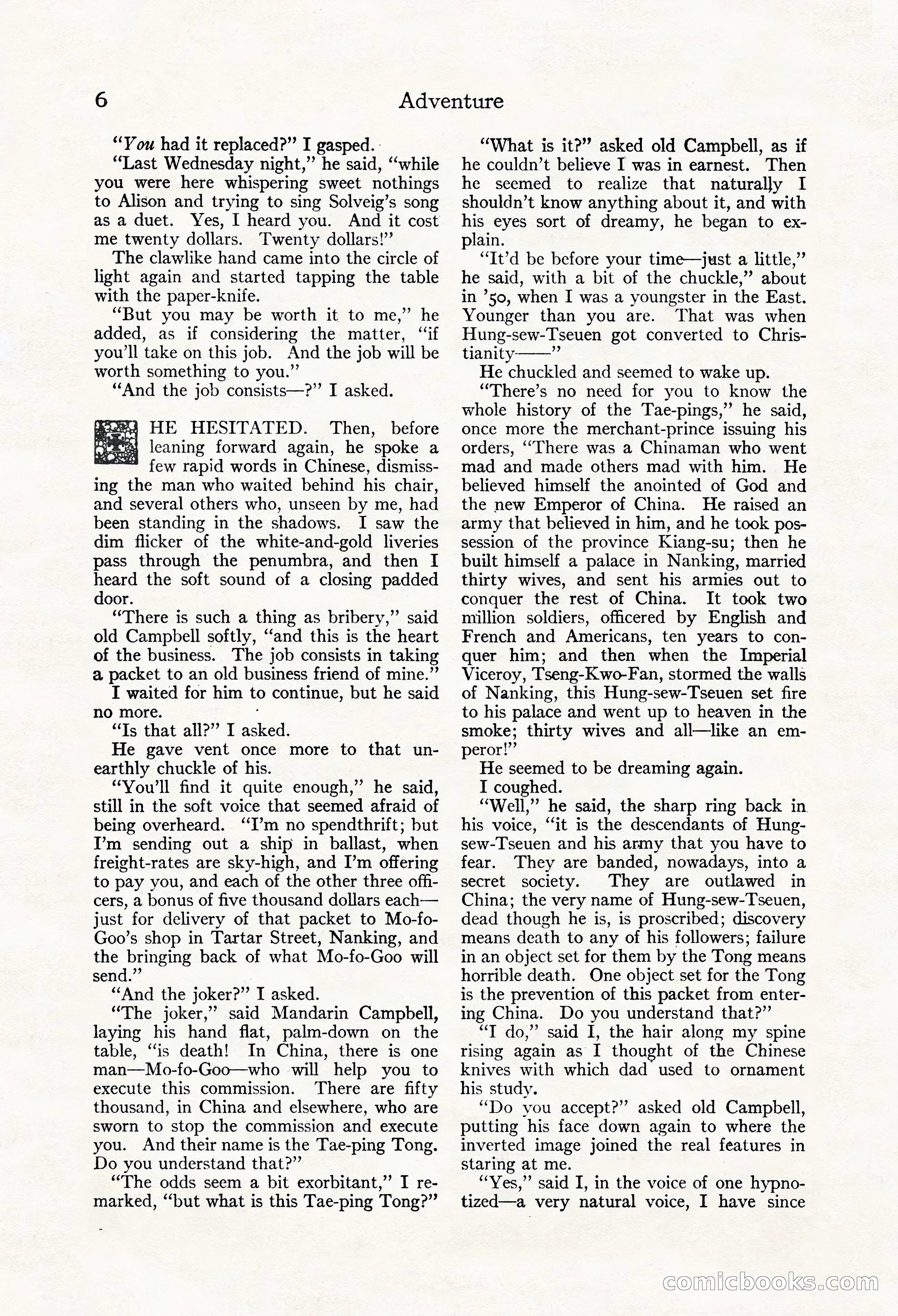
A restored page from Pulp Fiction, 1921. Page through the whole issue in the reader above.
📄 Transcribed text from this page (OCR, searchable)
Machine-transcribed from the original scan — historical spelling and the odd misread are preserved.
6 Adventure “You had it replaced?” I gasped. . “Last Wednesday night,” he said, ‘while you were here whispering sweet nothings to Alison and trying to sing Solveig’s song as a duet. Yes, I heard you. And it cost me twenty dollars. Twenty dollars!’’ The clawlike hand came into the circle of light again and started tapping the table with the paper-knife. “But you may be worth it to me,” he added, as if considering the matter, “‘if you'll take on this job. And the job will be worth something to you.” “And the job consists—?” I asked. yey HE HESITATED. Then, before peasy leaning forward again, he spoke a =<*" few rapid words in Chinese, dismiss- ing the man who waited behind his chair, and several others who, unseen by me, had been standing in the shadows. I saw the dim flicker of the white-and-gold liveries pass through the penumbra, and then I heard the soft sound of a closing padded door. “There is such a thing as bribery,” said old Campbell softly, ‘‘and this is the heart of the business. The job consists in taking a packet to an old business friend of mine.” I waited for him to continue, but he said no more. : “Ts that all?” I asked. He gave vent once more to that un- earthly chuckle of his. “You'll find it quite enough,” he said, still in the soft voice that seemed afraid of being overheard. “I’m no spendthrift; but I’m sending out a ship in ballast, when freight-rates are sky-high, and I’m offering to pay you, and each of the other three off- cers, a bonus of five thousand dollars each— just for delivery of that packet to Mo-fo- Goo’s shop in Tartar Street, Nanking, and the bringing back of what Mo-fo-Goo will send.”’ ‘And the joker?” I asked. “The joker,” said Mandarin Campbell, laying his hand flat, palm-down on the table, “‘is death! In China, there is one man—Mo-fo-Goo—who will help you to execute this commission. There are fifty thousand, in China and elsewhere, who are sworn to stop the commission and execute you. And their name is the Tae-ping Tong. Do you understand that?” “The odds seem a bit exorbitant,” I re- marked, “but what is this Tae-ping Tong?” “What is it?” asked old Campbell, as if he couldn’t believe I was in earnest. Then he seemed to realize that naturally I shouldn’t know anything about it, and with his eyes sort of dreamy, he began to ex- plain. “It'd be before your time—just a little,” he said, with a bit of the chuckle,” about in ’50, when I was a youngster in the East. Younger than you are. That was when Hung-sew-Tseuen got converted to Chris- tianity “ He chuckled and seemed to wake up. ‘“‘There’s no need for you to know the whole history of the Tae-pings,’’ he said, once more the merchant-prince issuing his orders, ‘“There was a Chinaman who went mad and made others mad with him. He believed himself the anointed of God and the new Emperor of China. He raised an army that believed in him, and he took pos- session of the province Kiang-su; then he built himself a palace in Nanking, married thirty wives, and sent his armies out to conquer the rest of China. It took two million soldiers, officered by English and French and Americans, ten years to con- quer him; and then when the Imperial Viceroy, Tseng-Kwo-Fan, stormed the walls of Nanking, this Hung-sew-Tseuen set fire to his palace and went up to heaven in the smoke; thirty wives and all—like an em- peror!”’ He seemed to be dreaming again. I coughed. “Well,” he said, the sharp ring back in his voice, ‘it is the descendants of Hung- sew-Tseuen and his army that you have to fear. They are banded, nowadays, into a secret society. They are outlawed in China; the very name of Hung-sew-Tseuen, dead though he is, is proscribed; discovery means death to any of his followers; failure in an object set for them by the Tong means horrible death. One object set for the Tong is the prevention of this packet from enter- ing China. Do you understand that?” “T do,” said I, the hair along my spine rising again as I thought of the Chinese knives with which dad used to ornament his study. “Do vou accept?” asked old Campbell, putting his face down again to where the inverted image joined the real features in staring at me. “Yes,” said I, in the voice of one hypno- tized—a very natural voice, I have since COMicaoo S (©