
Pulp Fiction, 1921 · page 42 of 200
Adventure Magazine Cover, August 18, 1921 — page 42: what you’re looking at
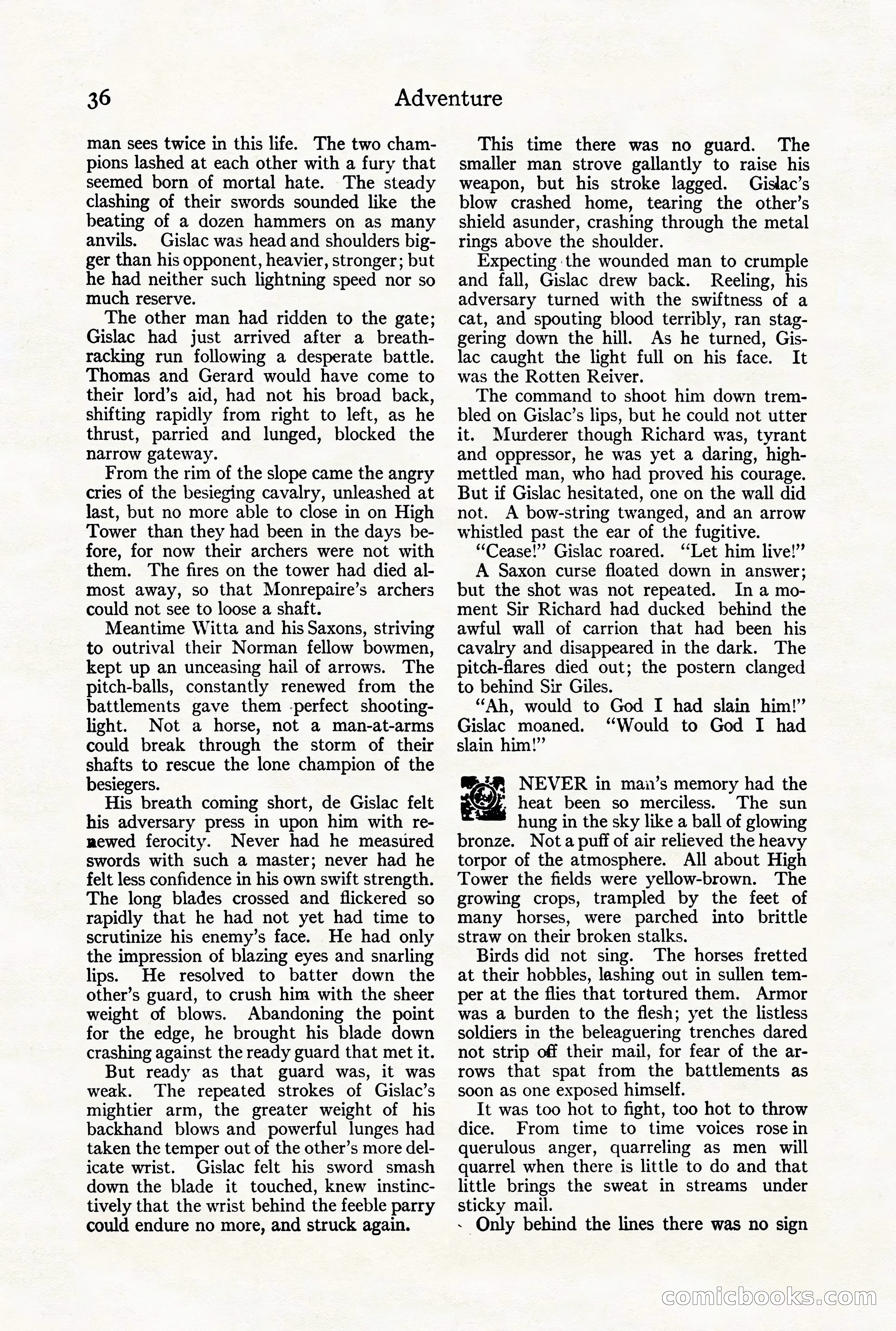
A restored page from Pulp Fiction, 1921. Page through the whole issue in the reader above.
📄 Transcribed text from this page (OCR, searchable)
Machine-transcribed from the original scan — historical spelling and the odd misread are preserved.
36 man sees twice in this life. The two cham- pions lashed at each other with a fury that seemed born of mortal hate. The steady clashing of their swords sounded like the beating of a dozen hammers on as many anvils. Gislac was head and shoulders big- ger than his opponent, heavier, stronger; but he had neither such lightning speed nor so much reserve. The other man had ridden to the gate; Gislac had just arrived after a breath- racking run following a desperate battle. Thomas and Gerard would have come to their lord’s aid, had not his broad back, shifting rapidly from right to left, as he thrust, parried and lunged, blocked the narrow gateway. From the rim of the slope came the angry cries of the besieging cavalry, unleashed at last, but no more able to close in on High Tower than they had been in the days be- fore, for now their archers were not with them. The fires on the tower had died al- most away, so that Monrepaire’s archers could not see to loose a shaft. Meantime Witta and his Saxons, striving to outrival their Norman fellow bowmen, kept up an unceasing hail of arrows. The pitch-balls, constantly renewed from the battlements gave them -perfect shooting- light. Not a horse, not a man-at-arms could break through the storm of their shafts to rescue the lone champion of the besiegers. His breath coming short, de Gislac felt his adversary press in upon him with re- newed ferocity. Never had he measured swords with such a master; never had he felt less confidence in his own swift strength. The long blades crossed and flickered so rapidly that he had not yet had time to scrutinize his enemy’s face. He had only the impression of blazing eyes and snarling lips. He resolved to batter down the other’s guard, to crush him with the sheer weight of blows. Abandoning the point for the edge, he brought his blade down crashing against the ready guard that met it. But ready as that guard was, it was weak. The repeated strokes of Gislac’s mightier arm, the greater weight of his backhand blows and powerful lunges had taken the temper out of the other’s more del- icate wrist. Gislac felt his sword smash down the blade it touched, knew instinc- tively that the wrist behind the feeble parry could endure no more, and struck again. Adventure This time there was no guard. The smaller man strove gallantly to raise his weapon, but his stroke lagged. Gislac’s blow crashed home, tearing the other’s shield asunder, crashing through the metal rings above the shoulder. Expecting the wounded man to crumple and fall, Gislac drew back. Reeling, his adversary turned with the swiftness of a cat, and spouting blood terribly, ran stag- gering down the hill. As he turned, Gis- lac caught the light full on his face. It was the Rotten Reiver. The command to shoot him down trem- bled on Gislac’s lips, but he could not utter it. Murderer though Richard was, tyrant and oppressor, he was yet a daring, high- mettled man, who had proved his courage. But if Gislac hesitated, one on the wall did not. A bow-string twanged, and an arrow whistled past the ear of the fugitive. “‘Cease!”’ Gislac roared. ‘Let him live!” A Saxon curse floated down in answer; but the shot was not repeated. In a mo- ment Sir Richard had ducked behind the awful wall of carrion that had been his cavalry and disappeared in the dark. The pitch-flares died out; the postern clanged to behind Sir Giles. “Ah, would to God I had slain him!” Gislac moaned. ‘Would to God I had 199 slain him! . heat been so merciless. The sun hung in the sky like a ball of glowing bronze. Nota puff of air relieved the heavy torpor of the atmosphere. All about High Tower the fields were yellow-brown. The growing crops, trampled by the feet of many horses, were parched into brittle straw on their broken stalks. Birds did not sing. The horses fretted at their hobbles, lashing out in sullen tem- per at the flies that tortured them. Armor was a burden to the flesh; yet the listless soldiers in the beleaguering trenches dared not strip off their mail, for fear of the ar- rows that spat from the battlements as soon as one exposed himself. It was too hot to fight, too hot to throw dice. From time to time voices rose in querulous anger, quarreling as men will quarrel when there is little to do and that little brings the sweat in streams under sticky mail. ~ Only behind the lines there was no sign “oy NEVER in mai’s memory had the COmiclbook CO