
Pulp Fiction, 1921 · page 41 of 200
Adventure Magazine Cover, August 18, 1921 — page 41: what you’re looking at
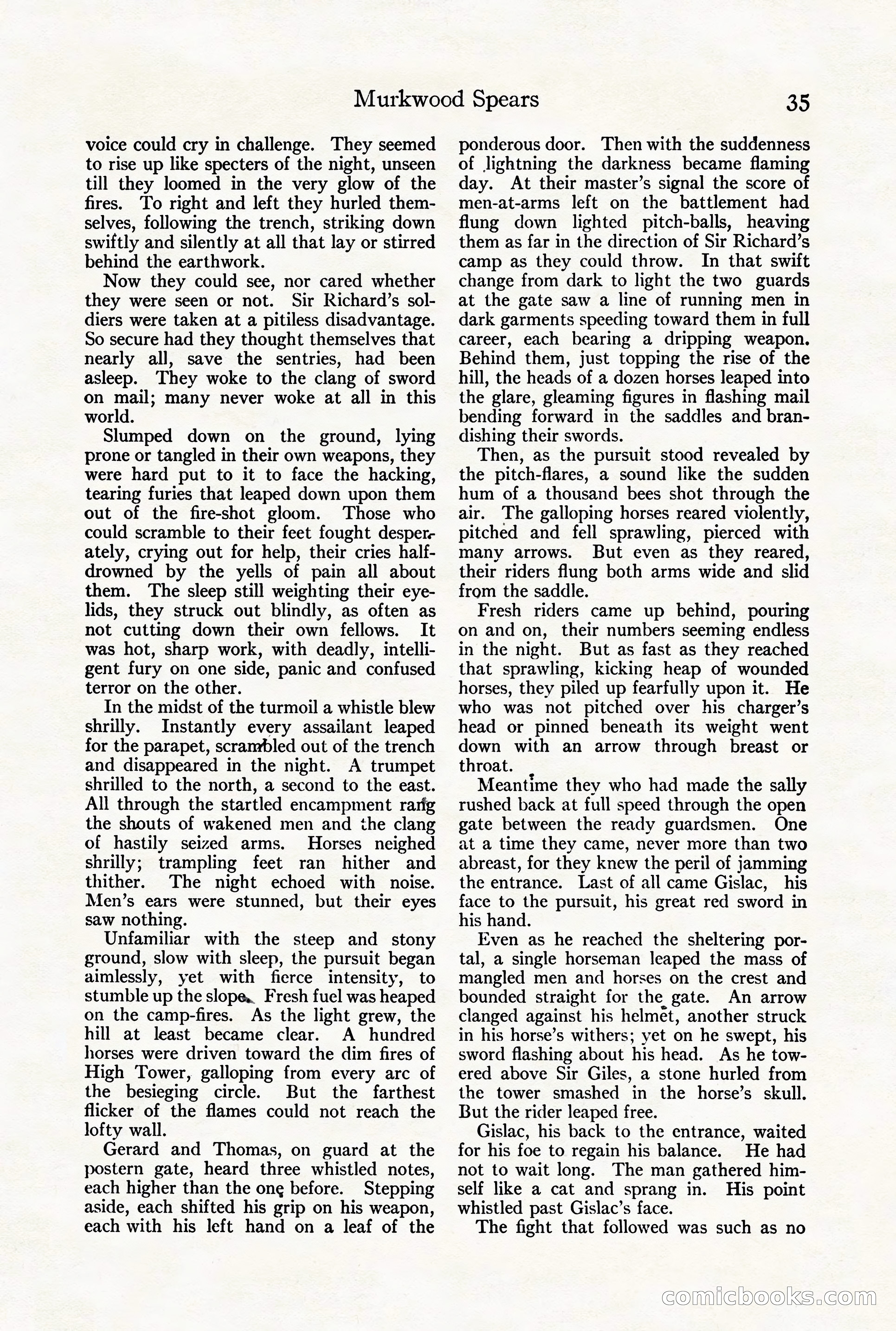
A restored page from Pulp Fiction, 1921. Page through the whole issue in the reader above.
📄 Transcribed text from this page (OCR, searchable)
Machine-transcribed from the original scan — historical spelling and the odd misread are preserved.
Murkwood Spears voice could cry in challenge. They seemed to rise up like specters of the night, unseen till they loomed in the very glow of the fires. To right and left they hurled them- selves, following the trench, striking down swiftly and silently at all that lay or stirred behind the earthwork. Now they could see, nor cared whether they were seen or not. Sir Richard’s sol- diers were taken at a pitiless disadvantage. So secure had they thought themselves that nearly all, save the sentries, had been asleep. They woke to the clang of sword on mail; many never woke at all in this world. Slumped down on the ground, lying prone or tangled in their own weapons, they were hard put to it to face the hacking, tearing furies that leaped down upon them out of the fire-shot gloom. Those who could scramble to their feet fought desper- ately, crying out for help, their cries half- drowned by the yells of pain all about them. The sleep still weighting their eye- lids, they struck out blindly, as often as not cutting down their own fellows. It was hot, sharp work, with deadly, intelli- gent fury on one side, panic and confused terror on the other. In the midst of the turmoil a whistle blew shrilly. Instantly every assailant leaped for the parapet, scranvbled out of the trench and disappeared in the night. A trumpet shrilled to the north, a second to the east. All through the startled encampment rarig the shouts of wakened men and the clang of hastily seized arms. Horses neighed shrilly; trampling feet ran hither and thither. The night echoed with noise. Men’s ears were stunned, but their eyes saw nothing. Unfamiliar with the steep and stony ground, slow with sleep, the pursuit began aimlessly, yet with fierce intensity, to stumble up the slope. Fresh fuel was heaped on the camp-fires. As the light grew, the hill at least became clear. A hundred horses were driven toward the dim fires of High Tower, galloping from every arc of the besieging circle. But the farthest flicker of the flames could not reach the lofty wall. Gerard and Thomas, on guard at the postern gate, heard three whistled notes, each higher than the one before. Stepping aside, each shifted his grip on his weapon, each with his left hand on a leaf of the 35 ponderous door. Then with the suddenness of lightning the darkness became flaming day. At their master’s signal the score of men-at-arms left on the battlement had flung down lighted pitch-balls, heaving them as far in the direction of Sir Richard’s camp as they could throw. In that swift change from dark to light the two guards at the gate saw a line of running men in dark garments speeding toward them in full career, each bearing a dripping weapon. Behind them, just topping the rise of the hill, the heads of a dozen horses leaped into the glare, gleaming figures in flashing mail bending forward in the saddles and bran- dishing their swords. Then, as the pursuit stood revealed by the pitch-flares, a sound like the sudden hum of a thousand bees shot through the air. The galloping horses reared violently, pitched and fell sprawling, pierced with many arrows. But even as they reared, their riders flung both arms wide and slid from the saddle. Fresh riders came up behind, pouring on and on, their numbers seeming endless in the night. But as fast as they reached that sprawling, kicking heap of wounded horses, they piled up fearfully upon it. He who was not pitched over his charger’s head or pinned beneath its weight went down with an arrow through breast or throat. | Meantime they who had made the sally rushed back at full speed through the open gate between the ready guardsmen. One at a time they came, never more than two abreast, for they knew the peril of jamming the entrance. Last of all came Gislac, his face to the pursuit, his great red sword in his hand. Even as he reached the sheltering por- tal, a single horseman leaped the mass of mangled men and horses on the crest and bounded straight for the gate. An arrow clanged against his helmet, another struck in his horse’s withers; yet on he swept, his sword flashing about his head. As he tow- ered above Sir Giles, a stone hurled from the tower smashed in the horse’s skull. But the rider leaped free. Gislac, his back to the entrance, waited for his foe to regain his balance. He had not to wait long. The man gathered him- self like a cat and sprang in. His point whistled past Gislac’s face. The fight that followed was such as no comiclboooks CO