
Pulp Fiction, 1921 · page 112 of 200
Adventure Magazine Cover, August 18, 1921 — page 112: what you’re looking at
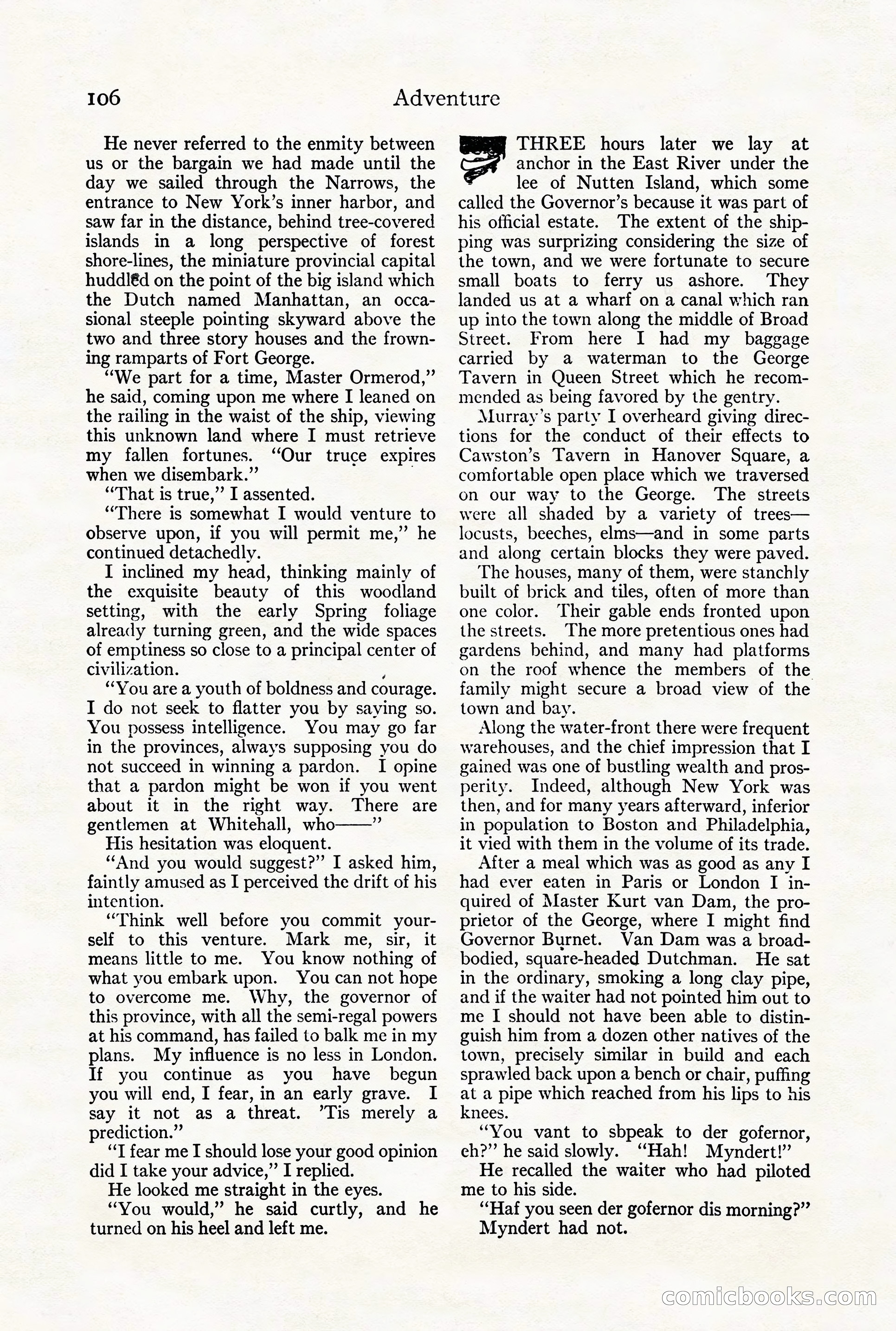
A restored page from Pulp Fiction, 1921. Page through the whole issue in the reader above.
📄 Transcribed text from this page (OCR, searchable)
Machine-transcribed from the original scan — historical spelling and the odd misread are preserved.
106 He never referred to the enmity between us or the bargain we had made until the day we sailed through the Narrows, the entrance to New York’s inner harbor, and saw far in the distance, behind tree-covered islands in a long perspective of forest shore-lines, the miniature provincial capital huddl€d on the point of the big island which the Dutch named Manhattan, an occa- sional steeple pointing skyward above the two and three story houses and the frown- ing ramparts of Fort George. ‘“‘We part for a time, Master Ormerod,” he said, coming upon me where I leaned on the railing in the waist of the ship, viewing this unknown land where I must retrieve my fallen fortunes. “Our truce expires when we disembark.” “That is true,” I assented. “There is somewhat I would venture to observe upon, if you will permit me,” he continued detachedly. I inclined my head, thinking mainly of the exquisite beauty of this woodland setting, with the early Spring foliage already turning green, and the wide spaces of emptiness so close to a principal center of civilization. ; ‘You are a youth of boldness and courage. I do not seek to flatter you by saying so. You possess intelligence. You may go far in the provinces, always supposing you do not succeed in winning a pardon. I opine that a pardon might be won if you went about it in the right way. There are gentlemen at Whitehall, who “ His hesitation was eloquent. ‘“‘And you would suggest?” I asked him, faintly amused as I perceived the drift of his intention. “Think well before you commit your- self to this venture. Mark me, sir, it means little to me. You know nothing of what you embark upon. You can not hope to overcome me. Why, the governor of this province, with all the semi-regal powers at his command, has failed to balk me in my plans. My influence is no less in London. If you continue as you have begun you will end, I fear, in an early grave. I say it not as a threat. ’Tis merely a prediction.” “‘T fear me I should lose your good opinion did I take your advice,’ I replied. He looked me straight in the eyes. “You would,” he said curtly, and he turned on his heel and left me. Adventure THREE hours later we lay at anchor in the East River under the lee of Nutten Island, which some called the Governor’s because it was part of his official estate. The extent of the ship- ping was surprizing considering the size of the town, and we were fortunate to secure small boats to ferry us ashore. They landed us at a wharf on a canal which ran up into the town along the middle of Broad Street. From here I had my baggage carried by a waterman to the George Tavern in Queen Street which he recom- mended as being favored by the gentry. Murray’s party I overheard giving direc- tions for the conduct of their effects to Cawston’s Tavern in Hanover Square, a comfortable open place which we traversed on our way to the George. The streets were all shaded by a variety of trees— locusts, beeches, elms—and in some parts and along certain blocks they were paved. The houses, many of them, were stanchly built of brick and tiles, often of more than one color. Their gable ends fronted upon the streets. The more pretentious ones had gardens behind, and many had platforms on the roof whence the members of the family might secure a broad view of the town and bay. Along the water-front there were frequent warehouses, and the chief impression that I gained was one of bustling wealth and pros- perity. Indeed, although New York was then, and for many years afterward, inferior in population to Boston and Philadelphia, it vied with them in the volume of its trade. After a meal which was as good as any I had ever eaten in Paris or London I in- quired of Master Kurt van Dam, the pro- prietor of the George, where I might find Governor Burnet. Van Dam was a broad- bodied, square-headed Dutchman. He sat in the ordinary, smoking a long clay pipe, and if the waiter had not pointed him out to me I should not have been able to distin- guish him from a dozen other natives of the town, precisely similar in build and each sprawled back upon a bench or chair, puffing at a pipe which reached from his lips to his knees. “You vant to sbpeak to der gofernor, eh?” he said slowly. “Hah! Myndert!” He recalled the waiter who had piloted me to his side. ‘“‘Haf you seen der gofernor dis morning?” Myndert had not. C© MICLOOKS ©