
Pulp Fiction, 1921 · page 111 of 200
Adventure Magazine Cover, August 18, 1921 — page 111: what you’re looking at
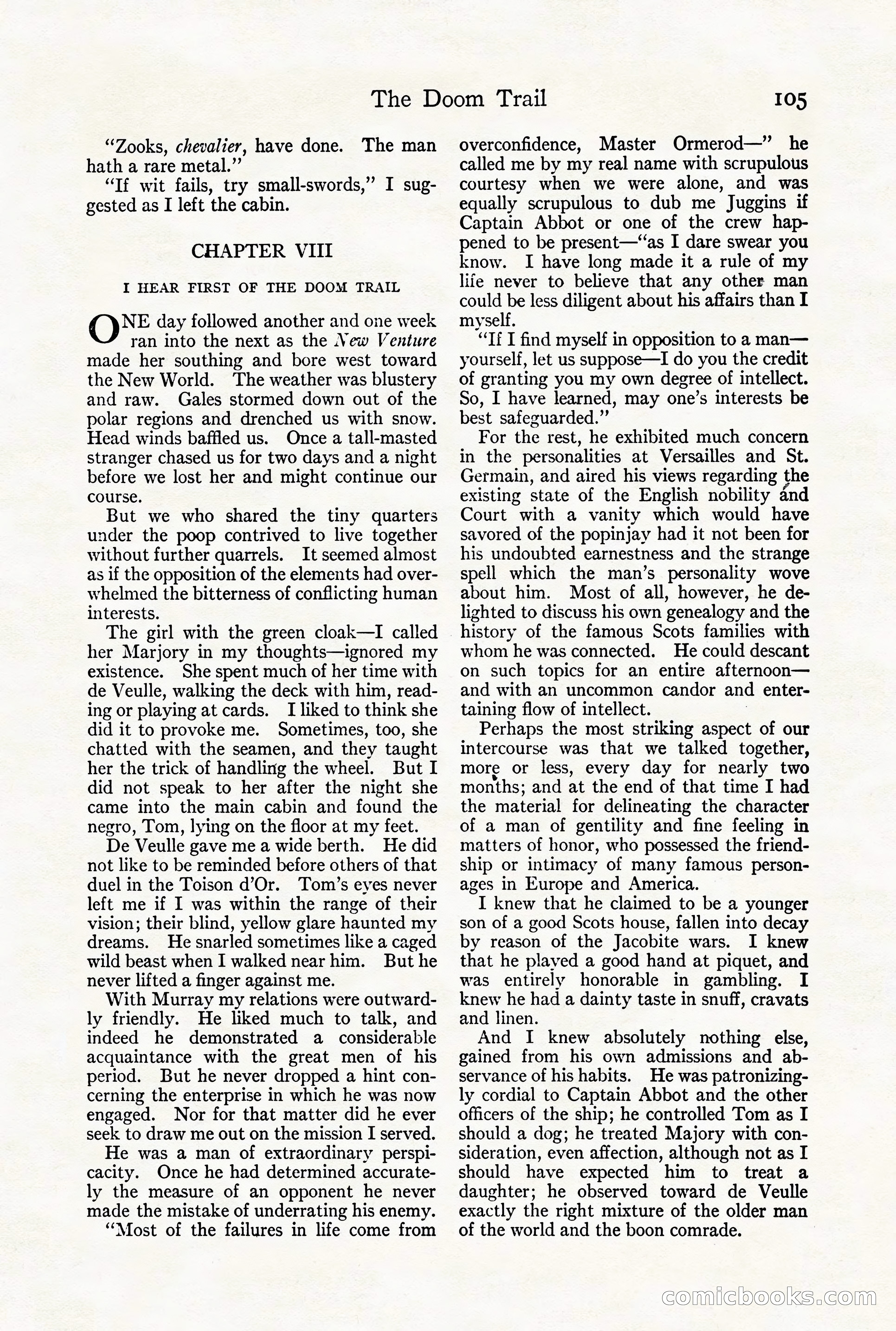
A restored page from Pulp Fiction, 1921. Page through the whole issue in the reader above.
📄 Transcribed text from this page (OCR, searchable)
Machine-transcribed from the original scan — historical spelling and the odd misread are preserved.
The Doom Trail “Zooks, chevalier, have done. The man hath a rare metal.” “Tf wit fails, try small-swords,” I sug- gested as I left the cabin. CHAPTER VIII I HEAR FIRST OF THE DOOM TRAIL Q)NE day followed another and one week ran into the next as the Vew Venture made her southing and bore west toward the New World. The weather was blustery and raw. Gales stormed down out of the polar regions and drenched us with snow. Head winds baffled us. Once a tall-masted stranger chased us for two days and a night before we lost her and might continue our course. But we who shared the tiny quarters under the poop contrived to live together without further quarrels. It seemed almost as if the opposition of the elements had over- whelmed the bitterness of conflicting human interests. The girl with the green cloak—I called her Marjory in my thoughts—ignored my existence. She spent much of her time with de Veulle, walking the deck with him, read- ing or playing at cards. I liked to think she did it to provoke me. Sometimes, too, she chatted with the seamen, and they taught her the trick of handling the wheel. But I did not speak to her after the night she came into the main cabin and found the negro, Tom, lying on the floor at my feet. De Veulle gave me a wide berth. He did not like to be reminded before others of that duel in the Toison d’Or. Tom’s eves never left me if I was within the range of their vision; their blind, yellow glare haunted my dreams. He snarled sometimes like a caged wild beast when I walked near him. But he never lifted a finger against me. With Murray my relations were outward- ly friendly. He liked much to talk, and indeed he demonstrated a_ considerable acquaintance with the great men of his period. But he never dropped a hint con- cerning the enterprise in which he was now engaged. Nor for that matter did he ever seek to draw me out on the mission I served. He was a man of extraordinary perspi- cacity. Once he had determined accurate- ly the measure of an opponent he never made the mistake of underrating his enemy. “Most of the failures in life come from 105 overconfidence, Master Ormerod—” he called me by my real name with scrupulous courtesy when we were alone, and was equally scrupulous to dub me Juggins if Captain Abbot or one of the crew hap- pened to be present—‘‘as I dare swear you know. I have long made it a rule of my liie never to believe that any other man could be less diligent about his affairs than I myself. “Tf I find myself in opposition to a man— yourself, let us suppose—I do you the credit of granting you my own degree of intellect. So, I have learned, may one’s interests be best safeguarded.” For the rest, he exhibited much concern in the personalities at Versailles and St. Germain, and aired his views regarding the existing state of the English nobility and Court with a vanity which would have savored of the popinjay had it not been for his undoubted earnestness and the strange spell which the man’s personality wove about him. Most of all, however, he de- lighted to discuss his own genealogy and the history of the famous Scots families with whom he was connected. He could descant on such topics for an entire afternoon— and with an uncommon candor and enter- taining flow of intellect. Perhaps the most striking aspect of our intercourse was that we talked together, more or less, every day for nearly two months; and at the end of that time I had the material for delineating the character of a man of gentility and fine feeling in matters of honor, who possessed the friend- ship or intimacy of many famous person- ages in Europe and America. I knew that he claimed to be a younger son of a good Scots house, fallen into decay by reason of the Jacobite wars. I knew that he plaved a good hand at piquet, and was entirely honorable in gambling. I knew he had a dainty taste in snuff, cravats and linen. And I knew absolutely nothing else, gained from his own admissions and ab- servance of his habits. He was patronizing- ly cordial to Captain Abbot and the other officers of the ship; he controlled Tom as I should a dog; he treated Majory with con- sideration, even affection, although not as I should have expected him to treat a daughter; he observed toward de Veulle exactly the right mixture of the older man of the world and the boon comrade. CoMmicbhook C©