
Pulp Fiction, 1921 · page 73 of 204
Adventure Magazine Cover — page 73: what you’re looking at
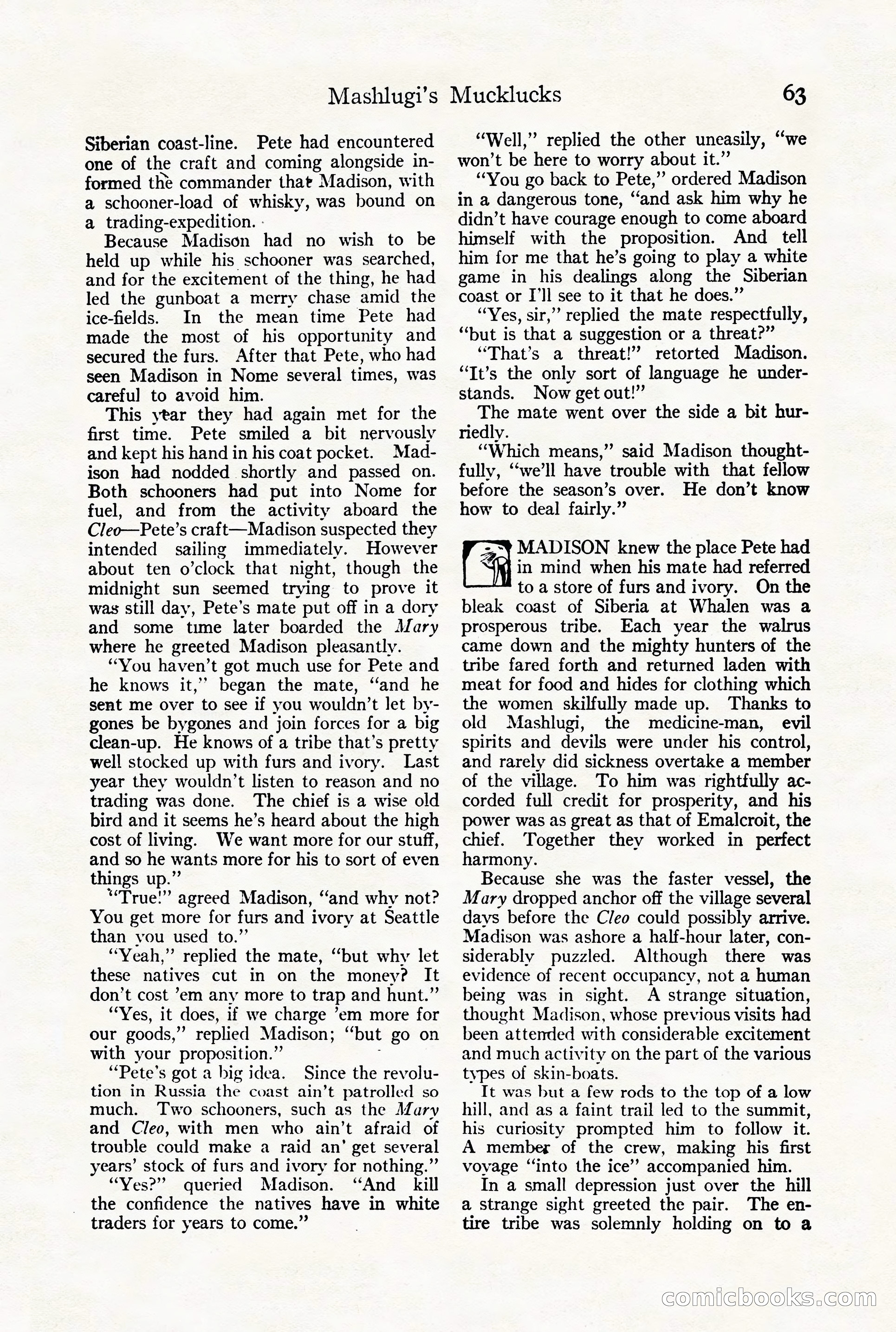
A restored page from Pulp Fiction, 1921. Page through the whole issue in the reader above.
📄 Transcribed text from this page (OCR, searchable)
Machine-transcribed from the original scan — historical spelling and the odd misread are preserved.
Mashlugi’s Siberian coast-line. Pete had encountered one of the craft and coming alongside in- formed the commander that Madison, with a schooner-load of whisky, was bound on a trading-expedition. - Because Madison had no wish to be held up while his schooner was searched, and for the excitement of the thing, he had led the gunboat a merry chase amid the ice-fields. In the mean time Pete had made the most of his opportunity and secured the furs. After that Pete, who had seen Madison in Nome several times, was careful to avoid him. This year they had again met for the first time. Pete smiled a bit nervously and kept his hand in his coat pocket. Mad- ison had nodded shortly and passed on. Both schooners had put into Nome for fuel, and from the activity aboard the Cleo—Pete’s craft—Madison suspected they intended sailing immediately. However about ten o’clock that night, though the midnight sun seemed trying to prove it was still day, Pete’s mate put off in a dory and some time later boarded the Mary where he greeted Madison pleasantly. “You haven’t got much use for Pete and he knows it,” began the mate, “and he sent me over to see if you wouldn’t let by- gones be bygones and join forces for a big clean-up. He knows of a tribe that’s pretty well stocked up with furs and ivory. Last year they wouldn’t listen to reason and no trading was done. The chief is a wise old bird and it seems he’s heard about the high cost of living. We want more for our stuff, and so he wants more for his to sort of even things up.” “True!” agreed Madison, “and why not? You get more for furs and ivory at Seattle than vou used to.”’ “Yeah,” replied the mate, “but why let these natives cut in on the money? It don’t cost ’em any more to trap and hunt.” “Yes, it does, if we charge ’em more for our goods,” replied Madison; “but go on with your proposition.” ‘Pete's got a big idea. Since the revolu- tion in Russia the coast ain’t patrolled so much. Two schooners, such as the Mary and Cleo, with men who ain’t afraid of trouble could make a raid an’ get several years’ stock of furs and ivory for nothing.” “Ves?” queried Madison. ‘And _ kill the confidence the natives have in white traders for years to come.” Mucklucks 63 “Well,” replied the other uneasily, “we won’t be here to worry about it.”’ “You go back to Pete,” ordered Madison in a dangerous tone, “and ask him why he didn’t have courage enough to come aboard himself with the proposition. And tell him for me that he’s going to play a white game in his dealings along the Siberian coast or I'll see to it that he does.” “Yes, sir,” replied the mate respectfully, “but is that a suggestion or a threat?” “That’s a threat!” retorted Madison. “Tt’s the only sort of language he under- stands. Now get out!” The mate went over the side a bit hur- riedly. “Which means,” said Madison thought- fully, ‘‘we’ll have trouble with that fellow before the season’s over. He don’t know how to deal fairly.” MADISON knew the place Pete had ta in mind when his mate had referred ™ to a store of furs and ivory. On the bleak coast of Siberia at Whalen was a prosperous tribe. Each year the walrus came down and the mighty hunters of the tribe fared forth and returned laden with meat for food and hides for clothing which the women skilfully made up. Thanks to old Mashlugi, the medicine-man, evil spirits and devils were under his control, and rarely did sickness overtake a member of the village. To him was rightfully ac- corded full credit for prosperity, and his power was as great as that of Emalcroit, the chief. Together they worked in perfect harmony. Because she was the faster vessel, the Mary dropped anchor off the village several days before the Cleo could possibly arrive. Madison was ashore a half-hour later, con- siderably puzzled. Although there was evidence of recent occupancy, not a human being was in sight. A strange situation, thought Madison, whose previous visits had been attended with considerable excitement and much activity on the part of the various types of skin-boats. It was but a few rods to the top of a low hill, and as a faint trail led to the summit, his curiosity prompted him to follow it. A member of the crew, making his first vovage “into the ice’? accompanied him. In a small depression just over the hill a strange sight greeted the pair. The en- tire tribe was solemnly holding on to a cComicloooks C©