
Pulp Fiction, 1921 · page 198 of 204
Adventure Magazine Cover — page 198: what you’re looking at
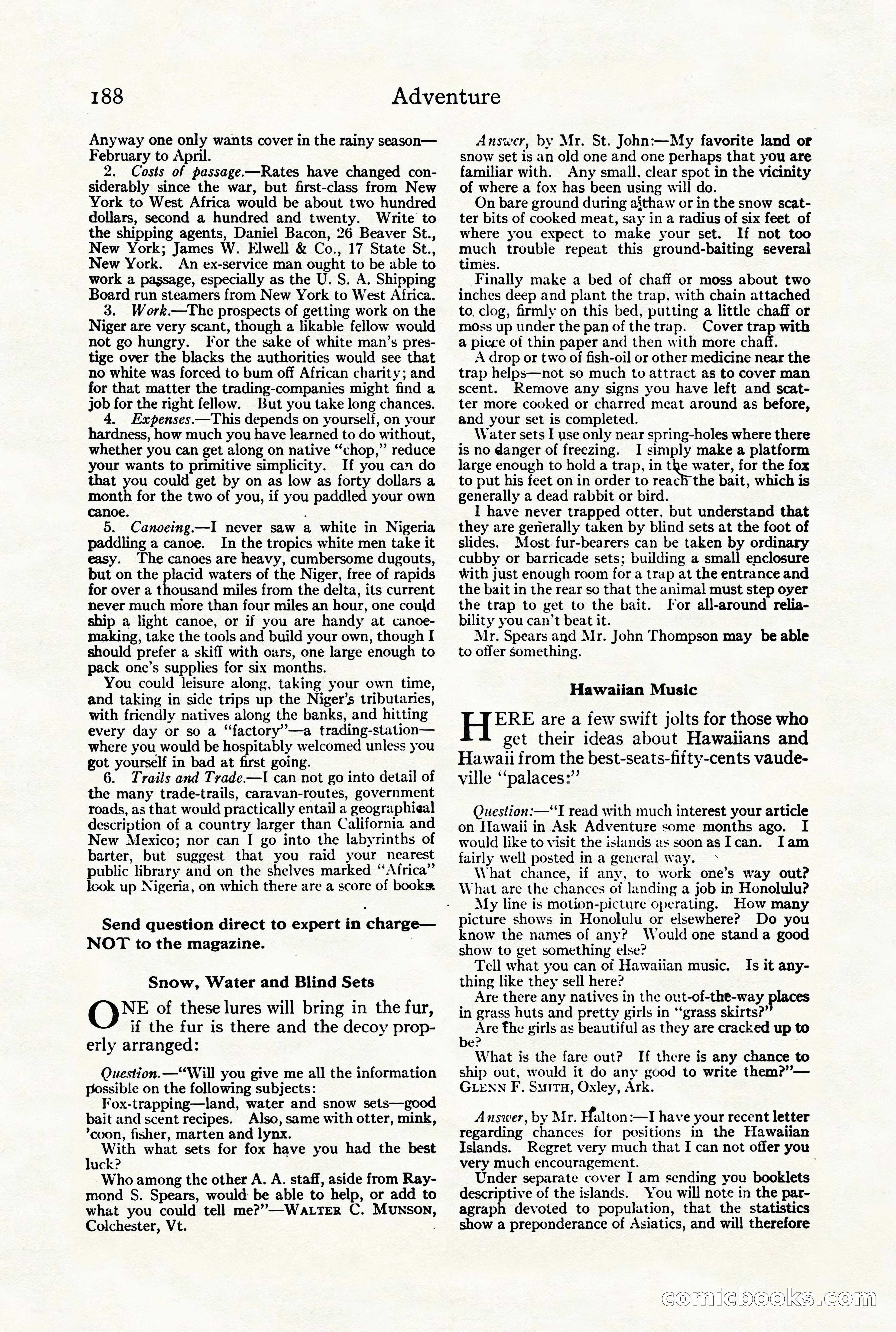
A restored page from Pulp Fiction, 1921. Page through the whole issue in the reader above.
📄 Transcribed text from this page (OCR, searchable)
Machine-transcribed from the original scan — historical spelling and the odd misread are preserved.
188 Anyway one only wants cover in the rainy season— February to Apnil. 2. Costs of passage.—Rates have changed con- siderably since the war, but first-class from New York to West Africa would be about two hundred dollars, second a hundred and twenty. Write to the shipping agents, Daniel Bacon, 26 Beaver St., New York; James W. Elwell & Co., 17 State St., New York. An ex-service man ought to be able to work a passage, especially as the U. S. A. Shipping Board run steamers from New York to West Africa. 3. Work.—The prospects of getting work on the Niger are very scant, though a likable fellow would not go hungry. For the sake of white man’s pres- tige over the blacks the authorities would see that no white was forced to bum off African charity; and for that matter the trading-companies might find a job for the right fellow. But you take long chances. 4. Expenses.—This depends on yourself, on your hardness, how much you have learned to do without, whether you can get along on native ‘“‘chop,”’ reduce your wants to primitive simplicity. If you can do that you could get by on as low as forty dollars a month for the two of you, if you paddled your own canoe. 5. Canoeing—lI never saw a white in Nigeria paddling a canoe. In the tropics white men take it easy. The canoes are heavy, cumbersome dugouts, but on the placid waters of the Niger, free of rapids for over a thousand miles from the delta, its current never much more than four miles an hour, one could ship a light canoe, or if you are handy at canoe- making, take the tools and build your own, though I should prefer a skiff with oars, one large enough to pack one’s supplies for six months. You could leisure along, taking your own time, and taking in side trips up the Niger’s tributaries, with friendly natives along the banks, and hitting every day or so a “factory”—a trading-station— where you would be hospitably welcomed unless you got yourself in bad at first going. 6. Trails and Trade.—I can not go into detail of the many trade-trails, caravan-routes, government roads, as that would practically entail a geographieal description of a country larger than California and New Mexico; nor can I go into the labyrinths of barter, but suggest that you raid your nearest public library and on the shelves marked “Africa” look up Nigeria, on which there are a score of books. Send question direct to expert in charge— NOT to the magazine. 7 Snow, Water and Blind Sets ‘pe of these lures will bring in the fur, if the fur is there and the decoy prop- erly arranged: Question. —“Will you give me all the information possible on the following subjects: Fox-trapping—land, water and snow sets—good bait and scent recipes. Also, same with otter, mink, ’coon, fisher, marten and lynx. With what sets for fox have you had the best luck? Who among the other A. A. staff, aside from Ray- mond S. Spears, would be able to help, or add to what you could tell me?”—WaLTER C. MUNSON, Colchester, Vt. ; Adventure Answer, by Mr. St. John:—My favorite land or snow set is an old one and one perhaps that you are familiar with. Any small, clear spot in the vicinity of where a fox has been using will do. On bare ground during ajthaw or in the snow scat- ter bits of cooked meat, say in a radius of six feet of where you expect to make your set. If not too much trouble repeat this ground-baiting several times. Finally make a bed of chaff or moss about two inches deep and plant the trap, with chain attached to. clog, firmly on this bed, putting a little chaff or moss up under the pan of the trap. Cover trap with a piece of thin paper and then with more chaff. A drop or two of fish-oil or other medicine near the trap helps—not so much to attract as to cover man scent. Remove any signs you have left and scat- ter more cooked or charred meat around as before, and your set is completed. Water sets I use only near spring-holes where there is no danger of freezing. I simply make a platform large enough to hold a trap, in the water, for the fox to put his feet on in order to reach the bait, which is generally a dead rabbit or bird. I have never trapped otter, but understand that they are generally taken by blind sets at the foot of slides. Most fur-bearers can be taken by ordinary cubby or barricade sets; building a small enclosure With just enough room for a trap at the entrance and the bait in the rear so that the animal must step oyer the trap to get to the bait. For all-around relia- bility you can't beat it. Mr. Spears and Mr. John Thompson may be able to offer Something. Hawaiian Music ERE are a few swift jolts for those who get their ideas about Hawaiians and Hawaii from the best-seats-fifty-cents vaude- ville ‘‘palaces:” Question: —“I read with much interest your article on Hawaii in. Ask Adventure some months ago. I would like to visit the islands as soonasIcan. Iam fairly well posted in a general way. What chance, if any, to work one’s way out? What are the chances of landing a job in Honolulu? My line is motion-picture operating. How many picture shows in Honolulu or elsewhere? Do you know the names of any? Would one stand a good show to get something else? Tell what you can of Hawaiian music. thing like they sell here? Are there any natives in the out-of-the-way places in grass huts and pretty girls in ‘‘grass skirts?” : Are the girls as beautiful as they are cracked up to e? What is the fare out? If there is any chance to ship out, would it do any good to write them?”— GLENN F. Suitu, Oxley, Ark. Ts it any- Answer, by Mr. Halton:—I have your recent letter regarding chances for positions in the Hawaiian Islands. very much encouragement. Under separate cover I am sending you booklets descriptive of the islands. You will note in the par- agraph devoted to population, that the statistics show a preponderance of Asiatics, and will therefore CO Regret very much that I can not offer you MICLOOKS C©