
Pulp Fiction, 1921 · page 197 of 204
Adventure Magazine Cover — page 197: what you’re looking at
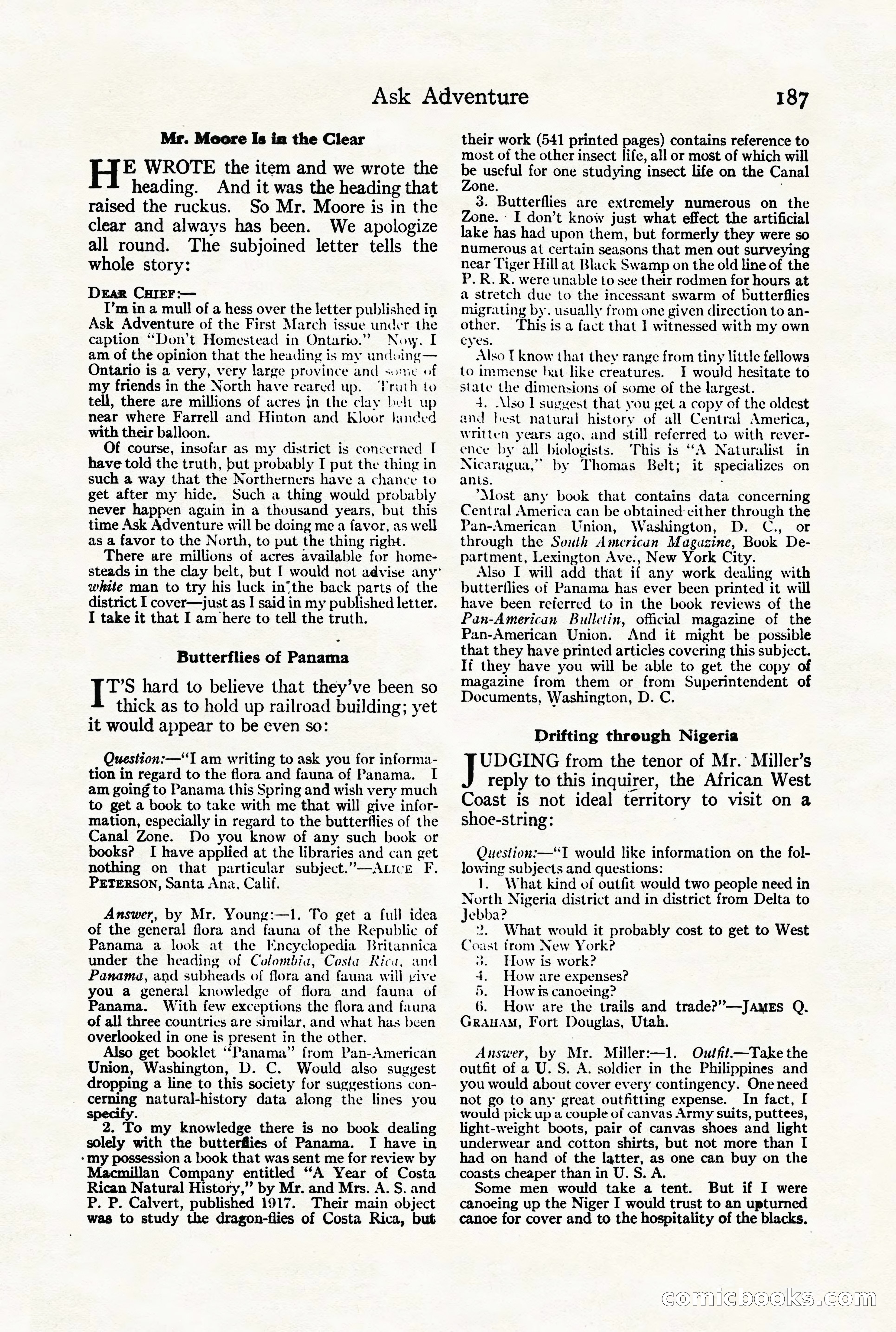
A restored page from Pulp Fiction, 1921. Page through the whole issue in the reader above.
📄 Transcribed text from this page (OCR, searchable)
Machine-transcribed from the original scan — historical spelling and the odd misread are preserved.
Ask Adventure Mr. Moore Is in the Clear E WROTE the item and we wrote the heading. And it was the heading that raised the ruckus. So Mr. Moore is in the clear and always has been. We apologize all round. The subjoined letter tells the whole story: DEAR CHIEF :— I’m in a mull of a hess over the letter published in Ask Adventure of the First March issue under the caption ‘Don't Homestead in Ontario.” Noy. I am of the opinion that the heading is my undving— Ontario is a very, very large province and some of my friends in the North have reared up. Truth to tell, there are millions of acres jn the clay belt up near where Farrell and Hinton and Klvoor Janded with their balloon. Of course, insofar as my district is concerned I have told the truth, but probably T put the thing in such a way that the Northerners have a chance to get after my hide. Such a thing would probably never happen again in a thousand years, but this time Ask Adventure will be doing me a favor, as well as a favor to the North, to put the thing right. There are millions of acres available for home- steads in the clay belt, but I would not advise any’ white man to try his luck inthe back parts of the district I cover—just as I said in my published letter. I take it that I am here to tell the truth. . Butterflies of Panama T’S hard to believe that they’ve been so thick as to hold up railroad building; yet it would appear to be even so: Question: —“I am writing to ask you for informa- tion in regard to the flora and fauna of Panama. I am going to Panama this Spring and wish very much to get a book to take with me that will give infor- mation, especially in regard to the butterflies of the Canal Zone. Do you know of any such book or books? I have applied at the libraries and can get nothing on that particular subject.”—ALice F. PETERSON, Santa Ana, Calif. Answer, by Mr. Young:—1. To get a full idea of the general flora and fauna of the Republic of Panama a look at the [Encyclopedia Britannica under the heading of Colombia, Costa’ Rica, and Panama, and subheads of flora and fauna will vive you a general knowledge of flora and fauna of Panama. With few exceptions the flora and fauna of all three countries are similar, and what has been overlooked in one is present in the other. Also get booklet “Panama” from Pan-American Union, Washington, D. C. Would also suggest dropping a line to this society for suggestions con- cerning natural-history data along the lines you S : 2. To my knowledge there is no book dealing solely with the butterflies of Panama. I have in ‘my possession a book that was sent me for review by illan Company entitled “A Year of Costa Rican Natural History,” by Mr. and Mrs. A. S. and P. P. Calvert, published 1917. Their main object was to study the dragon-tlies of Costa Rica, but 187 their work (541 printed pages) contains reference to most of the other insect life, all or most of which will ee useful for one studying insect life on the Canal ne, 3. Butterflies are extremely numerous on the Zone. - I don’t know just what effect the artificial lake has had upon them, but formerly they were so numerous at certain seasons that men out surveying near Tiger Hill at Black Swamp on the old line of the P. R. R. were unable to see their rodmen for hours at a stretch due to the incessant swarm of butterflies migrating by. usually from one given direction to an- other. This is a fact that I witnessed with my own cyes. Also T know that they range from tiny little fellows to immense bat like creatures. I would hesitate to state the dimensions of some of the largest. 4. Also 1] sugvest that you get a copy of the oldest and best natural history of all Central America, Written years ago, and still referred to with rever- ence by all biologists. This is ‘‘A Naturalist in Nicaragua,” by Thomas Belt; it specializes on ants. "Most any book that contains data concerning Central America can be obtained: cither through the Pan-American Union, Washington, D. C., or through the South American Magazine, Book De- partment, Lexington Ave., New York City. Also I will add that if any work dealing with butterflies of Panama has ever been printed it will have been referred to in the book reviews of the Pan-American Bulletin, official magazine of the Pan-American Union. And it might be possible that they have printed articles covering this subject. If they have you will be able to get the copy of magazine from them or from Superintendent of Documents, Washington, D. C. Drifting through Nigeria UDGING from the tenor of Mr. Miller’s reply to this inquirer, the African West Coast is not ideal territory to visit on a shoe-string: Question: —“T would like information on the fol- lowing subjects and questions: 1. What kind of outfit would two people need in North Nigeria district and in district from Delta to Jebba? 2. What would it probably cost to get to West Coast from New Yorke 3. How is work? 4. How are expenses? 5. Hows canoeing? 6. How are the trails and trade?”—JameEs Q. GRaAuAM, Fort Douglas, Utah. Answer, by Mr. Miller:—1. Outfit.—Take the outfit of a U. S. A. soldier in the Philippines and you would about cover every contingency. One need not go to any great outfitting expense. In fact, I would pick up a couple of canvas Army suits, puttees, light-weight boots, pair of canvas shoes and light underwear and cotton shirts, but not more than I had on hand of the latter, as one can buy on the coasts cheaper than in U.S. A. Some men would take a tent. But if I were canoeing up the Niger I would trust to an upturned canoe for cover and to the hospitality of the blacks. CO MICLOOKS ©