
Pulp Fiction, 1921 · page 132 of 204
Adventure Magazine Cover — page 132: what you’re looking at
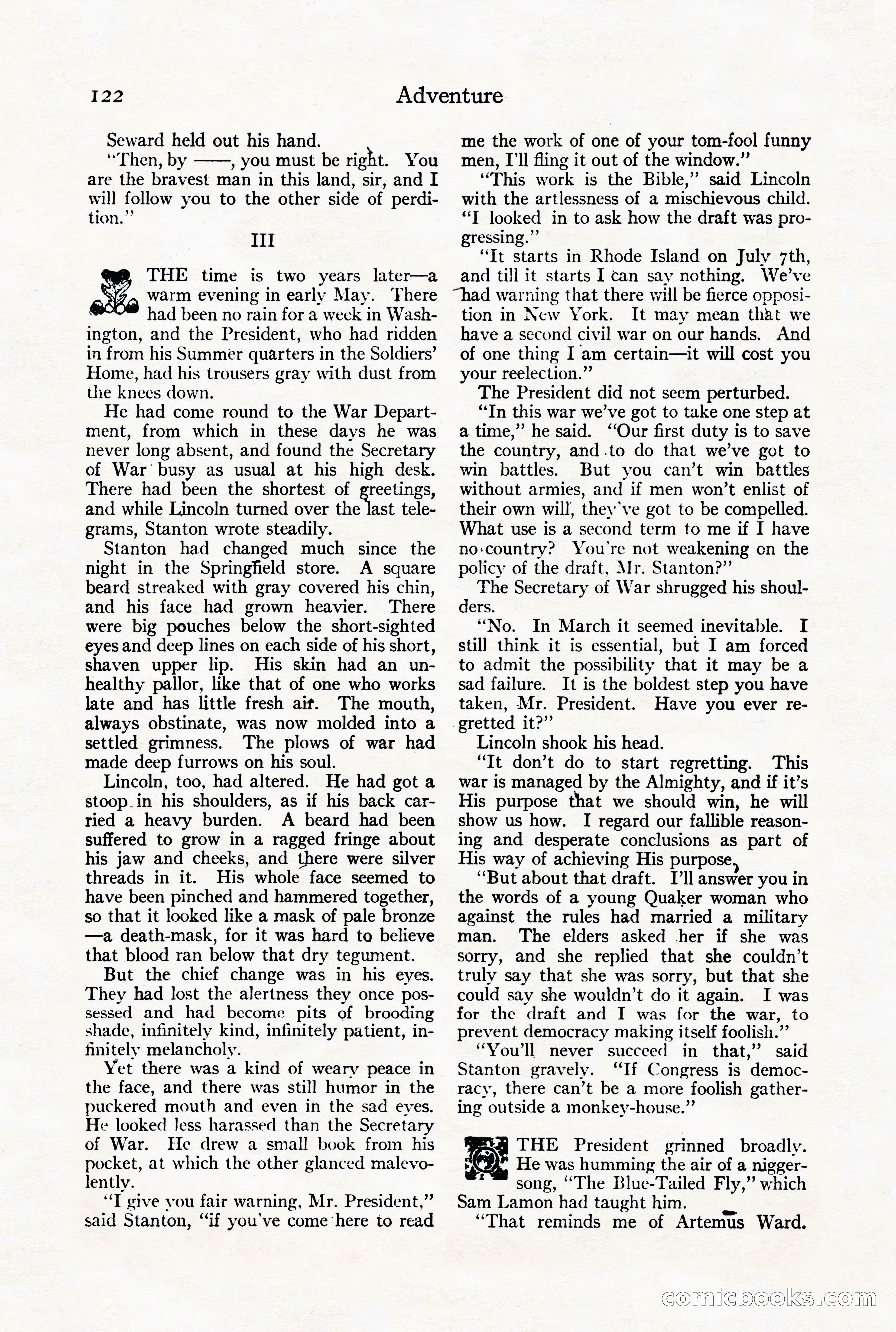
A restored page from Pulp Fiction, 1921. Page through the whole issue in the reader above.
📄 Transcribed text from this page (OCR, searchable)
Machine-transcribed from the original scan — historical spelling and the odd misread are preserved.
122 Seward held out his hand. ‘Then, by , you must be right. You are the bravest man in this land, sir, and I will follow you to the other side of perdi- tion.” Ill THE time is two years later—a warm evening in early May. There had been no rain for a week in Wash- ington, and the President, who had ridden in from his Summer quarters in the Soldiers’ Home, had his trousers gray with dust from the knees down. He had come round to the War Depart- ment, from which in these days he was never long absent, and found the Secretary of War’ busy as usual at his high desk. There had been the shortest of greetings, and while Lincoln turned over the last tele- grams, Stanton wrote steadily. Stanton had changed much since the night in the Springfield store. A square beard streaked with gray covered his chin, and his face had grown heavier. There were big pouches below the short-sighted eyes and deep lines on each side of his short, shaven upper lip. His skin had an un- healthy pallor, like that of one who works late and has little fresh aif. The mouth, always obstinate, was now molded into a settled grimness. The plows of war had made deep furrows on his soul. Lincoln, too, had altered. He had got a stoop.in his shoulders, as if his back car- ried a heavy burden. A beard had been suffered to grow in a ragged fringe about his jaw and cheeks, and there were silver threads in it. His whole face seemed to have been pinched and hammered together, so that it looked like a mask of pale bronze —a death-mask, for it was hard to believe that blood ran below that dry tegument. But the chief change was in his eyes. They had lost the alertness they once pos- sessed and had become pits of brooding shade, infinitely kind, infinitely patient, in- finitely melancholy. Yet there was a kind of weary peace in the face, and there was still humor in the puckered mouth and even in the sad eves. He looked less harassed than the Secretary of War. He drew a small book from his pocket, at which the other glanced malevo- lently. ‘‘T orve vou fair warning, Mr. President,” said Stanton, “if you've come ‘here to read Adventure me the work of one of your tom-fool funny men, I'll fling it out of the window.” “This work is the Bible,” said Lincoln with the artlessness of a mischievous child. “JT looked in to ask how the draft was pro- gressing.”’ “Tt starts in Rhode Island on July 7th, and till it starts I can say nothing. We’ve “had warning that there will be fierce opposi- tion in New York. It may mean that we have a second civil war on our hands. And of one thing I am certain—it will cost you your reelection.” The President did not seem perturbed. “In this war we’ve got to take one step at a time,” he said. ‘Our first duty is to save the country, and .to do that we’ve got to win battles. But you can’t win battles without armies, and if men won’t enlist of their own will, they've got to be compelled. What use is a second term to me if I have no:country? You're not weakening on the policy of the draft, Mr. Stanton?” The Secretary of War shrugged his shoul- ders. “No. In March it seemed inevitable. I still think it is essential, but I am forced to admit the possibility that it may be a sad failure. It is the boldest step you have taken, Mr. President. Have you ever re- -gretted it?” Lincoln shook his head. “Tt don’t do to start regretting. This war is managed by the Almighty, and if it’s His purpose that we should win, he will show us how. I regard our fallible reason- ing and desperate conclusions as part of His way of achieving His purpose “But about that draft. Ill answer you in the words of a young Quaker woman who against the rules had married a military man. The elders asked her if she was sorry, and she replied that she couldn’t truly say that she was sorry, but that she could say she wouldn’t do it again. I was for the draft and I was for the war, to prevent democracy making itself foolish.” “You'll never succeed in that,” said Stanton gravely. “If Congress is democ- racy, there can’t be a more foolish gather- ing outside a monkey-house.”’ THE President grinned broadly. He was humming the air of a nigger- *™ song, “The Bluc-Tailed Fly,” which Sam Lamon had taught him. = “That reminds me of Artemus Ward. cCOmiclboolks CO