
Pulp Fiction, 1921 · page 131 of 204
Adventure Magazine Cover — page 131: what you’re looking at
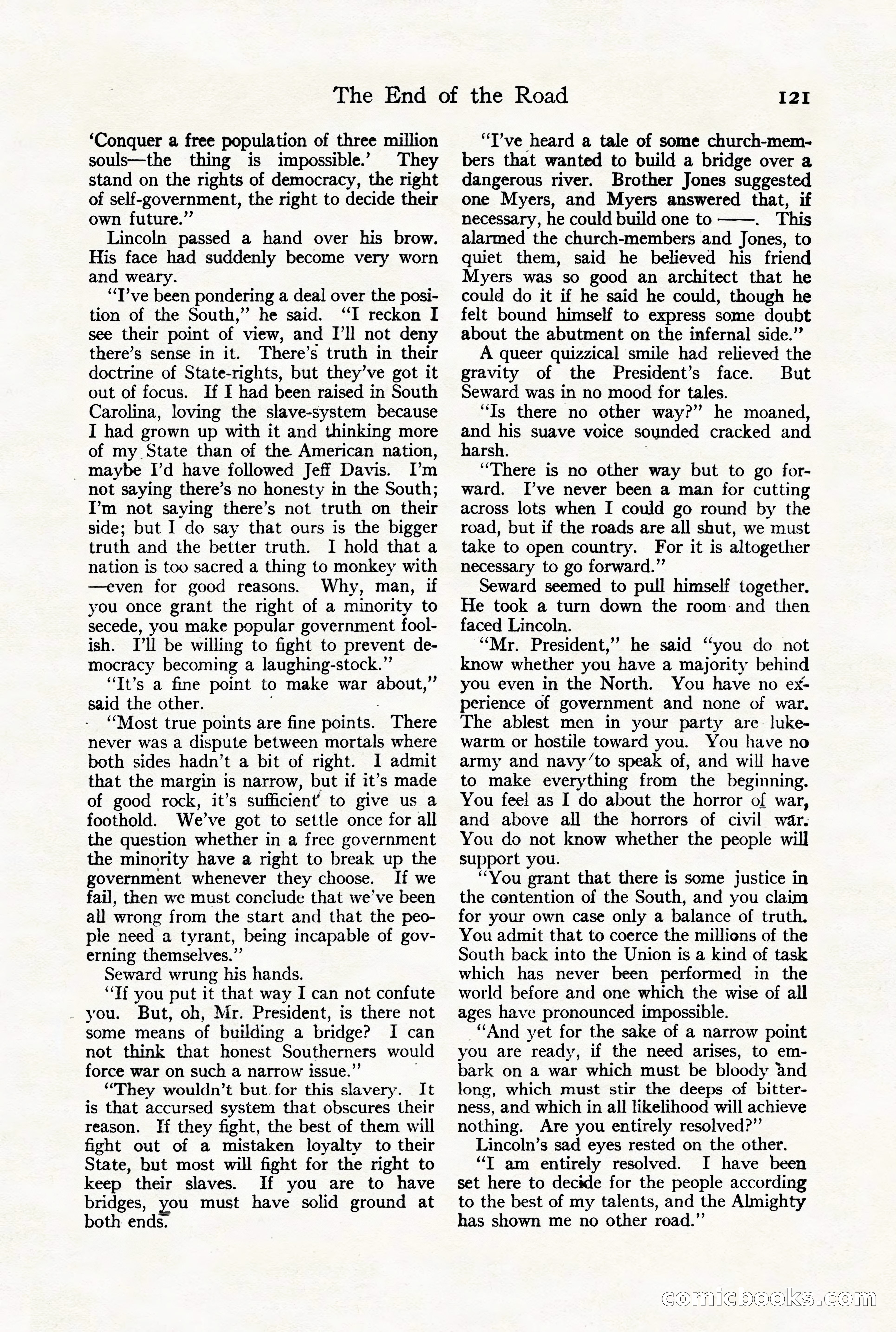
A restored page from Pulp Fiction, 1921. Page through the whole issue in the reader above.
📄 Transcribed text from this page (OCR, searchable)
Machine-transcribed from the original scan — historical spelling and the odd misread are preserved.
The End of the Road ‘Conquer a free population of three million souls—the thing is impossible.’ They stand on the rights of democracy, the right of self-government, the right to decide their own future.”’ Lincoln passed a hand over his brow. His face had suddenly become very worn and weary. “T’ve been pondering a deal over the posi- tion of the South,” he said. “I reckon I see their point of view, and I'll not deny there’s sense in it. There's truth in their doctrine of State-rights, but they’ve got it out of focus. If I had been raised in South Carolina, loving the slave-system because I had grown up with it and thinking more of my State than of the American nation, _ maybe I’d have followed Jeff Davis. I’m not saying there’s no honesty in the South; I’m not saying there’s not truth on their side; but I do say that ours is the bigger truth and the better truth. I hold that a nation is too sacred a thing to monkey with —even for good reasons. Why, man, if you once grant the right of a minority to secede, you make popular government fool- ish. Ill be willing to fight to prevent de- mocracy becoming a laughing-stock.”’ “Tt’s a fine point to make war about,” said the other. ‘Most true points are fine points: There never was a dispute between mortals where both sides hadn’t a bit of right. I admit that the margin is narrow, but if it’s made of good rock, it’s sufficient’ to give us a foothold. We've got to settle once for all the question whether in a free government the minority have a right to break up the government whenever they choose. If we fail, then we must conclude that we’ve been all wrong from the start and that the peo- ple need a tyrant, being incapable of gov- erning themselves.’ Seward wrung his hands. “Tf you put it that way I can not confute you. But, oh, Mr. President, is there not some means of building a bridge? I can not think that honest Southerners would force war on such a narrow issue.’ “They wouldn’t but for this slavery. It is that accursed system that obscures their reason. If they fight, the best of them will fight out of a mistaken loyalty to their State, but most will fight for the right to keep their slaves. If you are to have bridges, Pe must have solid ground at both end I21 “T’ve heard a tale of some church-mem- bers that wanted to build a bridge over a dangerous river. Brother Jones suggested one Myers, and Myers answered that, if necessary, he could build one to ——. This alarmed the church-members and Jones, to quiet them, said he believed his friend Myers was so good an architect that he could do it if he said he could, though he felt bound himself to express some doubt about the abutment on the infernal side.” A queer quizzical smile had relieved the gravity of the President’s face. But Seward was in no mood for tales. “Is there no other way?” he moaned, and his suave voice sounded cracked and harsh. ‘There is no other way but to go for- ward. I’ve never been a man for cutting across lots when I could go round by the road, but if the roads are all shut, we must take to open country. For it is altogether necessary to go forward.”’ Seward seemed to pull himself together. He took a turn down the room. and then faced Lincoln. “Mr. President,” he said “‘you do not know whether you have a majority behind you even in the North. You have no ex- perience of government and none of war. The ablest men in your party are luke- warm or hostile toward you. You have no army and navy‘to speak of, and will have to make everything from the beginning. You feel as I do about the horror of war, and above all the horrors of civil war. You do not know whether the people will support you. ‘You grant that there is some justice in the contention of the South, and you claim for your own case only a balance of truth. You admit that to coerce the millions of the South back into the Union is a kind of task which has never been performed in the world before and one which the wise of all ages have pronounced impossible. “And yet for the sake of a narrow point you are ready, if the need arises, to em- bark on a war which must be bloody and long, which must stir the deeps of bitter- ness, and which in all likelihood will achieve nothing. Are you entirely resolved?”’ Lincoln’s sad eyes rested on the other. “T am entirely resolved. I have been set here to decide for the people according to the best of my talents, and the Almighty has shown me no other read.” CoMmicbook C©