
Pulp Fiction, 1921 · page 129 of 204
Adventure Magazine Cover — page 129: what you’re looking at
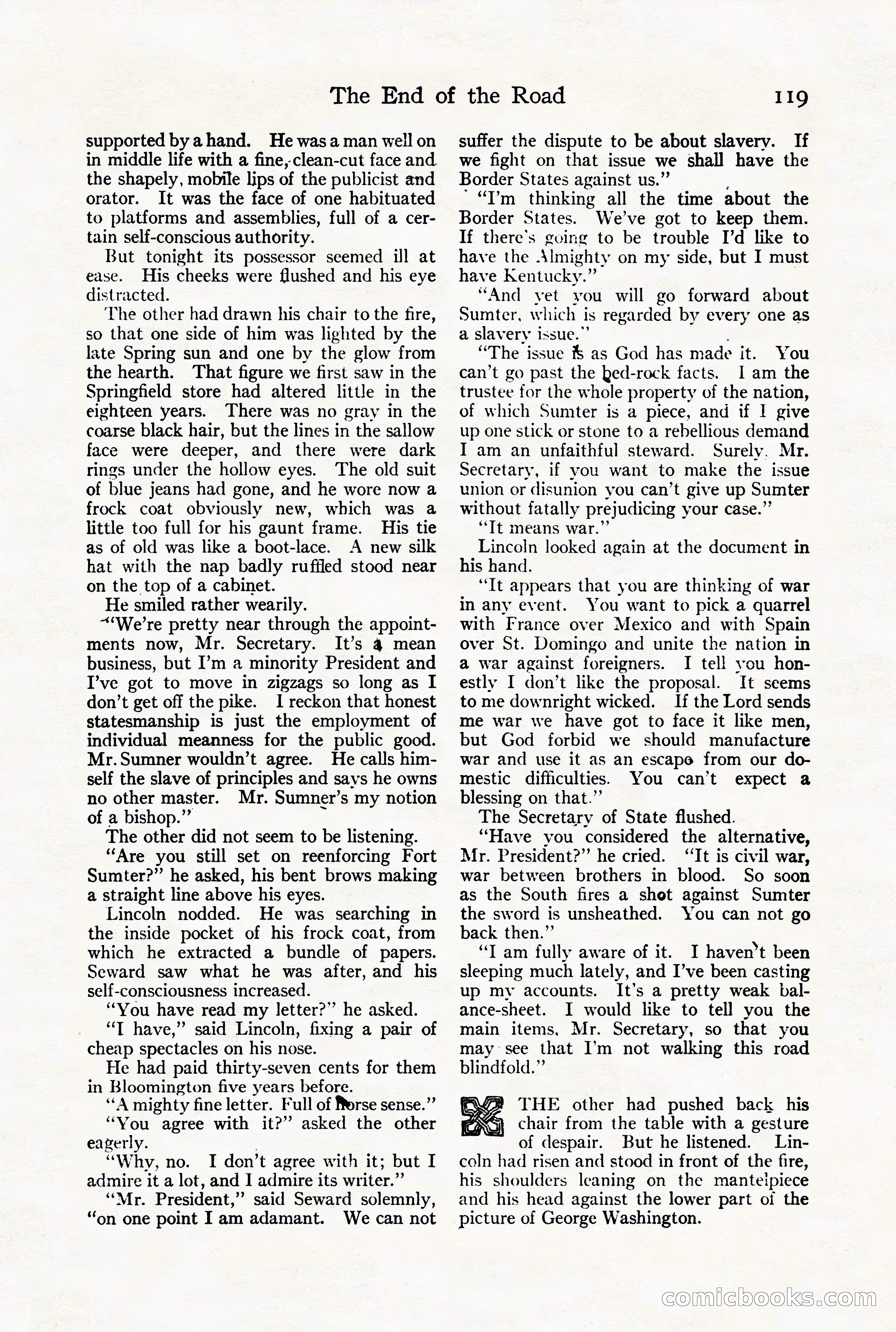
A restored page from Pulp Fiction, 1921. Page through the whole issue in the reader above.
📄 Transcribed text from this page (OCR, searchable)
Machine-transcribed from the original scan — historical spelling and the odd misread are preserved.
The End of the Road supported byahand. He wasaman well on in middle life with a fine,-clean-cut face and. the shapely, mobile lips of the publicist and orator. It was the face of one habituated to platforms and assemblies, full of a cer- tain self-conscious authority. But tonight its possessor seemed ill at ease. His cheeks were flushed and his eye distracted. The other had drawn his chair to the fire, so that one side of him was lighted by the late Spring sun and one by the glow from the hearth. That figure we first saw in the Springfield store had altered little in the eighteen years. There was no gray in the coarse black hair, but the lines in the sallow face were deeper, and there were dark rings under the hollow eyes. The old suit of blue jeans had gone, and he wore now a frock coat obviously new, which was a little too full for his gaunt frame. His tie as of old was like a boot-lace. A new silk hat with the nap badly ruffled stood near on the top of a cabinet. He smiled rather wearily. “‘We’re pretty near through the appoint- ments now, Mr. Secretary. It’s 4 mean business, but I’m a minority President and I’ve got to move in zigzags so long as I don’t get off the pike. I reckon that honest statesmanship is just the employment of individual meanness for the public good. Mr.Sumner wouldn’t agree. He calls him- self the slave of principles and savs he owns no other master. Mr. Sumner’s my notion of a bishop.” The other did not seem to be listening. “Are you still set on reenforcing Fort Sumter?” he asked, his bent brows making a straight line above his eyes. Lincoln nodded. He was searching in the inside pocket of his frock coat, from which he extracted a bundle of papers. Seward saw what he was after, and his self-consciousness increased. “You have read my letter?” he asked. “T have,” said Lincoln, fixing a pair of cheap spectacles on his nose. He had paid thirty-seven cents for them in Bloomington five years before. ‘‘A mighty fine letter. Full of Rerse sense.’ “You agree with it?” asked the Be eagerly. “Why, no. I don’t agree with it; but I admire it a lot, and I admire its writer.” “Mr. President,’’ said Seward solemnly, “on one point Iam adamant. We can not 119 suffer the dispute to be about slavery. If we fight on that issue we shall have the Border States against us.’ ’ “I’m thinking all the time about the Border States. We've got to keep them. If there’s going to be trouble I’d like to have the Almighty on my side, but I must have Kentucky.” “And vet you will go forward about Sumter, which is regarded by every one as a slavery issue.’ “The issue & as God has made it. You can’t go past the ked-rock facts. Iam the trustee tor the whole property of the nation, of which Sumter is a piece, and if I give up one stick or stone to a rebellious demand I am an unfaithful steward. Surely. Mr. Secretary, if you want to make the issue union or disunion you can’t give up Sumter without fatally prejudicing your case.” “Tt means war.” Lincoln looked again at the document in his hand. ‘It appears that you are thinking of war In any event. You want to pick a quarrel with France over Mexico and with Spain over St. Domingo and unite the nation in a war against foreigners. I tell you hon- estly I don’t like the proposal. It seems to me downright wicked. If the Lord sends me war we have got to face it like men, but God forbid we should manufacture war and use it as an escape from our do- mestic difficulties. You can’t expect a blessing on that.” The Secretary of State flushed. “Have you considered the alternative, Mr. President?” he cried. “It is civil war, war between brothers in blood. So soon as the South fires a shot against Sumter the sword is unsheathed. You can not go back then.” “T am fully aware of it. I haven’t been sleeping much lately, and I’ve been casting up my accounts. It’s a pretty weak bal- ance-sheet. I would like to tell you the main items, Mr. Secretary, so that you may see that I’m not walking this road blindfold.” THE other had pushed back his chair from the table with a gesture of despair. But he listened. Lin- coln had risen and stood in front of the fire, his shoulders leaning on the manteipiece and his head against the lower part oi the picture of George Washington. Ay iz CO MICLOOKS C©