
Pulp Fiction, 1921 · page 128 of 204
Adventure Magazine Cover — page 128: what you’re looking at
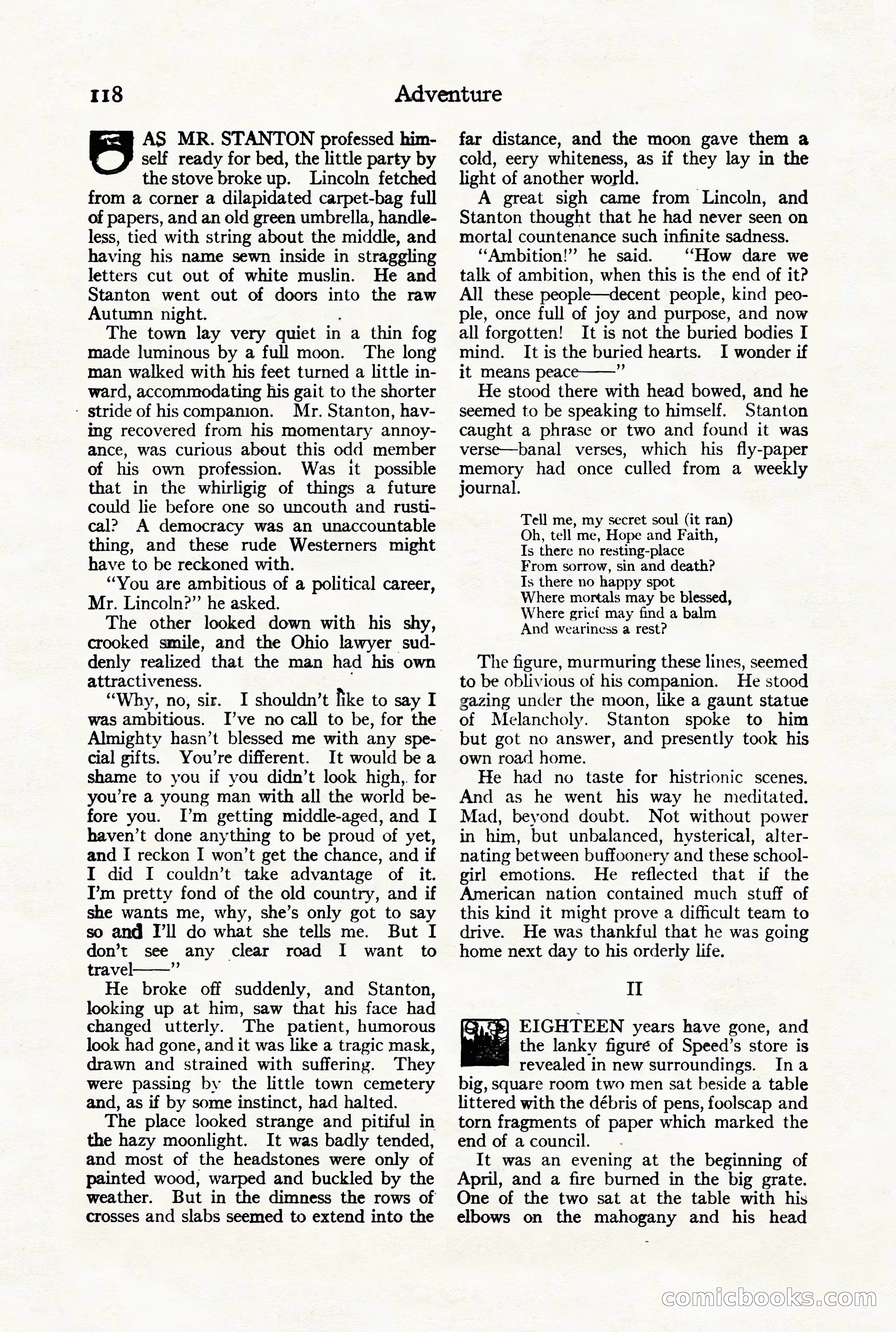
A restored page from Pulp Fiction, 1921. Page through the whole issue in the reader above.
📄 Transcribed text from this page (OCR, searchable)
Machine-transcribed from the original scan — historical spelling and the odd misread are preserved.
118 AS MR. STANTON professed him- self ready for bed, the little party by the stove broke up. Lincoln fetched from a corner a dilapidated carpet-bag full of papers, and an old green umbrella, handle- less, tied with string about the middle, and having his name sewn inside in straggling letters cut out of white muslin. He and Stanton went out of doors into the raw Autumn night. : The town lay very quiet in a thin fog made luminous by a full moon. The long man walked with his feet turned a little in- ward, accommodating his gait to the shorter - stride of his companion. Mr. Stanton, hav- mg recovered from his momentary annoy- ance, was curious about this odd member of his own profession. Was it possible that in the whirligig of things a future could lie before one so uncouth and rusti- cal? A democracy was an unaccountable thing, and these rude Westerners might have to be reckoned with. “You are ambitious of a political career, Mr. Lincoln?” he asked. The other looked down with his shy, crooked smile, and the Ohio lawyer sud- denly realized that the man had his own attractiveness. “Why, no, sir. I shouldn’t like to say I was ambitious. I’ve no call to be, for the Almighty hasn’t blessed me with any spe- cial gifts. You’re different. It would bea shame to you if you didn’t look high,. for you're a young man with all the world be- fore you. I’m getting middle-aged, and I haven’t done anything to be proud of yet, and I reckon I won’t get the chance, and if I did I couldn’t take advantage of it. I’m pretty fond of the old country, and if she wants me, why, she’s only got to say so and I’ll do what she tells me. But I don’t see any clear road I want to trave & He broke off suddenly, and Stanton, looking up at him, saw that his face had changed utterly. The patient, humorous look had gone, and it was like a tragic mask, drawn and strained with suffering. They were passing by the little town cemetery and, as if by some instinct, had halted. The place looked strange and pitiful in the hazy moonlight. It was badly tended, and most of the headstones were only of painted wood, warped and buckled by the weather. But in the dimness the rows of crosses and slabs seemed to extend into the Adventure far distance, and the moon gave them a cold, eery whiteness, as if they lay in the light of another world. A great sigh came from Lincoln, and Stanton thought that he had never seen on mortal countenance such infinite sadness. “Ambition!” he said. “How dare we talk of ambition, when this is the end of it? All these people—decent people, kind peo- ple, once full of joy and purpose, and now all forgotten! It is not the buried bodies I mind. It is the buried hearts. I wonder if it means peace——”’ He stood there with head bowed, and he seemed to be speaking to himself. Stanton caught a phrase or two and found it was verse—banal verses, which his fly-paper memory had once culled from a weekly journal. Tell me, my secret soul (it ran) Oh, tell me, Hope and Faith, Is there no resting-place From sorrow, sin and death? Is there no happy spot Where mortals may be blessed, Where grief may find a balm And weariness a rest? The figure, murmuring these lines, seemed to be oblivious of his companion. He stood gazing under the moon, like a gaunt statue of Melancholy. Stanton spoke to him but got no answer, and presently took his own road home. He had no taste for histrionic scenes. And as he went his way he meditated. Mad, beyond doubt. Not without power in him, but unbalanced, hysterical, alter- nating between buffoonery and these school- girl emotions. He reflected that if the American nation contained much stuff of this kind it might prove a difficult team to drive. He was thankful that he was going home next day to his orderly life. II 5 EIGHTEEN years have gone, and a the lanky figuré of Speed’s store is revealed in new surroundings. Ina big, square room two men sat beside a table littered with the débris of pens, foolscap and torn fragments of paper which marked the end of a council. It was an evening at the beginning of April, and a fire burned in the big grate. One of the two sat at the table with his elbows on the mahogany and his head cCOmicloolks (©