
Pulp Fiction, 1921 · page 173 of 200
Adventure Magazine Cover, February 3, 1921 — page 173: what you’re looking at
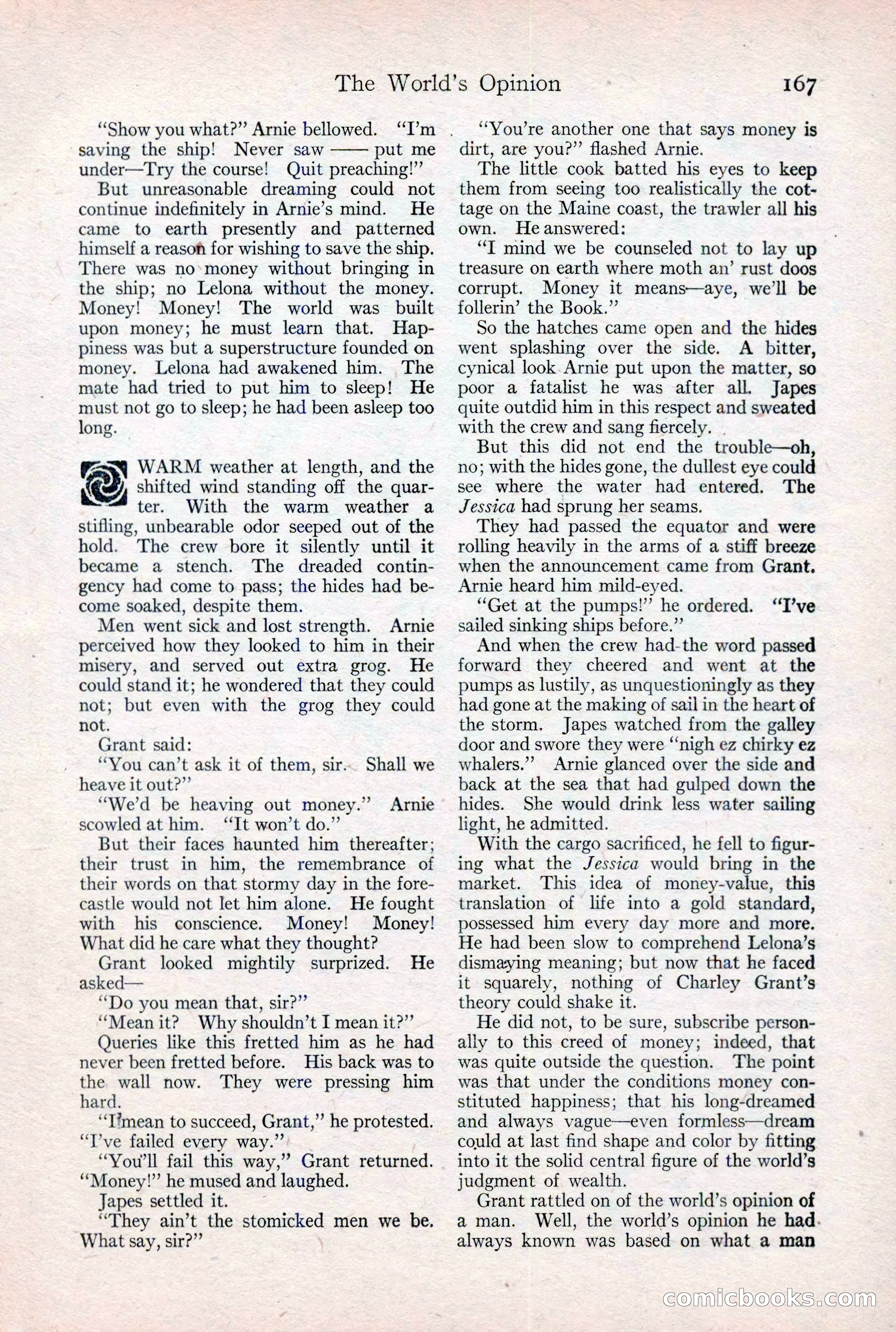
A restored page from Pulp Fiction, 1921. Page through the whole issue in the reader above.
📄 Transcribed text from this page (OCR, searchable)
Machine-transcribed from the original scan — historical spelling and the odd misread are preserved.
The World’s Opinion “Show you what?” Arnie bellowed. saving the ship! Never saw put me under—Try the course! Quit preaching!’ But unreasonable dreaming could not continue indefinitely in Arnie’s mind. He came to earth presently and patterned himself a reason for wishing to save the ship. There was no:-money without bringing in the ship; no Lelona without the money. Money! Money! The world was built upon money; he must learn that. Hap- piness was but a superstructure founded on money. Lelona had awakened him. The mate had tried to put him to sleep! He must not go to sleep; he had been asleep too long. © shifted wind standing off the quar- —™ ter. With the warm weather a stifling, unbearable odor seeped out of the hold. The crew bore it silently until it became a stench. The dreaded contin- gency had come to pass; the hides had be- come soaked, despite them. Men went sick and lost strength. Arnie perceived how they looked to him in their misery, and served out extra grog. He could stand it; he wondered that they could not; but even with the grog they could not. Grant said: “You can’t ask it of them, sir. heave it out?” ‘We'd be heaving out money.” scowled at him. ‘It won’t do.” But their faces haunted him thereafter; their trust in him, the remembrance of their words on that stormy day in the fore- castle would not Iet him alone. He fought with his conscience. Money! Money! What did he care what they thought? Grant looked mightily surprized. He asked— “Do you mean that, sir?” “Mean it? Why shouldn’t I mean it?” Queries like this fretted him as he had never been fretted before. His back was to the wall now. They were pressing him hard. ‘“‘T?mean to succeed, Grant,” he protested. “T’ve failed every way.” “You'll fail this way,” Grant returned. “Money!”’ he mused and laughed. Japes settled it. “They ain’t the stomicked men we be. What say, sir?” WARM weather at length, and the Shall we Arnie “Pm 167 ‘“‘You’re another one that says money is dirt, are you?” flashed Arnie. The little cook batted his eyes to keep them from seeing too realistically the cot- tage on the Maine coast, the trawler all his own. He answered: “T mind we be counseled not to lay up treasure on earth where moth an’ rust doos corrupt. Money it means—aye, we'll be follerin’ the Book.” So the hatches came open and the hides went splashing over the side. A bitter, cynical look. Arnie put upon the matter, so poor a fatalist he was after all. Japes quite outdid him in this respect and sweated with the crew and sang fiercely. - But this did not end the trouble—oh, no; with the hides gone, the dullest eye could see where the water had entered. The Jessica had sprung her seams. They had passed the equator and were rolling heavily in the arms of a stiff breeze when the announcement came from Grant. Arnie heard him mild-eyed. “Get at the pumps!” he ordered. sailed sinking ships before.”’ And when the crew had-the word passed forward they cheered and went at the pumps as lustily, as unquestioningly as they had gone at the making of sail in the heart of the storm. Japes watched from the galley door and swore they were “‘nigh ez chirky ez whalers.” Arnie glanced over the side and back at the sea that had gulped down the hides. She would drink less water sailing light, he admitted. With the cargo sacrificed, he fell to figur- ing what the Jessica would bring in the market. This idea of money-value, this translation of life into a gold standard, possessed him every day more and more. He had been slow to comprehend Lelona’s dismaying meaning; but now that he faced it squarely, nothing of Charley Grant’s theory could shake it. He did not, to be sure, subscribe person- ally to this creed of money; indeed, that was quite outside the question. The point was that under the conditions money con- stituted happiness; that his long-dreamed and always vague—even formless—dream could at last find shape and color by fitting into it the solid central figure of the world’s judgment of wealth. Grant rattled on of the world’s opinion of a man. always known was based on what a man “T’ve GomiGcbdooks Well, the world’s opinion he had. (C@)