
Pulp Fiction, 1921 · page 172 of 200
Adventure Magazine Cover, February 3, 1921 — page 172: what you’re looking at
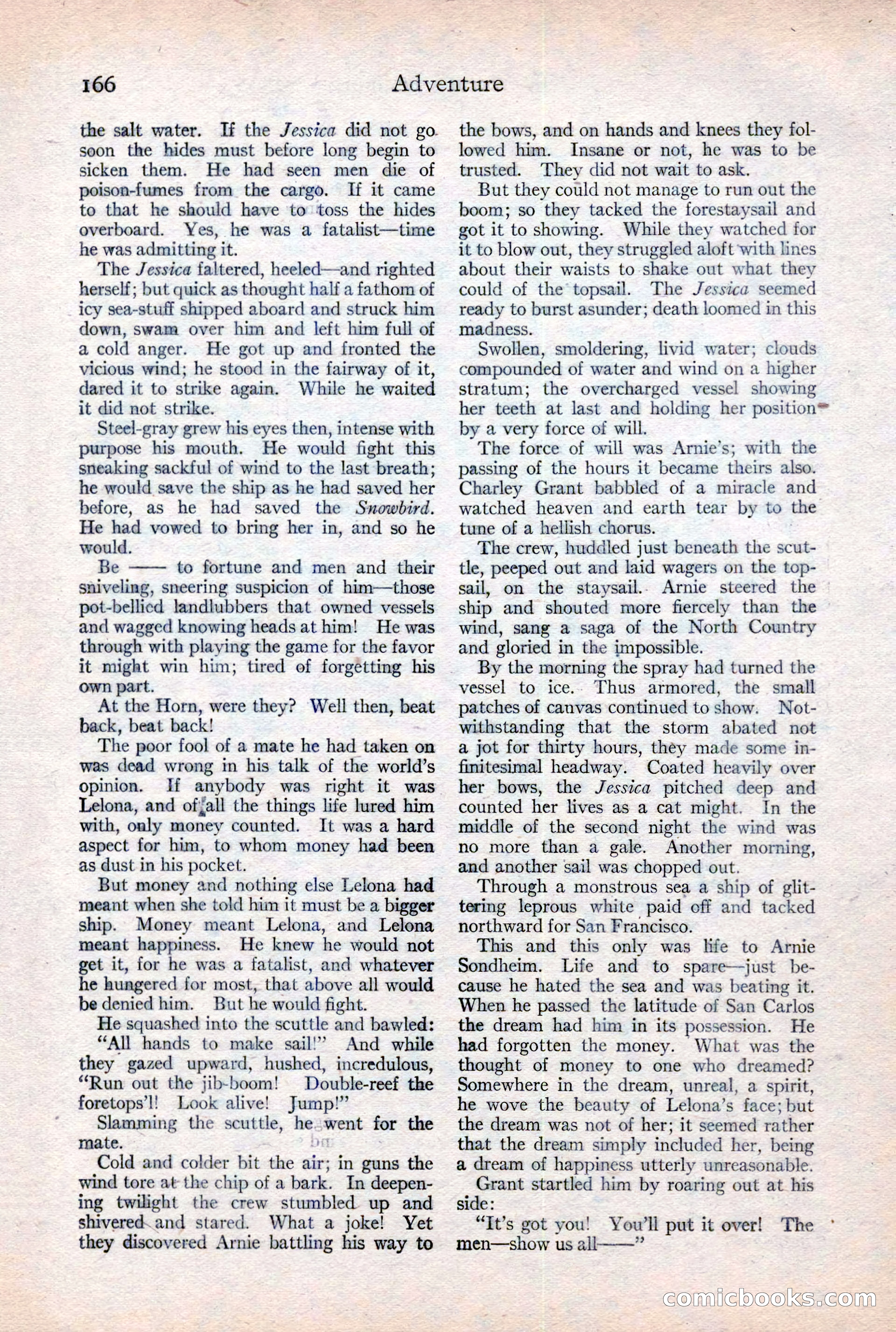
A restored page from Pulp Fiction, 1921. Page through the whole issue in the reader above.
📄 Transcribed text from this page (OCR, searchable)
Machine-transcribed from the original scan — historical spelling and the odd misread are preserved.
166 the salt water. soon the hides must before long begin to sicken them. He had seen men die of poison-fumes from the cargo. If it came to that he should have to toss the hides overboard. Yes, he was a fatalist—time he was admitting it. The Jessica faltered, heeled—and righted herself; but quick as thought half a fathom of icy sea-stuff shipped aboard and struck him down, swam over him and left him full of a cold anger. He got up and fronted the vicious wind; he stood in the fairway of it, dared it to strike again. While he waited it did not strike. Steel-gray grew his eyes then, intense with purpose his mouth. He would fight this sneaking sackful of wind to the last breath; he would save the ship as he had saved her before, as he had saved the Snowbird. He had vowed to bring her in, and so he would. Be —— to fortune and men and their sniveling, sneering suspicion of him—those pot-bellicd landlubbers that owned vessels and wagged knowing heads at him! He was through with playing the game for the favor it might win him; tired of forgetting his - own part. At the Horn, were they? Well then, beat back, beat back! The poor fool of a mate he had taken on was dead wrong in his talk of the world’s opinion. If anybody was right it was Lelona, and of{all the things life lured him with, only money counted. It was a hard aspect for him, to whom money had been as dust in his pocket. But money and nothing else Lelona had meant when she told him it must be a bigger ship. Money meant Lelona, and Lelona meant happiness. He knew he would not get it, for he was a fatalist, and whatever he hungered for most, that above all would be denied him. But he would fight. He squashed into the scuttle and bawled: “All hands to make sail!” And while they gazed upward, hushed, incredulous, “Run out the jib-boom! Double-reef the foretops’!! Look alive! Jump!” Slamming the scuttle, hes went for the mate. Cold and colder bit the air; in guns the wind tore at the chip of a bark. In deepen- ing twilight the crew stumbled up and shivered. and stared. What a joke! Yet they discovered Arnie battling his way to If the Jessica did not go. Adventure the bows, and on hands and knees they fol- lowed him. Insane or not, he was to be trusted. They did not wait to ask. But they could not manage to run out the boom; so they tacked the forestaysail and got it to showing. While they watched for it to blow out, they struggled aloft with lines about their waists to shake out what they could of the topsail. The Jessica seemed ready to burst asunder; death loomed in this madness. Swollen, smoldering, livid water; clouds compounded of water and wind on a higher stratum; the overcharged vessel showing her teeth at last and holding her position® by a very force of will. The force of will was Arnie’s; with the passing of the hours it became theirs also. Charley Grant babbled of a miracle and watched heaven and earth tear by to the tune of a hellish chorus. The crew, huddled just beneath the scut- tle, peeped out and laid wagers on the top- sail, on the staysail.. Arnie steered the ship and shouted more fiercely than the wind, sang a saga of the North Country and gloried in the impossible. By the morning the spray had turned the vessel to ice.. Thus armored, the small patches of canvas continued to show. Not- withstanding that the storm abated not a jot for thirty hours, they made some in- finitesimal headway. Coated heavily over her bows, the Jessica pitched deep and counted her lives as a cat might. In the middle of the second night the wind was no more than a gale. Another morning, and another sail was chopped out. Through a monstrous sea a ship of glit- tering leprous white paid off and tacked northward for San Francisco. This and this only was life to Arnie — Sondheim. Life and to spare—just be- cause he hated the sea and was beating it. When he passed the latitude of San Carlos the dream had him in its possession. He had forgotten the money. What was the thought of money to one who dreamed? Somewhere in the dream, unreal, a spirit, he wove the beauty of Lelona’s face; but the dream was not of her; it seemed rather that the dream simply included her, being a dream of happiness utterly unreasonable. Grant startled him by roaring out at his side: “It’s got you! You'll put it over! The men—show us all——’ GComicbooks (C@