
Pulp Fiction, 1920 · page 162 of 172
Adventure, December 3, 1920 — page 162: what you’re looking at
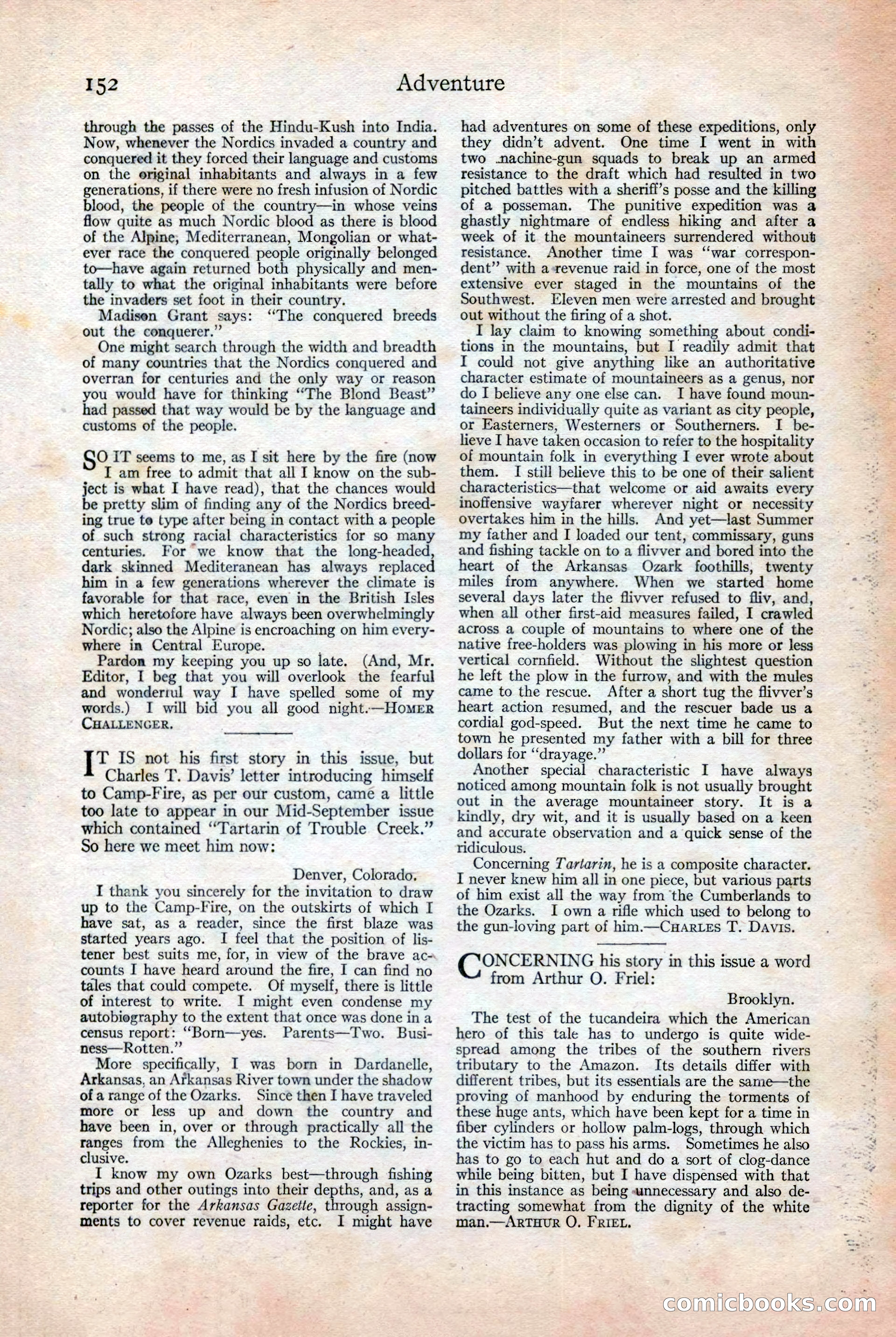
A restored page from Pulp Fiction, 1920. Page through the whole issue in the reader above.
📄 Transcribed text from this page (OCR, searchable)
Machine-transcribed from the original scan — historical spelling and the odd misread are preserved.
152 through the passes of the Hindu-Kush into India. Now, whenever the Nordics invaded a country and conquered it they forced their language and customs on the original inhabitants and always in a few generations, if there were no fresh infusion of Nordic blood, the people of the country—in whose veins flow quite as much Nordic blood as there is blood of the Alpine; Mediterranean, Mongolian or what- ever race the conquered people originally belonged to—have again returned both physically and men- tally to what the original inhabitants were before the invaders set foot in their country. Madisen Grant says: “The conquered breeds out the conquerer.” One might search through the width and breadth of many countries that the Nordics conquered and overran for centuries and the only way or reason you would have for thinking “The Blond Beast” had passed that way would be by the language and customs of the people. So IT seems to me, as I sit here by the fire (now I am free to admit that all I know on the sub- ject is what I have read), that the chances would e pretty slim of finding any of the Nordics breed- ing true te type after being in contact with a people of such strong racial characteristics for so many centuries. For we know that the long-headed, dark skinned Mediteranean has always replaced him in a few generations wherever the climate is favorable for that race, even in the British Isles which heretofore have always been overwhelmingly Nordic; also the Alpine is encroaching on him every- where in Central Europe. Pardon my keeping you up so late. (And, Mr. Editor, I beg that you will overlook the fearful and wondertul way I have spelled some of my words.) I will bid you all good night.—Homer CHALLENGER, [¢ IS not his first story in this issue, but Charles T. Davis’ letter introducing himself to Camp-Fire, as per our custom, came a little too late to appear in our Mid-September issue which contained “Tartarin of Trouble Creek.” So here we meet him now: Denver, Colorado, I thank you sincerely for the invitation to draw up to the Camp-Fire, on the outskirts of which I have sat, as a reader, since the first blaze was started years ago. I feel that the position of lis- tener best suits me, for, in view of the brave ac- counts I have heard around the fire, I can find no tales that could compete. Of myself, there is little of interest to write. I might even condense my autobiography to the extent that once was done ina census report: , Born—yes. Parents—Two. Busi- ness—Rotten.”’ More specifically, I was born in Dardanelle, Arkansas, an Arkansas River town under the shadow of a range of the Ozarks. Since then I have traveled more or less up and down the country and have been in, over or through practically all the ranges from the Alleghenies to the Rockies, in- clusive. I know my own Ozarks best—through fishing trips and other outings into their depths, and, as a reporter for the Arkansas Gazette, through assign- ments to cover revenue raids, etc. I might have Adventure had adventures on some of these expeditions, only they didn’t advent. One time I went in with two .nachine-gun squads to break up an armed resistance to the draft which had resulted in two pitched battles with a sheriff’s posse and the killing of a posseman. The punitive expedition was a ghastly nightmare of endless hiking and after a week of it the mountaineers surrendered without resistance. Another time I was “war correspon- dent” with a-revenue raid in force, one of the most extensive ever staged in the mountains of the Southwest. Eleven men were arrested and brought out without the firing of a shot. I lay claim to knowing something about condi- tions in the mountains, but I readily admit that I could not give anything like an authoritative character estimate of mountaineers as a genus, nor do I believe any one else can. I have found moun- taineers individually quite as variant as city people, or Easterners, Westerners or Southerners. I be- lieve I have taken occasion to refer to the hospitality of mountain folk in everything I ever wrote about them. [I still believe this to be one of their salient characteristics—that welcome or aid awaits every inoffensive wayfarer wherever night or necessity overtakes him in the hills. And yet—last Summer my father and I loaded our tent, commissary, guns and fishing tackle on to a flivver ‘and bored into the heart of the Arkansas Ozark foothills, twenty miles from anywhere. When we started home several days later the flivver refused to fliv, and, when all other first-aid measures failed, I crawled across a couple of mountains to where one of the native free-holders was plowing in his more or less vertical cornfield. Without the slightest question he left the plow in the furrow, and with the mules came to the rescue. After a short tug the flivver’s heart action resumed, and the rescuer bade us a cordial god-speed. But the next time he came to town he presented my father with a bill for three dollars for “‘drayage.” Another special characteristic I have always noticed among mountain folk is not usually brought out in the average mountaineer story. It is a kindly, dry wit, and it is usually based on a keen and accurate observation and a quick sense of the ridiculous. Concerning Tartarin, he is a composite character. I never knew him all in one piece, but various parts of him exist all the way from the Cumberlands to the Ozarks. I own a rifle which used to belong to the gun-loving part of him.—Cwartes T. Davis. CoN CERNING his story in this issue a word from Arthur O. Friel: Brooklyn. The test of the tucandeira which the American hero of this tale has to undergo is quite wide- spread among the tribes of the southern rivers tributary to the Amazon. Its details differ with different tribes, but its essentials are the same—the proving of manhood by enduring the torments of these huge ants, which have been kept for a time in fiber cylinders or hollow palm-logs, through which the victim has to pass his arms. Sometimes he also has to go to each hut and do a sort of clog-dance while being bitten, but I have dispensed with that in this instance as being ainnecessary and also de- tracting somewhat from the Bangs of the white man.—ARTHUR O. FRIEL, EOPMIC OOO ((o)