
Pulp Fiction, 1920 · page 161 of 172
Adventure, December 3, 1920 — page 161: what you’re looking at
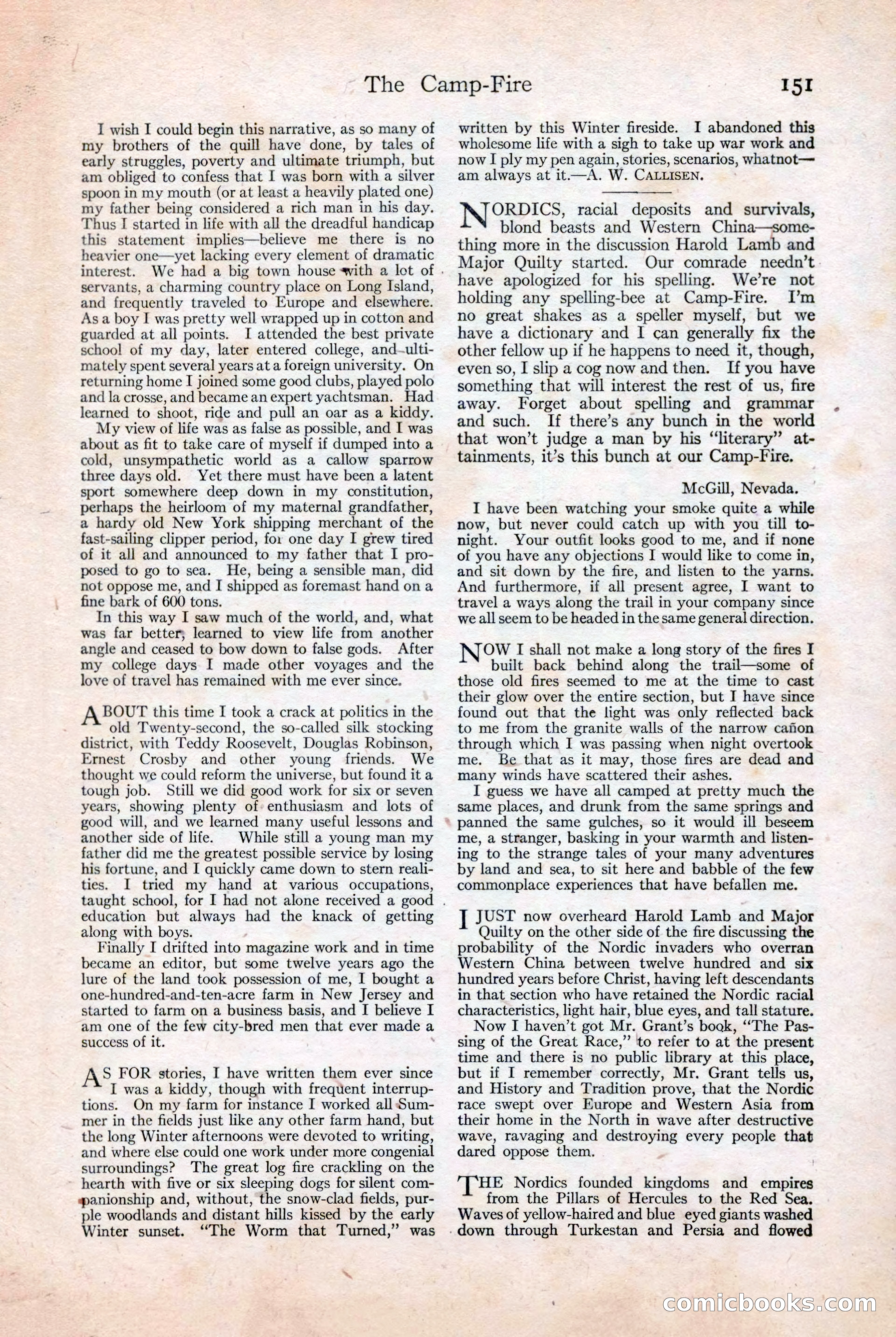
A restored page from Pulp Fiction, 1920. Page through the whole issue in the reader above.
📄 Transcribed text from this page (OCR, searchable)
Machine-transcribed from the original scan — historical spelling and the odd misread are preserved.
The Camp-Fire I wish I could begin this narrative, as so many of my brothers of the quill have done, by tales of early struggles, poverty and ultimate triumph, but am obliged to confess that I was born with a silver spoon in my mouth (or at least a heavily plated one) my father being considered a rich man in his day. Thus I started in life with all the dreadful handicap this statement implies—believe me there is no heavier one—yet lacking every element of dramatic interest. servants, a charming country place on Long Island, and frequently traveled to Europe and elsewhere. Asa boy I was pretty well wrapped up in cotton and guarded at all points. I attended the best private school of my day, later entered college, and—ulti- mately spent several years at a foreign university. On returning home I joined some good clubs, played polo and la crosse, and became an expert yachtsman. Had learned to shoot, ride and pull an oar as a kiddy. My view of life was as false as possible, and I was about as fit to take care of myself if dumped into a cold, unsympathetic world as a callow sparrow three days old. Yet there must have been a latent sport somewhere deep down in my constitution, perhaps the heirloom of my maternal grandfather, a hardy old New York shipping merchant of the fast-sailing clipper period, for one day I grew tired of it all and announced to my father that I pro- posed to go to sea. He, being a sensible man, did not oppose me, and I shipped as foremast hand on a fine bark of 600 tons. In this way I saw much of the world, and, what was far better; learned to view life from another angle and ceased to bow down to false gods. After my college days I made other voyages and the love of travel has remained with me ever since. A BouT this time I took a crack at politics in the old Twenty-second, the so-called silk stocking district, with Teddy Roosevelt, Douglas Robinson, Ernest Crosby and other young friends. We thought we could reform the universe, but found it a tough job. Still we did good work for six or seven years, showing plenty of enthusiasm and lots of good will, and we learned many useful lessons and another side of life. While still a young man my father did me the greatest possible service by losing his fortune, and I quickly came down to stern reali- ties. I tried my hand at various occupations, taught school, for I had not alone received a good . education but always had the knack of getting along with boys. Finally I drifted into magazine work and in time became an editor, but some twelve years ago the lure of the land took possession of me, I bought a one-hundred-and-ten-acre farm in New Jersey and started to farm on a business basis, and I believe I am one of the few city-bred men that ever made a success of it. . S FOR stories, I have written them ever since I was a kiddy, though with frequent interrup- tions. On my farm for instance I worked all Sum- mer in the fields just like any other farm hand, but the long Winter afternoons were devoted to writing, and where else could one work under more congenial surroundings? ‘The great log fire crackling on the hearth with five or six sleeping dogs for silent com- anionship and, without, the snow-clad fields, pur- ple woodlands and distant hills kissed by the early Winter sunset. ‘The Worm that Turned,” was We had a big town house «with a lot of . 151 written by this Winter fireside. I abandoned this wholesome life with a sigh to take up war work and now I ply my pen again, stories, scenarios, whatnot— am always at it—A. W. CALLISEN. N OBDICS, racial deposits and survivals, blond beasts and Western China—some- thing more in the discussion Harold Lamb and Major Quilty started. Our comrade needn’t have apologized for his spelling. We’re not holding any spelling-bee at Camp-Fire. I’m no great shakes as a speller myself, but we have a dictionary and I can generally fix the other fellow up if he happens to need it, though, even so, I slip a cog now and then. If you have something that will interest the rest of us, fire away. Forget about spelling and grammar and such. If there’s any bunch in the world that won’t judge a man by his “literary” at- tainments, it’s this bunch at our Camp-Fire. McGill, Nevada. I have been watching your smoke quite a while now, but never could catch up with you till to- night. Your outfit looks good to me, and if none of you have any objections I would like to come in, and sit down by the fire, and listen to the yarns. And furthermore, if all present agree, I want to travel a ways along the trail in your company since we all seem to be headed in the same general direction. Now. I shall not make a long story of the fires I built back behind along the trail—some of those old fires seemed to me at the time to cast their glow over the entire section, but I have since found out that the light was only reflected back to me from the granite walls of the narrow cafon through which I was passing when night overtook me. Be that as it may, those fires are dead and many winds have scattered their ashes. I guess we have all camped at pretty much the same places, and drunk from the same springs and panned the same gulches, so it would ill beseem me, a stranger, basking in your warmth and listen- ing to the strange tales of your many adventures by land and sea, to sit here and babble of the few commonplace experiences that have befallen me. | JUST now overheard Harold Lamb and Major Quilty on the other side of the fire discussing the probability of the Nordic invaders who overran Western China between twelve hundred and six hundred years before Christ, having left descendants in that section who have retained the Nordic racial characteristics, light hair, blue eyes, and tall stature. Now I haven’t got Mr. Grant’s boak, ‘‘The Pas- sing of the Great Race,” to refer to at the present time and there is no public library at this place, but if I remember correctly, Mr. Grant tells us, and History and Tradition prove, that the Nordic race swept over Europe and Western Asia from their home in the North in wave after destructive wave, ravaging and destroying every people that dared oppose them. "THE Nordics founded kingdoms and empires from the Pillars of Hercules to the Red Sea. Waves of yellow-haired and blue eyed giants washed -down through Turkestan and Persia and flowed EOMICLOO© (C@