
Pulp Fiction, 1920 · page 108 of 172
Adventure, December 3, 1920 — page 108: what you’re looking at
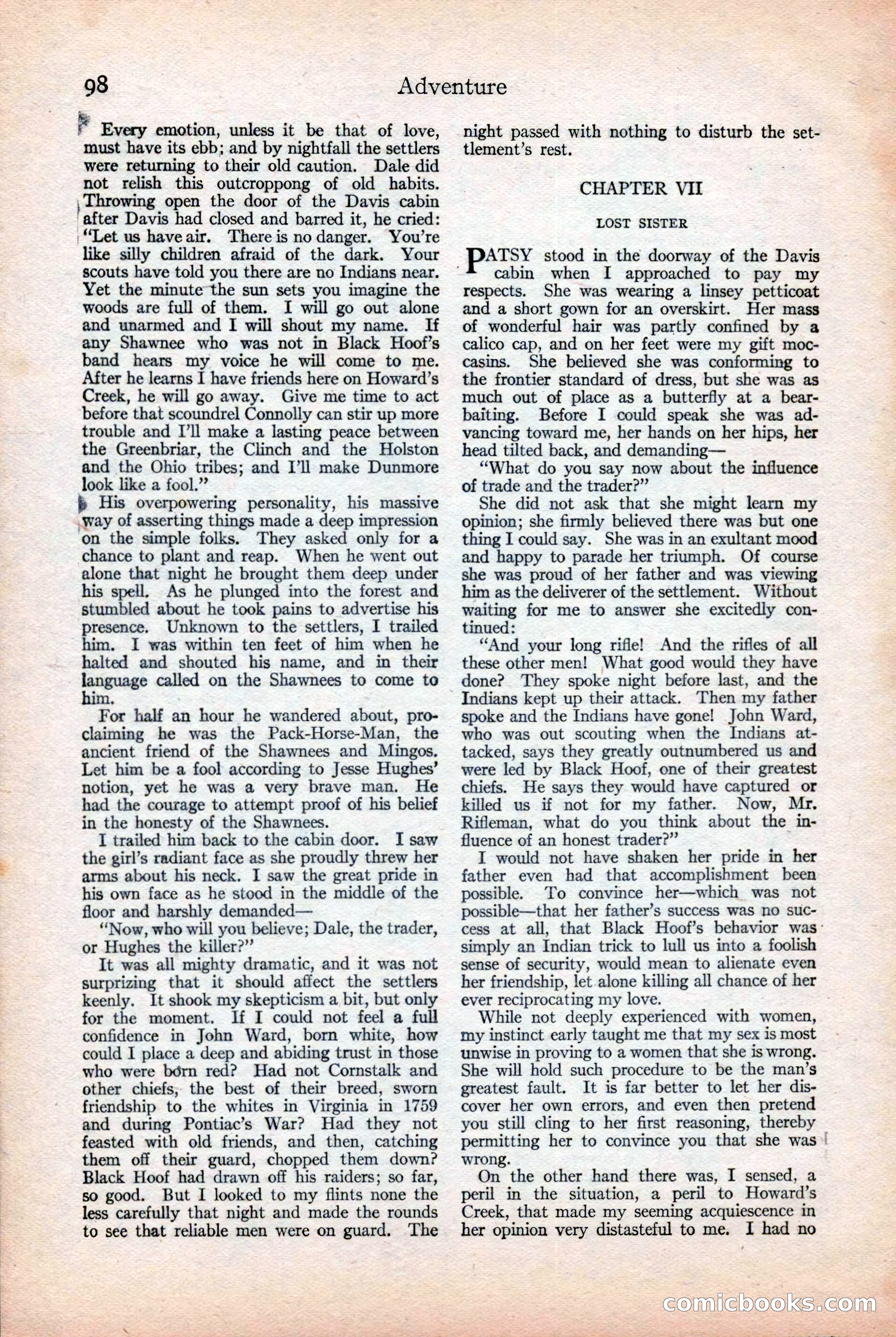
A restored page from Pulp Fiction, 1920. Page through the whole issue in the reader above.
📄 Transcribed text from this page (OCR, searchable)
Machine-transcribed from the original scan — historical spelling and the odd misread are preserved.
“et Ue) WOULD « pA RR SS a cB PR ee . 98 Adventure f Every emotion, unless it be that of love, must have its ebb; and by nightfall the settlers were returning to their old caution. Dale did not relish this outcroppong of old habits. , Throwing open the door of the Davis cabin after Davis had closed and barred it, he cried: “Let us haveair. Thereis no danger. You're like silly children afraid of the dark. Your scouts have told you there are no Indians near. Yet the minute the sun sets you imagine the woods are full of them. I will go out alone and unarmed and I will shout my name. any Shawnee who was not in Black Hoof’s band hears my voice he will come to me. After he learns I have friends here on Howard’s Creek, he will go away. Give me time to act before that scoundrel Connolly can stir up more trouble and I’ll make a lasting peace between the Greenbriar, the Clinch and the Holston and the Ohio tribes; and I’ll make Dunmore look like a fool.” His overpowering personality, his massive way of asserting things made a deep impression on the simple folks. They asked only for a chance to plant and reap. When he went out alone that night he brought them deep under his spell. As he plunged into the forest and stumbled about he took pains to advertise his presence. Unknown to the settlers, I trailed him. I was within ten feet of him when he halted and shouted his name, and in their eee called on the Shawnees to come to For half an hour he wandered about, pro- claiming he was the Pack-Horse-Man, the ancient friend of the Shawnees and Mingos. Let him be a fool according to Jesse Hughes’ notion, yet he was a very brave man. He had the courage to attempt proof of his belief in the honesty of the Shawnees. I trailed him back to the cabin door. I saw the girl’s radiant face as she proudly threw her arms about his neck. I saw the great pride in his own face as he stood in the middle of the floor and harshly demanded— “Now, who will you believe; Dale, the trader, or Hughes the killer?” It was all mighty dramatic, and it was not surprizing that it should affect the settlers keenly. It shook my skepticism a bit, but only for the moment. If I could not feel a full confidence in John Ward, born white, how could I place a deep and abiding trust in those who were bérn red? Had not Cornstalk and other chiefs, the best of their breed, sworn friendship to the whites in Virginia in 1759 and during Pontiac’s War? Had they not feasted with old friends, and then, catching them off their guard, chopped them down? Black Hoof had drawn off his raiders; so far, so good. But I looked to my flints none the less carefully that night and made the rounds to see that reliable men were on guard. The night passed with nothing to disturb the set- tlement’s rest. CHAPTER VII LOST SISTER 3 patsy stood in the doorway of the Davis cabin when I approached to pay my respects. She was wearing a linsey petticoat and a short gown for an overskirt. Her mass of wonderful hair was partly confined by a calico cap, and on her feet were my gift moc- casins. She believed she was conforming to the frontier standard of dress, but she was as much out of place as a butterfly at a bear- baiting. Before I could speak she was ad- vancing toward me, her hands on her hips, her head tilted back, and demanding— “What do you say now about the influence of trade and the trader?” She did not ask that she might learn my opinion; she firmly believed there was but one thing I could say. She was in an exultant mood and happy to parade her triumph. Of course she was proud of her father and was viewing him as the deliverer of the settlement. Without waiting for me to answer she excitedly con- tinued: “And your long rifle! And the rifles of all these other men! What good would they have done? They spoke night before last, and the Indians kept up their attack. Then my father spoke and the Indians have gone! John Ward, who was out scouting when the Indians at- tacked, says they greatly outnumbered us and were led by Black Hoof, one of their greatest chiefs. He says they would have captured or killed us if not for my father. Now, Mr. Rifleman, what do you think about the in- fluence of an honest trader?” I would not have shaken her pride in her father even had that accomplishment been possible. ‘To convince her—which was not possible—that her father’s success was no suc- cess at all, that Black Hoof’s behavior was: simply an Indian trick to lull us into a foolish sense of security, would mean to alienate even her friendship, let alone killing all chance of her ever reciprocating my love. While not deeply experienced with women, my instinct early taught me that my sex is most unwise in proving to a women that she is wrong. She will hold such procedure to be the man’s greatest fault. It is far better to let her dis- cover her own errors, and even then pretend you still cling to her first reasoning, thereby permitting her to convince you that she was wrong. On the other hand there was, I sensed, a peril in the situation, a peril to Howard’s Creek, that made my seeming acquiescence in her opinion very distasteful to me. I had no EOPMICEL OOO K<S —* (E@) ss ~— a, ae we ~~ “_- .. ~ om — a o — oe