
Pulp Fiction, 1920 · page 107 of 172
Adventure, December 3, 1920 — page 107: what you’re looking at
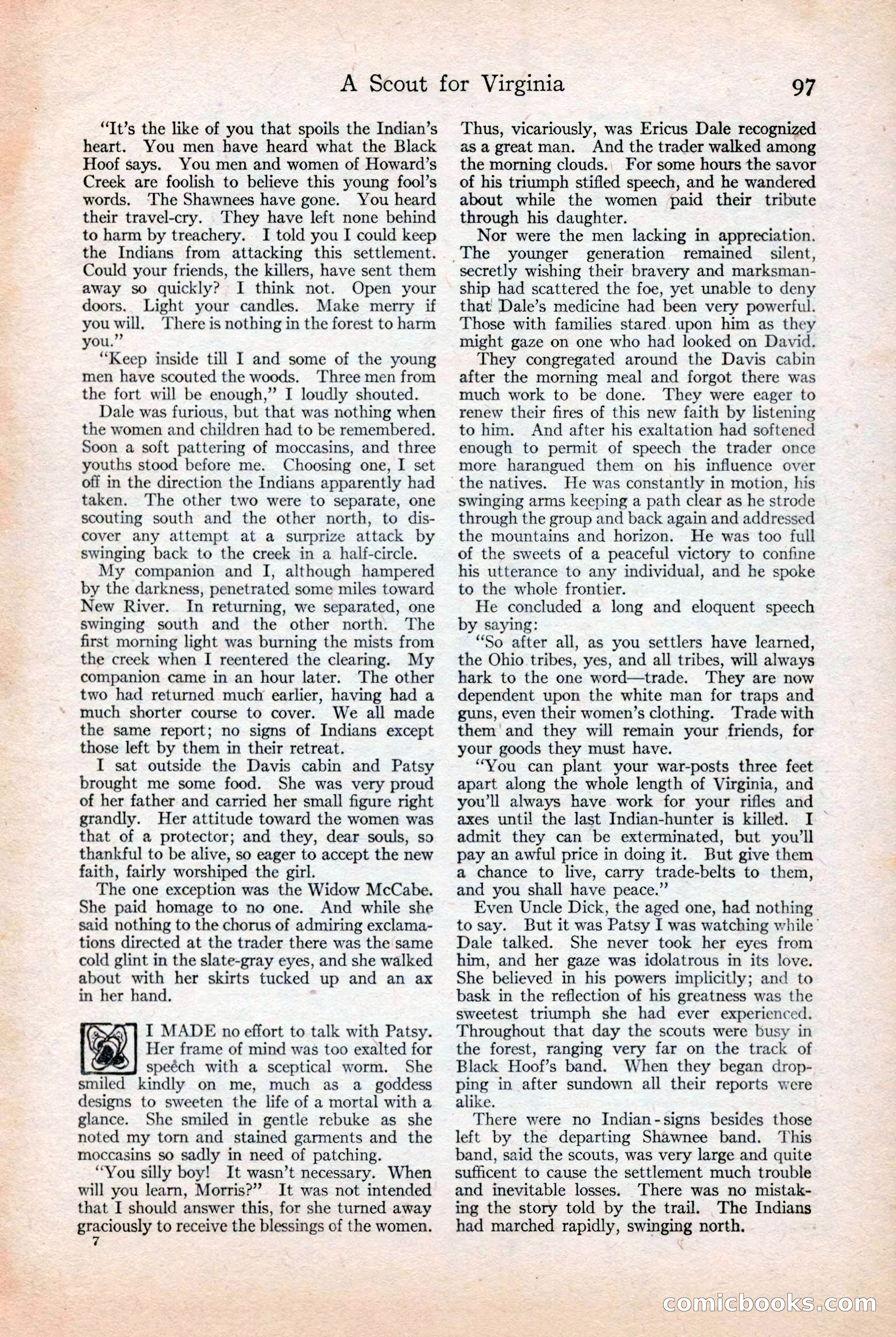
A restored page from Pulp Fiction, 1920. Page through the whole issue in the reader above.
📄 Transcribed text from this page (OCR, searchable)
Machine-transcribed from the original scan — historical spelling and the odd misread are preserved.
A Scout for Virginia “Tt’s the like of you that spoils the Indian’s heart. You men have heard what the Black Hoof says. You men and women of Howard’s Creek are foolish to believe this young fool’s words. The Shawnees have gone. You heard their travel-cry. They have left none behind to harm by treachery. I told you I could keep the Indians from attacking this settlement. Could your friends, the killers, have sent them away so quickly? I think not. Open your doors. Light your candles. Make merry if you will. ‘There is nothing in the forest to harm you.” “Keep inside till I and some of the young men have scouted the woods. Three men from the fort will be enough,” I loudly shouted. Dale was furious, but that was nothing when the women and children had to be remembered. Soon a soft pattering of moccasins, and three youths stood before me. Choosing one, I set off in the direction the Indians apparently had taken. The other two were to separate, one scouting south and the other north, to dis- cover any attempt at a surprize attack by swinging back to the creek in a half-circle. My companion and I, although hampered by the darkness, penetrated some miles toward New River. In returning, we separated, one swinging south and the other north. The first morning light was burning the mists from the creek when I reentered the clearing. My companion came in an hour later. The other two had returned much earlier, having had a much shorter course to cover. We all made the same report; no signs of Indians except those left by them in their retreat. I sat outside the Davis cabin and Patsy brought me some food. She was very proud of her father and carried her small figure right grandly. Her attitude toward the women was that of a protector; and they, dear souls, so thankful to be alive, so eager to accept the new faith, fairly worshiped the girl. The one exception was the Widow McCabe. She paid homage to no one. And while she said nothing to the chorus of admiring exclama- tions directed at the trader there was the same cold glint in the slate-gray eyes, and she walked about with her skirts tucked up and an ax in her hand. ‘py Her frame of mind was too exalted for C= J speéch with a sceptical worm. She smiled kindly on me, much as a_ goddess designs to sweeten the life of a mortal with a glance. She smiled in gentle rebuke as she noted my torn and stained garments and the moccasins so sadly in need of patching. “You silly boy! It wasn’t necessary. When will you learn, Morris?” It was not intended that I should answer this, for she turned away graciously to receive the blessings of the women. 7 I MADE no effort to talk with Patsy. The younger 97 Thus, vicariously, was Ericus Dale recognized asagreat man. And the trader walked among the morning clouds. For some hours the savor of his triumph stifled speech, and he wandered about while the women paid their tribute through his daughter. Nor were the men lacking in appreciation. generation remained silent, secretly wishing their bravery and marksman- ship had scattered the foe, yet unable to deny that Dale’s medicine had been very powerful. Those with families stared. upon him as they might gaze on one who had looked on David. They congregated around the Davis cabin after the morning meal and forgot there was much work to be done. They were eager to renew their fires of this new faith by listening to him. And after his exaltation had softened enough to permit of speech the trader once more harangued them on his influence over the natives. He was constantly in motion, his swinging arms keeping a path clear as he strode through the group and back again and addressed the mountains and horizon. He was too full of the sweets of a peaceful victory to confine his utterance to any individual, and he spoke to the whole frontier. He concluded a long and eloquent speech by saying: “So after all, as you settlers have learned, the Ohio tribes, yes, and all tribes, will always hark to the one word—trade. ‘They are now dependent upon the white man for traps and guns, even their women’s clothing. ‘Trade with them and they will remain your friends, for your goods they must have. “You can plant your war-posts three feet apart along the whole length of Virginia, and you'll always have work for your rifles and — axes until the last Indian-hunter is killed. I admit they can be exterminated, but you'll pay an awful price in doing it. But give them a chance to live, carry trade-belts to them, and you shall have peace.”’ Even Uncle Dick, the aged one, had nothing to say. But it was Patsy I was watching while’ Dale talked. She never took her eyes from him, and her gaze was idolatrous in its love. She believed in his powers implicitly; and to bask in the reflection of his greatness was the sweetest triumph she had ever experienced. Throughout that day the scouts were busy in the forest, ranging very far on the track of Black Hoof’s band. When they began drop- ping in after sundown all their reports were alike. There were no Indian-signs besides those left by the departing Shawnee band. This band, said the scouts, was very large and quite sufficent to cause the settlement much trouble and inevitable losses. ‘There was no mistak- ing the story told by the trail. The Indians had marched rapidly, swinging north. EOMMICLOOO© (C@