
Pulp Fiction, 1920 · page 57 of 172
Adventure Magazine Cover — page 57: what you’re looking at
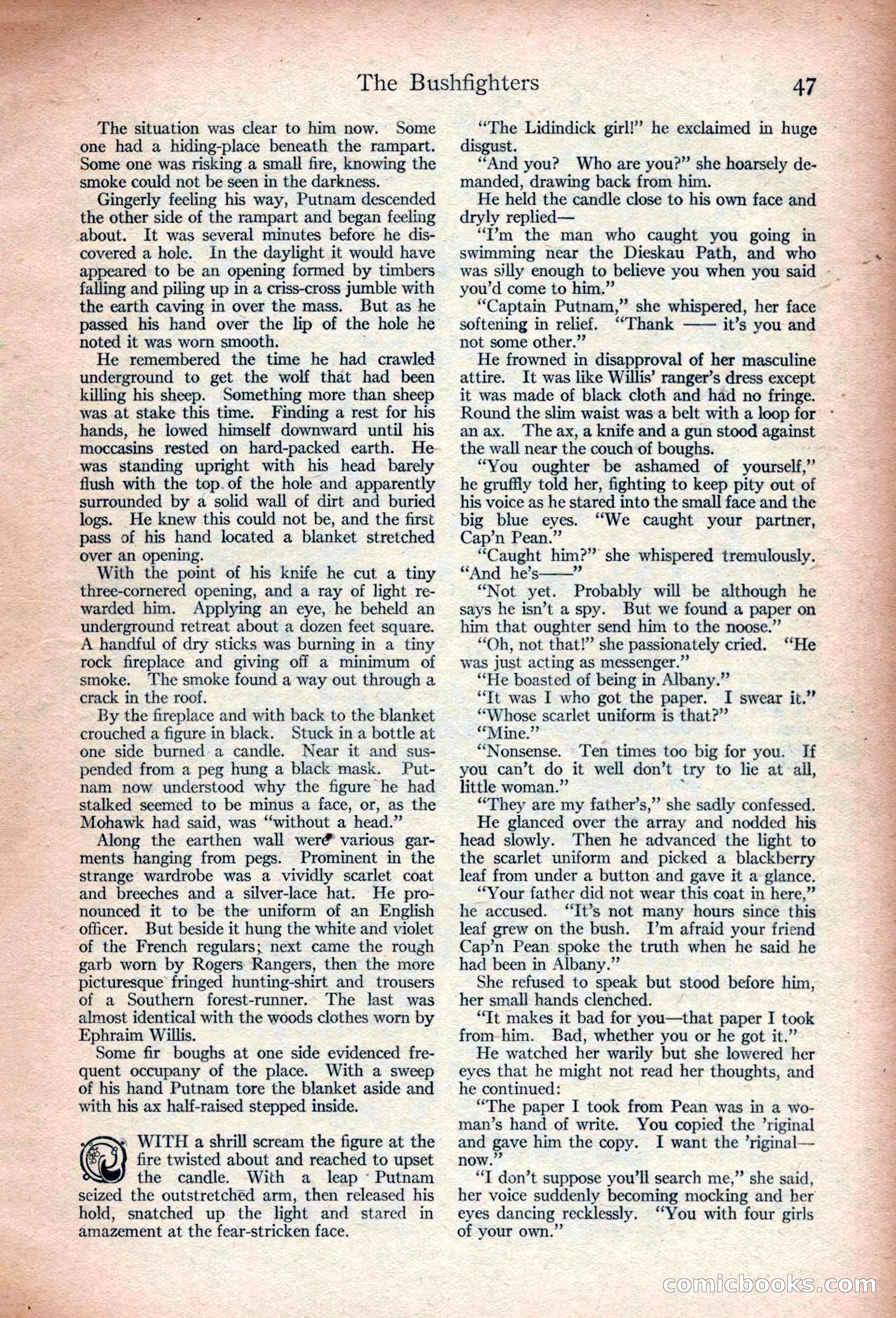
A restored page from Pulp Fiction, 1920. Page through the whole issue in the reader above.
📄 Transcribed text from this page (OCR, searchable)
Machine-transcribed from the original scan — historical spelling and the odd misread are preserved.
- officer. The Bushfighters The situation was clear to him now. Some one had a hiding-place beneath the rampart. Some one was risking a small fire, knowing the smoke could not be seen in the darkness. © Gingerly feeling his way, Putnam descended the other side of the rampart and began feeling about. It was several minutes before he dis- covered a hole. In the daylight it would have appeared to be an opening formed by timbers falling and piling up in a criss-cross jumble with the earth caving in over the mass. But as he passed his hand over the lip of the hole he noted it was worn smooth. He remembered the time he had crawled underground to get the wolf that had been killing his sheep. Something more than sheep was at stake this time. Finding a rest for his hands, he lowed himself downward until his moccasins rested on hard-packed earth. He was standing upright with his head barely flush with the top.of the hole and apparently surrounded by a solid wall of dirt and buried logs. He knew this could not be, and the first pass of his hand located a blanket stretched over an opening. With the point of his knife he cut a tiny three-cornered opening, and a ray of light re- warded him. Applying an eye, he beheld an underground retreat about a dozen feet square. A handful of dry sticks was burning in a tiny rock fireplace and giving off a minimum of smoke. The smoke found a way out through a crack in the roof. By the fireplace and with back to the blanket crouched a figure in black. Stuck in a bottle at one side burned-a candle. Near it and sus- pended from a peg hung a black mask. Put- nam now understood why the figure he had stalked seemed to be minus a face, or, as the Mohawk had said, was “without a head.” Along the earthen wall wer various gar- ments hanging from pegs. Prominent in the strange wardrobe was a vividly scarlet coat and breeches and a silver-lace hat. He pro- nounced it to be the uniform of an English But beside it hung the white and violet of the French regulars; next came the rough garb worn by Rogers Rangers, then the more picturesque fringed hunting-shirt and trousers of a Southern forest-runner. The last was almost identical with the woods clothes worn by Some fir boughs at one side evidenced fre- quent occupany of the place. With a sweep of his hand Putnam tore the blanket aside and with his ax half-raised stepped inside. 2) &) fire twisted about and reached to upset the candle. With a leap © Putnam seized the outstretched arm, then released his hold, snatched up the light and stared in amazement at the fear-stricken face. WITH a shrill scream the figure at the 47 “The Lidindick girl!” he exclaimed in huge disgust. “And you? Who are you?” she hoarsely de- manded, drawing back from him. He held the candle close to his own face and dryly replied— “T’m the man who caught you going in swimming near the Dieskau Path, and who was silly enough to believe you when you said -— you’d come to “Captain Putnam, ” she whispered, her face softening in relief. “Thank —— it’s you and not some other.” He frowned in disapproval of her masculine attire. It was like Willis’ ranger’s dress except it was made of black cloth and had no fringe. Round the slim waist was a belt with a loop for ° anax. The ax, a knife and a gun stood against the wall near the couch of boughs. “You oughter be ashamed of yourself,” he gruffly told her, fighting to keep pity out of his voice as he stared into the small face and the big blue eyes. “We caught your partner, Cap’n Pean.” “Caught him?’ she whispered tremulously. “And he’s——” “Not yet. Probably will be although he says he isn’t a spy. But we found a paper on him that oughter send him to the noose.” “Oh, not that!” she passionately cried. ‘He was just acting as messenger.” “He boasted of being in Albany.” “Tt was I who got the paper. I swear it.” “Whose scarlet uniform is that?” “Mine.” “Nonsense. Ten times too big for you. If you can’t do it well don’t try to lie at all, little woman.’ “They are my father’s,” she sadly confessed. He glanced over the array and nodded his head slowly. Then he advanced the light to the scarlet uniform and picked a_ blackberry leaf from under a button and gave it a glance. “Your father did not wear this coat in here,” he accused. “It’s not many hours since this leaf grew on the bush. I’m afraid your friend Cap’n Pean spoke the truth when he said he had been in Albany.” She refused to speak but stood before him, her small hands clenched. “Tt makes it bad for you—that paper I took from him. Bad, whether you or he got it.” He watched her warily but she lowered her eyes that he might not read her thoughts, and he continued: “The paper I took from Pean was in a wo- man’s hand of write. You copied the ’riginal and gave him the copy. I want the ’riginal— now.” “T don’t suppose you'll search me,” she said, her voice suddenly becoming mocking and her eyes dancing recklessly. “You with four girls of your own.” RR COnmicloool< (E@ ef -& His p : abe MW : Oi AP isl) a Papal te) . i yeeer iy va By ROam ayy SIH Ry ites Pear Se , ¥ A lie ha ea a ye