
Pulp Fiction, 1920 · page 56 of 172
Adventure Magazine Cover — page 56: what you’re looking at
A restored page from Pulp Fiction, 1920. Page through the whole issue in the reader above.
📄 Transcribed text from this page (OCR, searchable)
Machine-transcribed from the original scan — historical spelling and the odd misread are preserved.
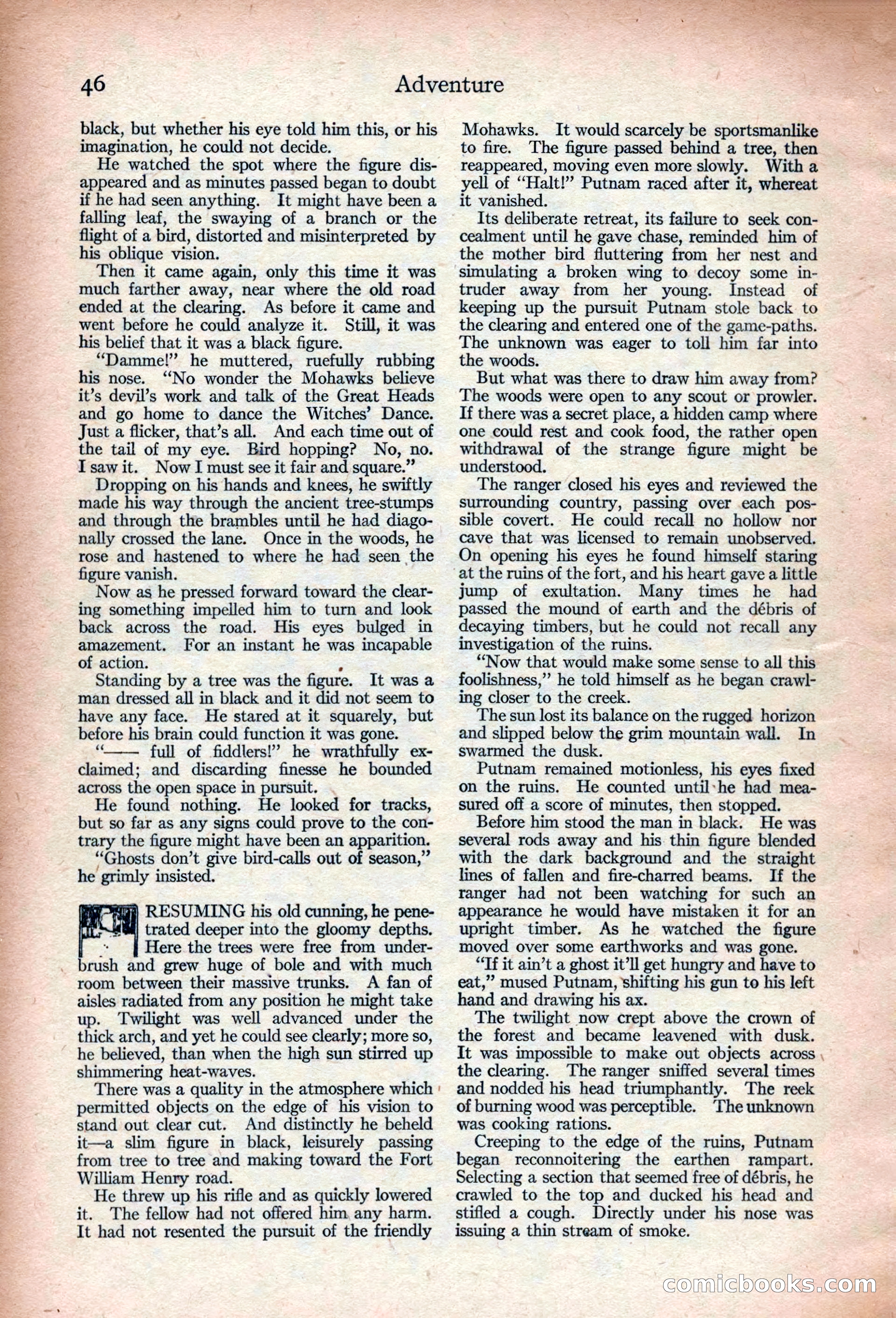
IC ag PSAs PARC Ere Sep MRE ee 8s IRE PY Pa aR Te iy TEEN EMR 4 7 ’ ‘e\ ‘ ° NN Sri a U5 ys : y - ag fay vy : ‘ -o Lf aX Pel), 3 th Sie aiiiiy Na oF Pit Lah bans a9 5 ao La oe Mah be va Fe nd 46 black, but whether his eye told him this, or his imagination, he could not decide. He watched the spot where the figure dis- appeared and as minutes passed began to doubt if he had seen anything. It might have been a falling leaf, the swaying of a branch or the flight of a bird, distorted and misinterpreted by his oblique vision. Then it came again, only this time it was much farther away, near where the old road ended at the clearing. As before it came and went before he could analyze it. Still, it was his belief that it was a black figure. “Damme!” he muttered, ruefully rubbing his nose. “No wonder the Mohawks believe it’s devil’s work and talk of the Great Heads and go home to dance the Witches’ Dance. Just a flicker, that’s all. And each time out of the tail of my eye. Bird hopping? No, no. Isaw it. Now I must see it fair and square.” Dropping on his hands and knees, he swiftly made his way through the ancient tree-stumps and through the brambles until he had diago- nally crossed the lane. Once in the woods, he rose and hastened to where he had seen the figure vanish. Now as he pressed forward toward the clear- ing something impelled him to turn and look back across the road. His eyes bulged in amazement. For an instant he was incapable of action. Standing by a tree was the figure. It was a man dressed all in black and it did not seem to have any face. He stared at it squarely, but before his brain could function it was gone. —— full of fiddlers!’ he wrathfully ex- claimed; and discarding finesse he bounded across the open space in pursuit. He found nothing. He looked for tracks, but so far as any signs could prove to the con- trary the figure might have been an apparition. “Ghosts don’t give bird-calls out of season,” he grimly insisted. RESUMING his old cunning, he pene- trated deeper into the gloomy depths. Here the trees were free from under- _ brush and grew huge of bole and with much room between their massive trunks. A fan of aisles radiated from any position he might take up. Twilight was well advanced under the thick arch, and yet he could see clearly; more so, he believed, than when the high sun stirred up shimmering heat-waves. There was a quality in the atmosphere which permitted objects on the edge of his vision to stand out clear cut. And distinctly he beheld it—a slim figure in black, leisurely passing from tree to tree and making toward the Fort William Henry road. He threw up his rifle and as quickly lowered it. The fellow had not offered him any harm. It had not resented the pursuit of the friendly Adventure Mohawks. It would scarcely be sportsmanlike to fire. The figure passed behind a tree, then reappeared, moving even more slowly. With a yell of “Halt!” Putnam raced after it, whereat it vanished. Its deliberate retreat, its failure to seek con- cealment until he gave chase, reminded him of the mother bird fluttering from her nest and simulating a broken wing to decoy some in- truder away from her young. Instead of keeping up the pursuit Putnam stole back to the clearing and entered one of the game-paths. The unknown was eager to toll him far into the woods. But what was there to draw him away from? The woods were open to any scout or prowler. If there was a secret place, a hidden camp where one could rest and cook food, the rather open withdrawal of the strange figure might be understood. The ranger closed his eyes and reviewed the surrounding country, passing over each pos- sible covert.. He could recall no hollow nor cave that was licensed to remain unobserved. On opening his eyes he found himself s at the ruins of the fort, and his heart gave a little jump of exultation. Many times he had passed the mound of earth and the débris of decaying timbers, but he could not recall any investigation of the ruins. “Now that would make some sense to all this foolishness,” he told himself as he began crawl- ing closer to the creek. The sun lost its balance on the rugged horizon and slipped below the grim mountain wall. In swarmed the dusk. Putnam remained motionless, his eyes fixed on the ruins. He counted until»he had mea- sured off a score of minutes, then stopped. Before him stood the man in black. He was several rods away and his thin figure blended with the dark background and the straight lines of fallen and fire-charred beams. If the ranger had not been watching for such an appearance he would have mistaken it for an upright timber. As he watched the figure moved over some earthworks and was gone. “Tf it ain’t a ghost it’ll get hungry and have to eat,” mused Putnam, shifting his gun to his left hand and drawing his ax. The twilight now crept above the crown of the forest and became leavened with dusk. It was impossible to make out objects across , the clearing. The ranger sniffed several times and nodded his head triumphantly. The reek of burning wood was perceptible. ‘The unknown was cooking rations. Creeping to the edge of the ruins, Putnam began reconnoitering the earthen rampart. Selecting a section that seemed free of débris, he crawled to the top and ducked his head and stifled a cough. Directly under his nose was issuing a thin stream of smoke. COMmICLOOOkKS (E@)