
Pulp Fiction, 1920 · page 184 of 208
Adventure Magazine Cover — page 184: what you’re looking at
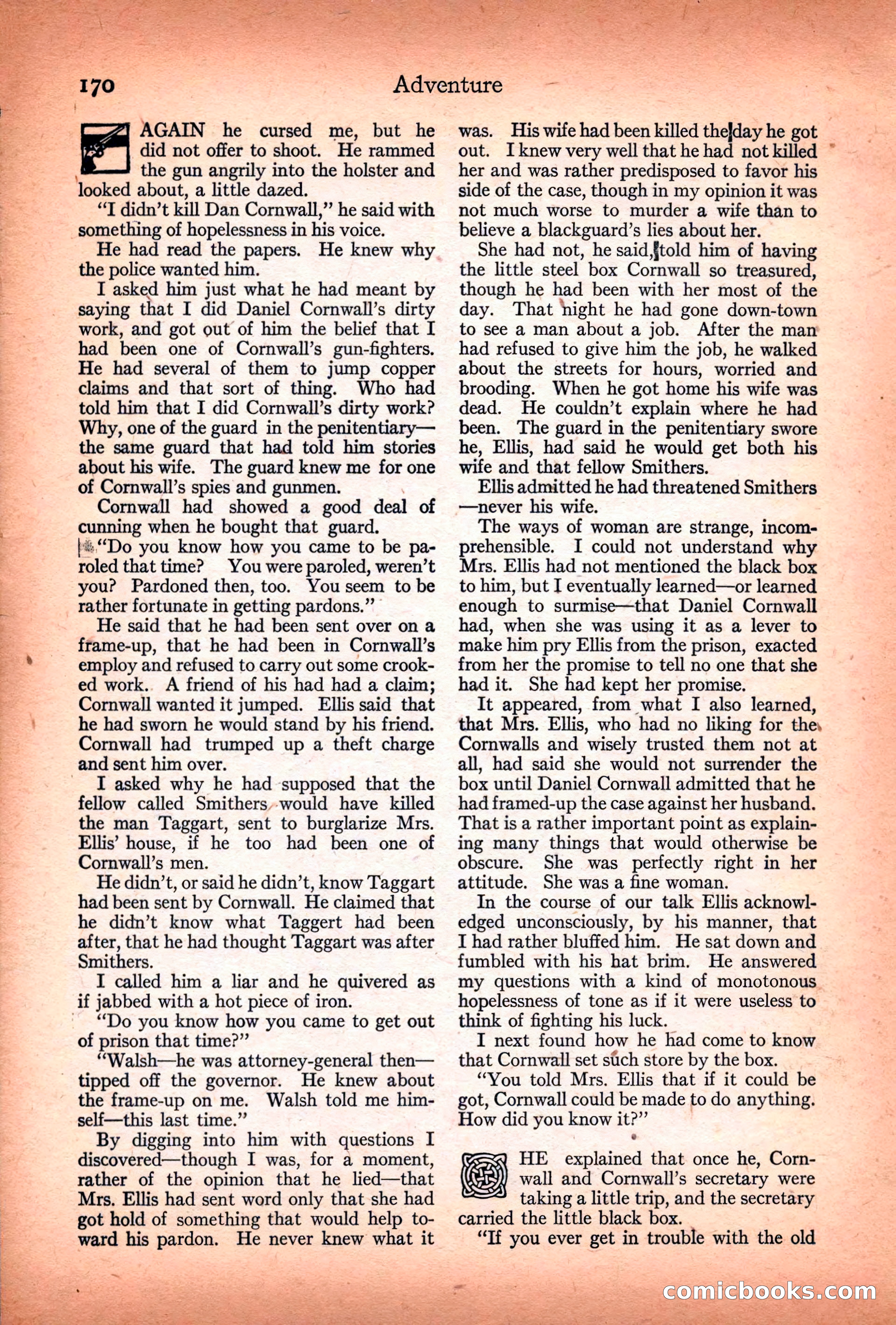
A restored page from Pulp Fiction, 1920. Page through the whole issue in the reader above.
📄 Transcribed text from this page (OCR, searchable)
Machine-transcribed from the original scan — historical spelling and the odd misread are preserved.
S n - _ tipped off the governor. did not offer to shoot. He rammed the gun angrily into the holster and ‘looked about, a little dazed. “T didn’t kill Dan Cornwall,” he said with something of hopelessness in his voice. He had read the papers. He knew why the police wanted him. I asked him just what he had meant by saying that I did Daniel Cornwall’s dirty work, and got out of him the belief that I had been one of Cornwall’s gun-fighters. He had several of them to jump copper claims and that sort of thing. Who had told him that I did Cornwall’s dirty work? Why, one of the guard in the penitentiary— the same guard that had told him stories about his wife. The guard knew me for one of Cornwall’s spies and gunmen. Cornwall had showed a good deal of cunning when he bought that guard. }“Do you know how you came to be pa- roled that time? You were paroled, weren’t you? Pardoned then, too. You seem to be _ rather fortunate in getting pardons.” He said that he had been sent over on a | frame-up, that he had been in Cornwall’s employ and refused to carry out some crook- ed work. A friend of his had had a claim; Cornwall wanted it jumped. Ellis said that he had sworn he would stand by his friend. Cornwall had trumped up a theft charge and sent him over. I asked why he had supposed that the fellow called Smithers,-would have killed the man Taggart, sent to burglarize Mrs. Ellis’ house, if he too had been one of Cornwall’s men. He didn’t, or said he didn’t, know Taggart had been sent by Cornwall. He claimed that he didn’t know what Taggert had been after, that he had thought Taggart was after Smithers. I called him a liar and he quivered as if jabbed with a hot piece of iron. “Do you know how you came to get out of prison that time?” “‘Walsh—he was attorney-general then— He knew about the frame-up on me. Walsh told me him- self—this last time.” By digging into him with questions I discovered—though I was, for a moment, rather of the opinion that he lied—that Mrs, Ellis had sent word only that she had got hold of something that would help to- eS ward his 3 sina He never knew what it Oy ae me - a J > 3 iF " a rae: ~ —, Sms = seek = 7 _— ce a zs Bus bsp Set, =~ e ip = ee Ras ERS BS x Cl 2 ee ae ee ee ee SO Oe a : Se ae a SAN SY wr a was. His wife had been killed thefday he got . out. I knew very well that he had not killed her and was rather predisposed to favor his side of the case, though in my opinion it was not much worse to murder a wife than to believe a blackguard’s lies about her. She had not, he said,{told him of having the little steel box Cornwall so treasured, though he had been with her most of the day. That hight he had gone down-town to see a man about a job. After the man had refused to give him the job, he walked about the streets for hours, worried and brooding. When he got home his wife was dead. He couldn’t explain where he had been. The guard in the penitentiary swore he, Ellis, had said he would get both his wife and that fellow Smithers. Ellis admitted he had threatened Smithers —never his wife. The ways of woman are strange, incom- prehensible. I could not understand why Mrs. Ellis had not mentioned the black box to him, but I eventually learned—or learned enough to surmise—that Daniel Cornwall had, when she was using it as a lever to make him pry Ellis from the prison, exacted from her the promise to tell no one that she had it. She had kept her promise. It appeared, from what I also learned, that Mrs. Ellis, who had no liking for the, Cornwalls and wisely trusted them not at all, had said she would not surrender the box until Daniel Cornwall admitted that he had framed-up the case against her husband. That is a rather important point as explain- ing many things that would otherwise be obscure. She was perfectly right in her attitude. She was a fine woman. In the course of our talk Ellis acknowl- edged unconsciously, by his manner, that I had rather bluffed him. He sat down and fumbled with his hat brim. He answered my questions with a kind of monotonous. hopelessness of tone as if it were useless to think of fighting his luck. I next found how he had come to know that Cornwall set sfich store by the box. “You told Mrs. Ellis that if it could be got, Cornwall could be made to do anything. How did you know itr” wall and Cornwall’s secretary were 9 taking a little trip, and the secretary are the little black box. “If you ever get in trouble wah the old HE eeiared that once he, Corn- aes: = a ae eee eds! Du ge