
Pulp Fiction, 1917 · page 7 of 228
Adventure, February 1917 — page 7: what you’re looking at
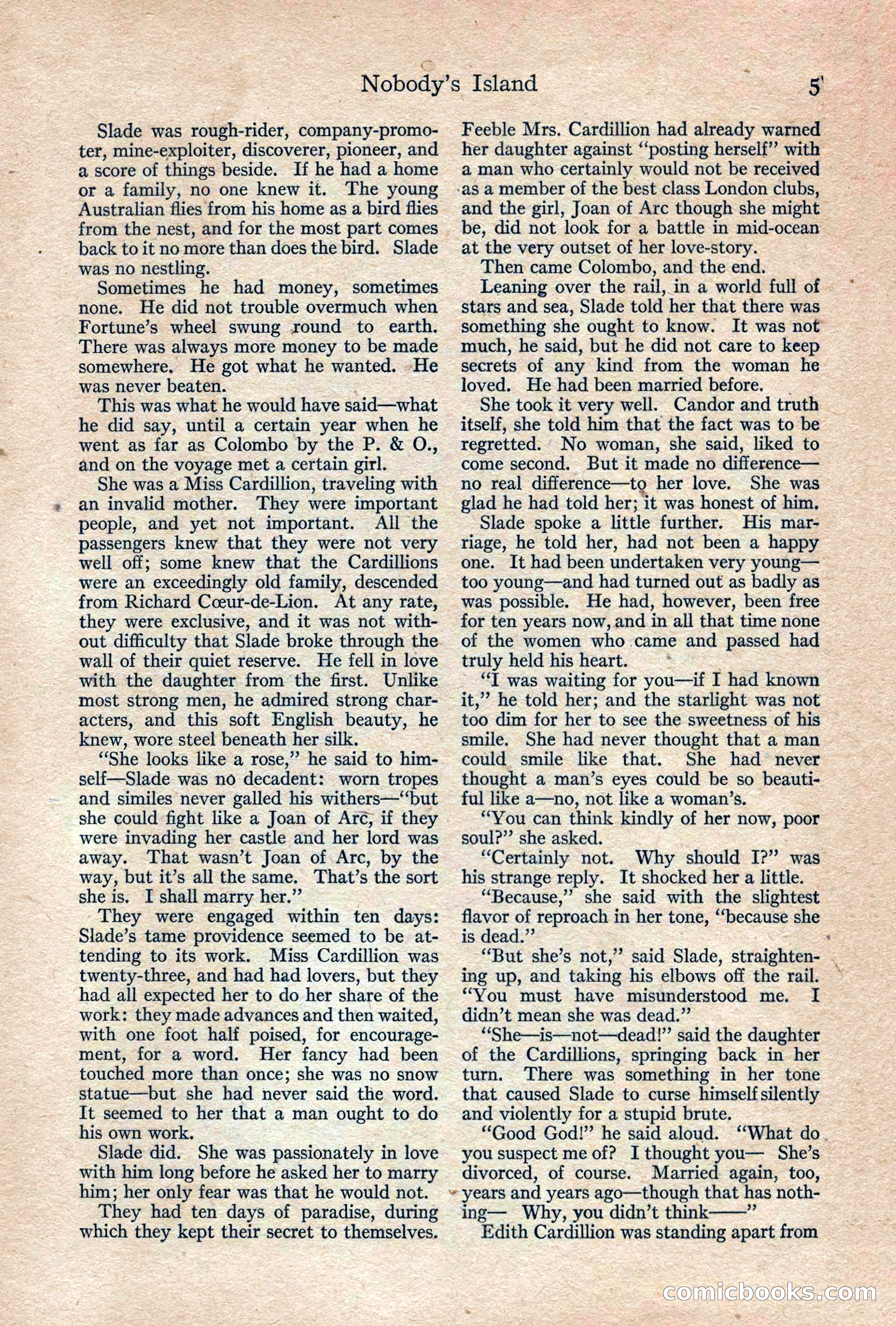
A restored page from Pulp Fiction, 1917. Page through the whole issue in the reader above.
📄 Transcribed text from this page (OCR, searchable)
Machine-transcribed from the original scan — historical spelling and the odd misread are preserved.
Nobody’s Island Slade was rough-rider, company-promo- ter, mine-exploiter, discoverer, pioneer, and a score of things beside. If he had a home or a family, no one knew it. The young Australian flies from his home as a bird flies from the nest, and for the most part comes back to it no more than does the bird. Slade _ ‘Was no nestling. Sometimes he had money, sometimes none. He did not trouble overmuch when Fortune’s wheel swung round to earth. There was always more money to be made somewhere. He got what he wanted. -He was never beaten. This was what he would have said—what he did say, until a certain year when he went as far as Colombo by the P. & O., and on the voyage met a certain girl. She was a Miss Cardillion, traveling with an invalid mother. They were important people, and yet not important. All the passengers knew that they were not very well off; some knew that the Cardillions were an exceedingly old family, descended from Richard Coeur-de-Lion. At any rate, they were exclusive, and it was not with- out difficulty that Slade broke through the wall of their quiet reserve. He fell in love with the daughter from the first. Unlike most strong men, he admired strong char- acters, and this soft English beauty, he knew, wore steel beneath her silk “She looks like a rose,” he said to him- self—Slade was no decadent: worn tropes and similes never galled his withers—‘‘but she could fight like a Joan of Arc, if they were invading her castle and her lord was away. ‘That wasn’t Joan of Arc, by the way, but it’s all the same. That’s the sort she is. I shall marry her.” They were engaged within ten days: Slade’s tame providence seemed to be at- tending to its work. Miss Cardillion was twenty-three, and had had lovers, but they had all expected her to do her share of the work: they made advances and then waited, with one foot half poised, for encourage- ment, for a word. Her fancy had been touched more than once; she was no snow statue—but she had never said the word. It seemed to her that a man ought to do his own work, Slade did. She was passionately in love with him long before he asked her to marry him; her only fear was that he would not. They had ten days of paradise, during which they kept their secret to themselves. Feeble Mrs. Cardillion had already warned her daughter against “‘posting herself” with a man who certainly would not be received — -as a member of the best class London clubs, and the girl, Joan of Arc though she might be, did not look for a battle in mid-ocean at the very outset of her love-story. Then came Colombo, and the end. Leaning over the rail, in a world full of stars and sea, Slade told her that there was something she ought to know. It was not much, he said, but he did not care to keep secrets of any kind from the woman he loved. He had been married before. __ She took it very well. Candor and truth itself, she told him that the fact was to be regretted. No woman, she said, liked to come second. But it made no difference— no real difference—to her love. She was glad he had told her; it was honest of him. Slade spoke a little further. His mar- riage, he told her, had not been a happy one. It had been undertaken very young— too young—and had turned out as badly as was possible. He had, however, been free for ten years now, and in all that time none of the women who came and passed had truly held his heart. : “T was waiting for you—if I had known it,’ he told her; and the starlight was not too dim for her to see the sweetness of his smile. She had never thought that a man could smile like that. She had never thought a man’s eyes could be so beauti- ful like a—no, not like a woman’s. “You can think kindly of her now, poor soul?’’ she asked. “Certainly not. Why should I?” was his strange reply. It shocked her a little. “Because,” she said with the slightest flavor of reproach i in her tone, “‘because she is dead.” “But she’s not,” said Slade, straighten: < ing up, and taking his elbows off the rail. “You must have misunderstood me. I didn’t mean she was dead.” “‘She—is—not—dead!”’ said the daughter of the Cardillions, springing back in her turn. There was something in her tone that caused Slade to curse himself silently and violently for a stupid brute. “Good God!” he said aloud. you suspect me of? I thought you— She’s divorced, of course. Married again, too, ~ years and years ago—though that has noth- ing— Why, you didn’t think——” ‘Edith Cardillion was standing apart from CORMICLOOKS “What do. (©) (C