
Pulp Fiction, 1917 · page 6 of 228
Adventure, February 1917 — page 6: what you’re looking at
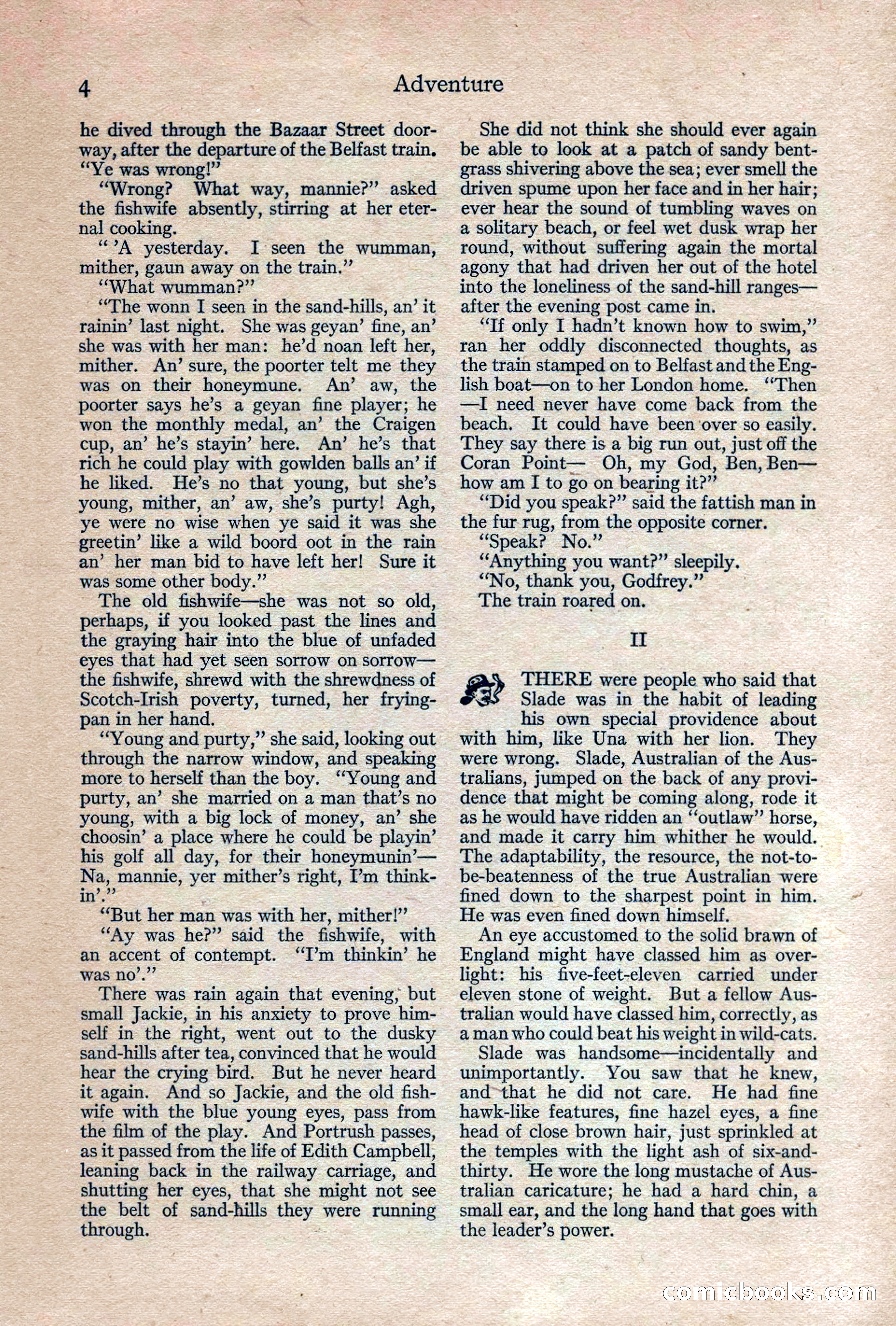
A restored page from Pulp Fiction, 1917. Page through the whole issue in the reader above.
📄 Transcribed text from this page (OCR, searchable)
Machine-transcribed from the original scan — historical spelling and the odd misread are preserved.
4 he dived through the Bazaar Street door- way, after the departure of the Belfast train. “Ye was wrong!” “Wrong? What way, mannie?” asked the fishwife absently, stirring at her eter- nal cooking. “°A yesterday. I seen the wumman, mither, gaun away on the train.” “What wumman?”’ ~The wonn I seen in the sand-hills, an’ it rainin’ last night. She was geyan’ fine, an’ she was with her man: he’d noan left her, mither. An’ sure, the poorter telt me they was on their honeymune. An’ aw, the poorter says he’s a geyan fine player; he won the monthly medal, an’ the Craigen cup, an’ he’s stayin’ here. An’ he’s that _ rich he could play with gowlden balls an’ if he liked. He’s no that young, but she’s young, mither, an’ aw, she’s purty! Agh, ye were no wise when ye said it was she greetin’ like a wild boord oot in the rain an’ her man bid to have left her! Sure it was some other body.” - The old fishwife—she was not so old, perhaps, if you looked past the lines and the graying hair into the blue of unfaded eyes that had yet seen sorrow on sorrow— the fishwife, shrewd with the shrewdness of Scotch-Irish poverty, turned, her frying- pan in her hand. “Young and purty,” she said, looking out through the narrow window, and speaking more to herself than the boy. “‘Young and purty, an’ she married on a man that’s no young, with a big lock of money, an’ she choosin’ a place where he could be playin’ his golf all day, for their honeymunin’— Na, mannie, yer mither’s right, I’m think- “But her man was with her, mither!”’ “Ay was he?” said the fishwife, with an accent of contempt. “I’m thinkin’ he was no’.”’ There was rain again that evening; but small Jackie, in his anxiety to prove him- self in the right, went out to the dusky sand-hills after tea, convinced that he would hear the crying bird. But he never heard it again. And so Jackie, and the old fish- - wife with the blue young eyes, pass from the film of the play. And Portrush passes, as it passed from the life of Edith Campbell, leaning back in the railway carriage, and shutting her eyes, that she might not see the belt of sand-hills hey were running through. Adventure She did not think she should ever again be able to look at a patch of sandy bent- grass shivering above the sea; ever smell the driven spume upon her face and in her hair; ever hear the sound of tumbling waves on a solitary beach, or feel wet dusk wrap her round, without suffering again the mortal agony that had driven her out of the hotel . into the loneliness of the sand-hill ranges— after the evening post came in. “Tf only I hadn’t known how to swim,” ran her oddly disconnected thoughts, as the train stamped on to Belfast and the Eng- lish boat—on to her London home. ‘Then —TI need never have come back from the beach. It could have been‘over so easily. They say there is a big run out, just off the Coran Point— Oh, my God, ‘Ben, Ben— how am I to go on bearing it?” “Did you speak?” said the fattish man in the fur rug, from the opposite corner. “Speak? No.” “Anything you want?” sleepily.. “No, thank you, Godfrey.” The train roared on. IT THERE were people who said that Slade was in the habit of leading his own special providence about with him, like Una with her lion. They were wrong. Slade, Australian of the Aus- tralians, jumped on the back of any provi- dence that might be coming along, rode it as he would have ridden an “‘outlaw” horse, and made it carry him whither he would. The adaptability, the resource, the not-to- be-beatenness of the true Australian were fined down to the sharpest point in him. He was even fined down himself. An eye accustomed to the solid brawn of England might have classed him as over- light: his five-feet-eleven carried under eleven stone of weight. But a fellow Aus- tralian would have classed him, correctly, as a man who could beat his weight in wild-cats. Slade was handsome—incidentally and unimportantly. You saw that he knew, and~that he did not care. He had fine hawk-like features, fine hazel eyes, a fine head of close brown hair, just sprinkled at the temples with the light ash of six-and- thirty. He wore the long mustache of Aus- tralian caricature; he had a hard chin, a small ear, and the long hand that goes with the leader’s power. (EO) WOOK (C@)