
Pulp Fiction, 1917 · page 49 of 228
Adventure, February 1917 — page 49: what you’re looking at
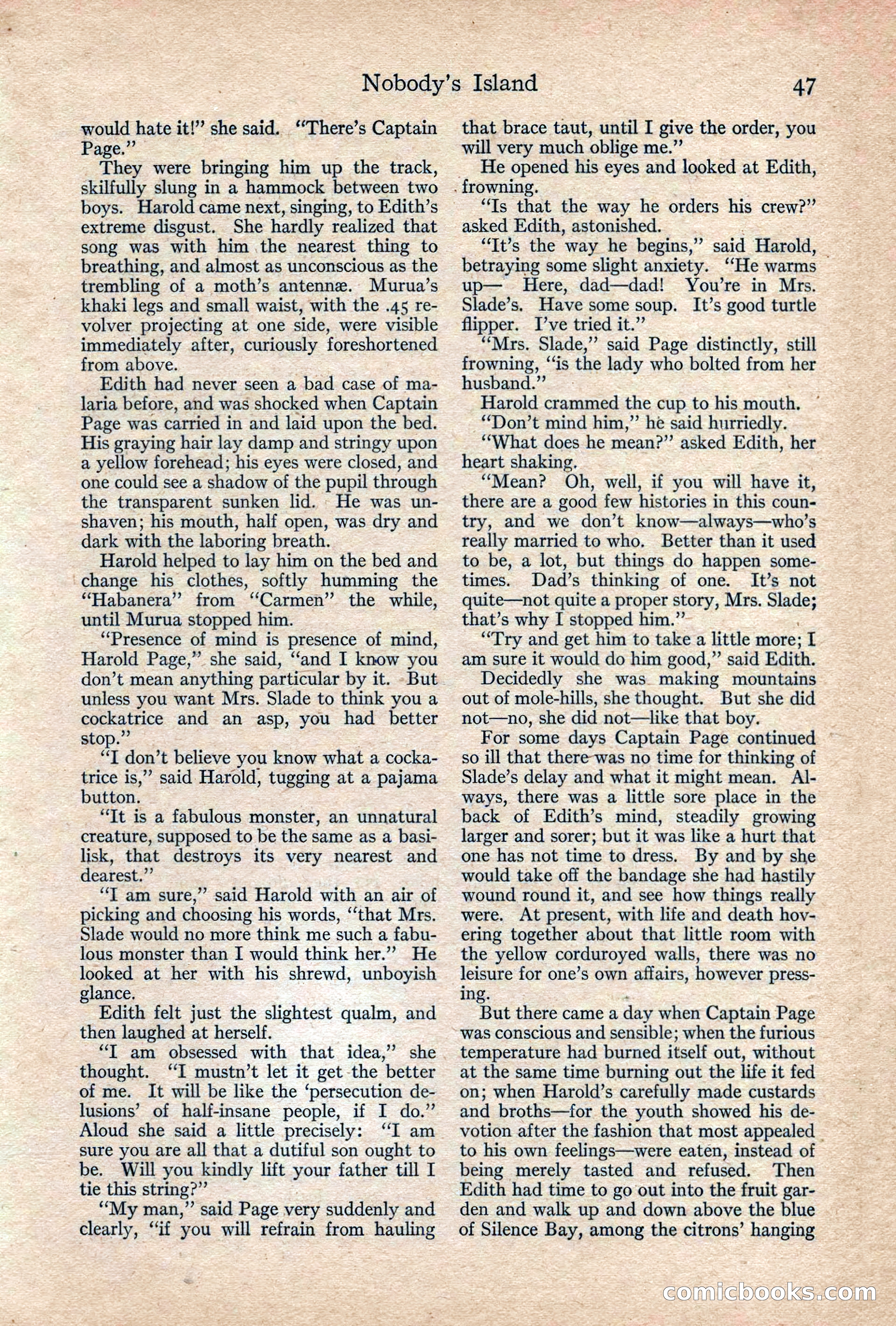
A restored page from Pulp Fiction, 1917. Page through the whole issue in the reader above.
📄 Transcribed text from this page (OCR, searchable)
Machine-transcribed from the original scan — historical spelling and the odd misread are preserved.
Nobody’s. Island would hate it!” she said. ‘“There’s Captain Page.” They were bringing him up the track, skilfully slung in a hammock between two boys. Harold came next, singing, to Edith’s extreme disgust. She hardly realized that song was with him .the nearest thing to breathing, and almost as unconscious as the trembling of a moth’s antenne. Murua’s khaki legs and small waist, with the .45 re- volver projecting at one side, were visible immediately after, curiously foreshortened from above. Edith had never seen a bad case of ma- laria before, and was shocked when Captain Page was carried in and laid upon the bed. His graying hair lay damp and stringy upon a yellow forehead; his eyes were closed, and one could see a shadow of the pupil through the transparent sunken lid. He was un- shaven; his mouth, half open, was dry and dark with the laboring breath. Harold helped to lay him on the bed and -change his clothes, softly humming the “Habanera” from ‘‘Carmen” the while, until Murua stopped him. “Presence of mind is presence of mind, Harold Page,” she said, “and I know you don’t mean anything particular by it. -But unless you want Mrs. Slade to think you a cockatrice and an asp, you had better stop.” —- don’ t believe you know what a cocka- ~ trice is,” said Harold, tugging at a pajama button. “It is a fabulous monster, an unnatural creature, supposed to be the same as a basi- lisk, that destroys its very nearest and dearest.” “T am sure,” said Harold with an air of picking and choosing his words, ‘‘that Mrs. Slade would no more think me such a fabu- lous monster than I would think her.” He looked at her with his shrewd, unboyish glance. Edith felt just the slightest qualm, and then laughed at herself. “T am obsessed with that idea,” she thought. “IT mustn’t let it get the better of me. It will be like the ‘persecution de- lusions’ of half-insane people, if I do.” Aloud she said a little precisely: “I am sure you are all that a dutiful son ought to be. Will you kindly lift your father till I tie this string?” ‘““My man,” said Page very suddenly and clearly, “if you will refrain from hauling that brace taut, until I give the order, you will very much oblige me.” He opened his eyes and looked at Edith, . frowning. “Ts that the way he orders his crew?” asked Edith, astonished. a7 “Tt’s the way he begins,” said Harold, | betraying some slight anxiety. “He warms up— Here, dad—dad! You’re in Mrs. Slade’s, Have some soup. It’s good turtle flipper. I’ve tried it.” “Mrs. Slade,” said Page distinctly, still frowning, “is the lady who bolted from her husband.” | Harold crammed the cup to his mouth. “Don’t mind him,” he said hurriedly. ‘‘What does he mean?” asked Edith, her heart shaking. “Mean? Oh, well, if you will have it, there are a good few histories in this coun- try, and we don’t know—always—who’s really married to who. Better than it used to be, a lot, but things do happen some- times. Dad’s thinking of one. It’s not quite—not quite a proper story, Mrs. sees that’s why I stopped him.” “Try and get him to take a little more; I am sure it would do him good,” said Edith. Decidedly she was. making mountains out of mole-hills, she thought. But she did not—no, she did not—like that boy. For some days Captain Page continued — so ill that there-was no time for thinking of Slade’s delay and what it might mean. Al- ways, there was a little sore place in the back of Edith’s mind, steadily growing larger and sorer; but it was like a hurt that one has not time to dress. By and by she would take off the bandage she had hastily wound round it, and see how things really were. At present, with life and death hov- ering together about that little room with the yellow corduroyed walls, there was no leisure for one’s own affairs, however press- ing. But there came a day when Captain Page was conscious and sensible; when the furious temperature had burned itself out, without at the same time burning out the life it fed on; when Harold’s carefully made custards and broths—for the youth showed his de- votion after the fashion that most appealed — to his own feelings—were eaten, instead of being merely tasted and refused. Then Edith had time to go out into the fruit gar- den and walk up and down above the blue of Silence Bay, among the citrons’ hanging COMIC OOOKS (E@)