
Pulp Fiction, 1917 · page 48 of 228
Adventure, February 1917 — page 48: what you’re looking at
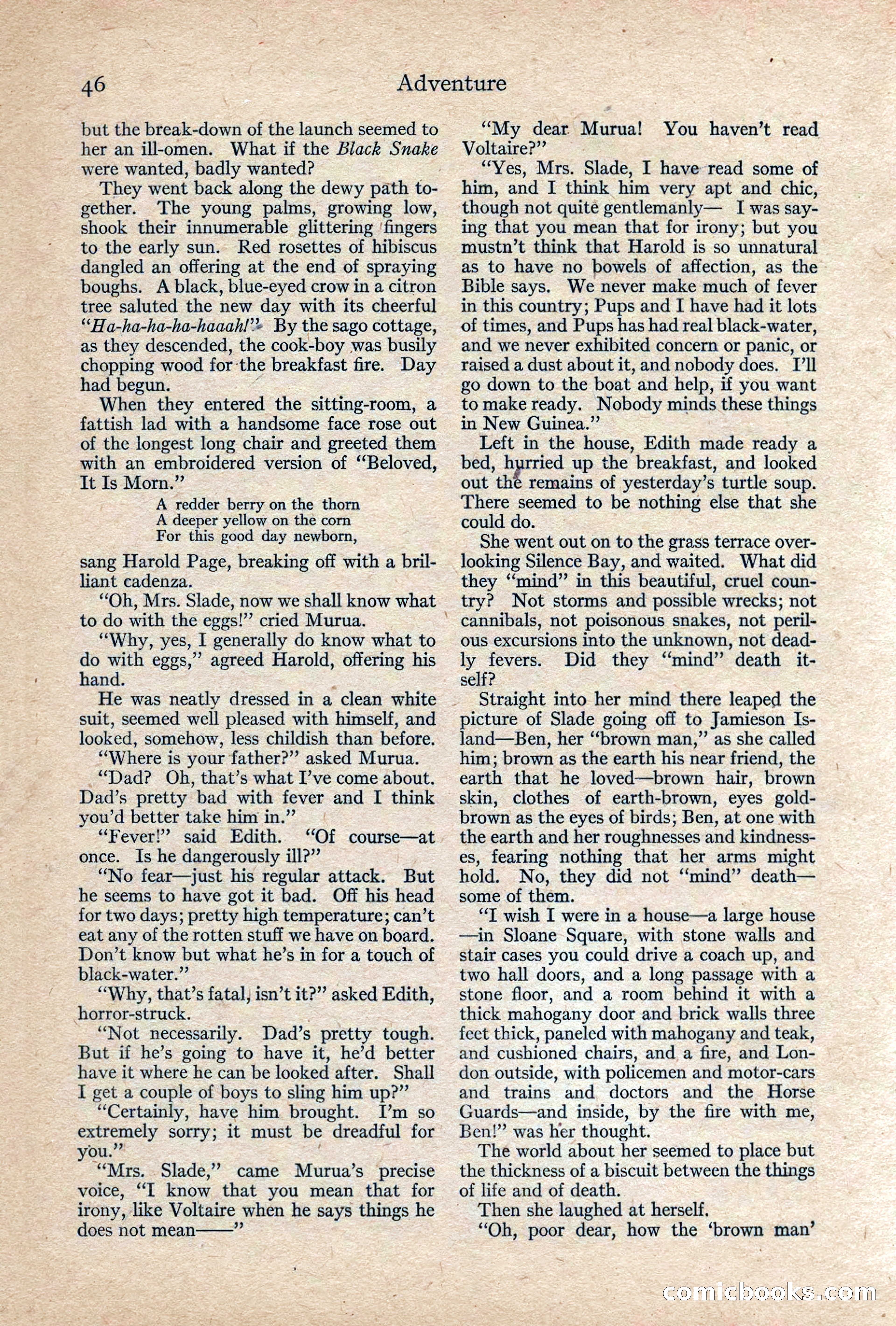
A restored page from Pulp Fiction, 1917. Page through the whole issue in the reader above.
📄 Transcribed text from this page (OCR, searchable)
Machine-transcribed from the original scan — historical spelling and the odd misread are preserved.
46 but the break-down of the launch seemed to her an ill-omen. What if the Black Snake were wanted, badly wanted? They went. back along the dewy path to- gether. The young palms, growing low, shook their innumerable glittering fingers to the early sun. Red rosettes of hibiscus dangled an ofiering at the end of spraying boughs. A black, blue-eyed crow in a citron tree saluted the new day with its cheerful “‘Ha-ha-ha-ha-haaah!’» By the sago cottage, as they descended, the cook-boy was busily chopping wood for: the breakfast fire. Day had begun. When they entered the sitting-room, a fattish lad with a handsome face rose out of the longest long chair and greeted them with an embroidered version of ‘ Pees It Is Morn.” A redder berry on the thorn A deeper yellow on the corn For this good day newborn, sang Harold Page, breaking off with a bril- liant cadenza. “Oh, Mrs. Slade, now we shall know what to do with the eggs!”’ cried Murua. “Why, yes, I generally do know what to do with eggs,’”’ agreed Harold, offering his hand. : He was neatly dressed in a clean white suit, seemed well pleased with himself, and looked, somehow, less childish than before. “Where is your father?” asked Murua. “Tad? Oh, that’s what I’ve come about. Dad’s pretty bad with fever and I think you'd better take him in.” | “Fever!” said Edith. “Of course—at once. Is he dangerously ill?” “No fear—just his regular attack. But he seems to have got it bad. Off his head for two days; pretty high temperature; can’t eat any of the rotten stuff we have on board. Don’t know but what he’s in for a touch of black-water.” “Why, that’s fatal, isn’t it?” asked Edith, Ahorror-struck. | “Not necessarily. Dad’s pretty tough. But if he’s going to have it, he’d better have it where he can be looked after. Shall I get a couple of boys to sling him up?” “Certainly, have him brought. I’m so extremely sorry; it must be * ireadful for Ou. > “Mrs. Slade,” came Murua’s precise voice, “I know that you mean that for irony, like Voltaire when he says things he does not mean——” Adventure “My dear Murua! You haven’t read Voltaire?” “Ves, Mrs. Slade, I have read some of him, and I think him very apt and chic, though not quite gentlemanly— I was say- ing that you mean that for irony; but you mustn’t think that Harold is so unnatural as to have no bowels of affection, as the Bible says. We never make much of fever in this country; Pups and I have had it lots of times, and Pups has had real black-water, and we never exhibited concern or panic, or raised a dust about it, and nobody does. T’ll go down to the boat and help, if you want to make ready. Nobody minds these things in New Guinea.” Left in the house, Edith made ready a bed, hurried up the breakfast, and looked out the remains of yesterday’s turtle soup. There seemed to be nothing else that she could do. She went out on to the grass terrace over- looking Silence Bay, and waited. What did they “‘mind” in this beautiful, cruel coun- try? Not storms and possible wrecks; not cannibals, not poisonous snakes, not peril- ous excursions into the unknown, not dead- ly fevers. Did they “mind” death it- self? Straight into her mind there leaped the picture of Slade going off to Jamieson Is- land—Ben, her ‘‘brown man,’ as she called him; brown as the earth his near friend, the earth that he loved—brown hair, brown skin, clothes of earth-brown, eyes gold- brown as the eyes of birds; Ben, at one with the earth and her roughnesses and kindness- es, fearing nothing that her arms might hold. No, they did not “mind” death— some of them. “T wish I were in a house—a large house —in Sloane Square, with stone walls and stair cases you could drive a coach up, and two hall doors, and a long passage with a stone floor, and a room behind it with a thick mahogany door and brick walls three feet thick, paneled with mahogany and teak, and cushioned chairs, and a fire, and Lon- don outside, with policemen and motor-cars and trains and doctors and the Horse Guards—and inside, by the fire with me, Ben!” was her thought. The world about her seemed to place but the thickness of a biscuit between the things of life and of death. Then she laughed at herself. “Oh, poor dear, how the ‘brown man’ (CCOLAMICE S (CO) NicGdoo