
Pulp Fiction, 1917 · page 24 of 228
Adventure, February 1917 — page 24: what you’re looking at
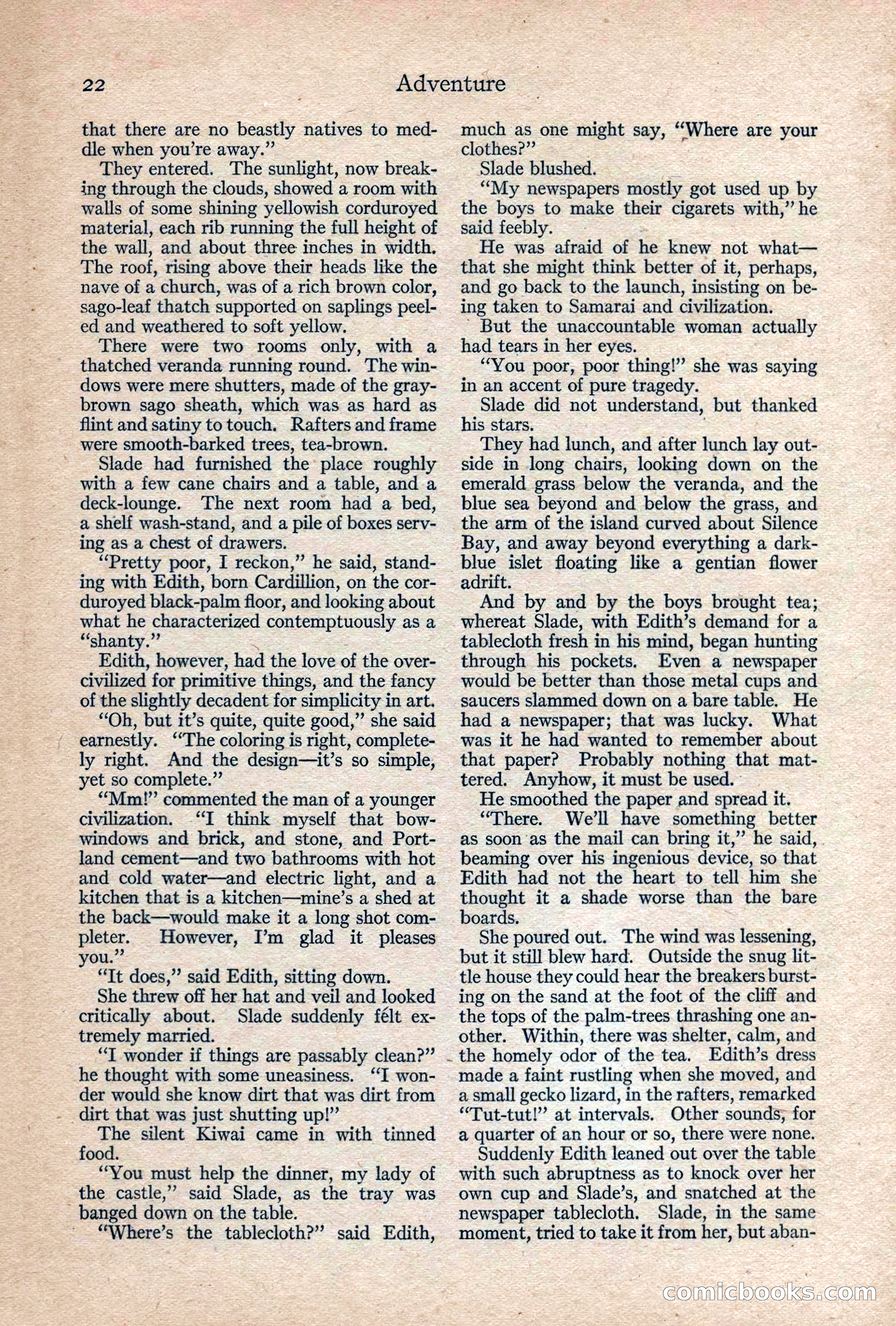
A restored page from Pulp Fiction, 1917. Page through the whole issue in the reader above.
📄 Transcribed text from this page (OCR, searchable)
Machine-transcribed from the original scan — historical spelling and the odd misread are preserved.
that there are no beastly natives to med- dle when you’re away.” They entered. The sunlight, now break- ing through the clouds, showed a room with walls of some shining yellowish corduroyed material, each rib running the full height of the wall, and about three inches in width. The roof, rising above their heads like the nave of a church, was of a rich brown color, sago-leaf thatch supported on saplings peel- ed and weathered to soft yellow. There were two rooms only, with a thatched veranda running round. The win- dows were mere shutters, made of the gray- brown sago sheath, which was as hard as flint and satiny totouch. Rafters and frame were smooth-barked trees, tea-brown. ' Slade had furnished the place roughly with a few cane chairs and a table, and a deck-lounge. The next room had a bed, a shelf wash-stand, and a pile of boxes serv- ing as a chest of drawers. “Pretty poor, I reckon,” he said, stand- ing with Edith, born Cardillion, on the cor- duroyed black-palm floor, and looking about what he characterized contemptuously as a “shanty.” : Edith, however, had the love of the over- civilized for primitive things, and the fancy of the slightly decadent for simplicity in art. “Oh, but it’s quite, quite good,” she said earnestly. ‘The coloring is right, complete- ly right. And the design—it’s so simple, yet so complete.” ‘Mm!’ commented the man of a younger civilization. “I think myself that bow- windows and brick, and stone, and Port- land cement—and two bathrooms with hot and cold water—and electric light, and a kitchen that is a kitchen—mine’s a shed at the back—would make it a long shot com- pleter. However, I’m glad it pleases you.” “Tt does,” said Edith, sitting down. She threw off her hat and veil and looked critically about. Slade suddenly félt ex- tremely married. “T wonder if things are passably clean?” he thought with some uneasiness. ‘I won- der would she know dirt that was dirt from . dirt that was just shutting up!” The silent Kiwai came in with tinned food. “You must help the dinner, my lady of _the castle,” said Slade, as the tray was banged down on the table. “Where’s the tablecloth?” said Edith, Adventure much as one might say, “Where are your clothes?”’ | . Slade blushed. ““My newspapers mostly got used up by the boys to make their cigarets with,” he said feebly. , He was afraid of he knew not what— that she might think better of it, perhaps, and go back to the launch, insisting on be- ing taken to Samarai and civilization. ' But the unaccountable woman actually had tears in her eyes. ‘“You poor, poor thing!” she was saying in an accent of pure tragedy. Slade did not understand, but thanked his stars. They had lunch, and after lunch lay out- side in long chairs, looking down on the emerald grass below the veranda, and the blue sea beyond and below the grass, and the arm of the island curved about Silence Bay, and away beyond everything a dark- blue islet floating like a gentian flower adrift. And by and by the boys brought tea; -whereat Slade, with Edith’s demand for a tablecloth fresh in his mind, began hunting through his pockets. Even a newspaper would be better than those metal cups and saucers slammed down on a bare table. He had a newspaper; that was lucky. What was it he had wanted to remember about that paper? Probably nothing that mat- tered. Anyhow, it must be used. _ He smoothed the paper and spread it. ‘There. We'll have something better as soon’as the mail can bring it,” he said, . beaming over his ingenious device, so that Edith had not the heart to tell him she thought it a shade worse than the bare boards. She poured out. The wind was lessening, but it still blew hard. Outside the snug lit- tle house they could hear the breakers burst- ing on the sand at the foot of the cliff and the tops of the palm-trees thrashing one an- other. Within, there was shelter, calm, and . the homely odor of the tea. Edith’s dress made a faint rustling when she moved, and a small gecko lizard, in the rafters, remarked “Tut-tut!” at intervals. Other sounds; for a quarter of an hour or so, there were none. Suddenly Edith leaned out over the table with such abruptness as to knock over her own cup and Slade’s, and snatched at the newspaper tablecloth. Slade, in the same moment, tried to take it from her, but aban- S AME Loxoye) (CO) (CO)