
Pulp Fiction, 1917 · page 23 of 228
Adventure, February 1917 — page 23: what you’re looking at
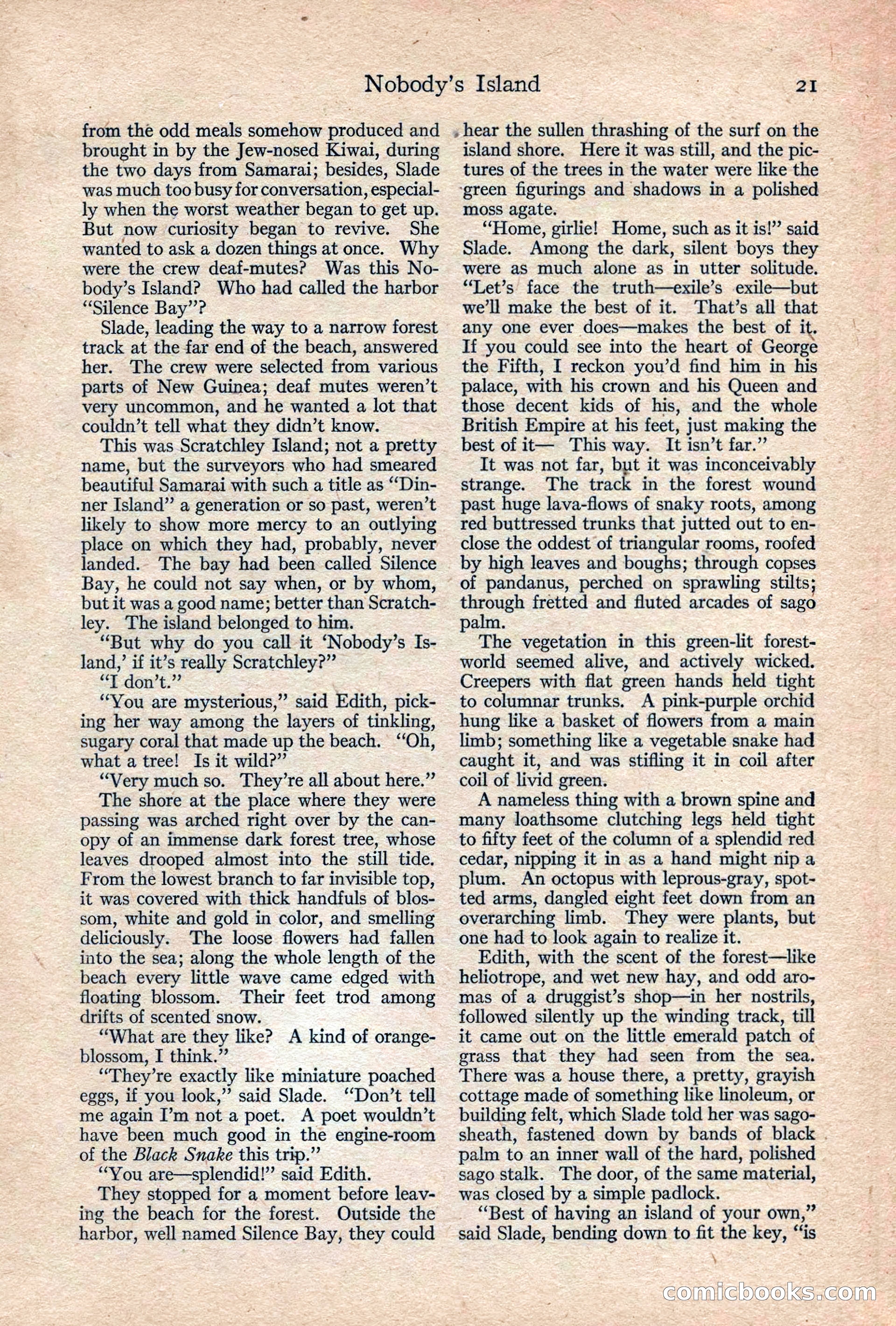
A restored page from Pulp Fiction, 1917. Page through the whole issue in the reader above.
📄 Transcribed text from this page (OCR, searchable)
Machine-transcribed from the original scan — historical spelling and the odd misread are preserved.
-~ Nobody’s Island from the odd meals somehow produced and brought in by the Jew-nosed Kiwai, during the two days from Samarai; besides, Slade was much too busy for conversation , especial- ly when the worst weather began to get up. But now curiosity began to revive. She wanted to ask a dozen things at once. Why were the crew deaf-mutes? Was this No- body’s Island? Who had called the harbor “Silence Bay’”’? Slade, leading the way to a narrow forest track at the far end of the beach, answered her. The crew were selected from various parts of New Guinea; deaf mutes weren’t very uncommon, and he wanted a lot that couldn’t tell what they didn’t know. This was Scratchley Island; not a pretty name, but the surveyors who had smeared beautiful Samarai with such a title as “Din- ner Island” a generation or so past, weren’t likely to show more mercy to an outlying place on which they had, probably, never landed.- The bay had been called Silence Bay, he could not say when, or by whom, but it was a good name; better than Scratch- ley. The island belonged to him. “But why do you call it ‘Nobody’s Is- land,’ if it’s really Scratchley?” “T don’t.” ‘You are mysterious,” said Edith, pick- ing her way among the layers of tinkling, sugary coral that made up the beach. ‘Oh, what a tree! Is it wild?” “Very much so. They’re all about here.” The shore at the place where they were passing was arched right over by the can- opy of an immense dark forest tree, whose leaves drooped almost into the still tide. From the lowest branch to far invisible top, it was covered with thick handfuls of blos- som, white and gold in color, and smelling deliciously. The loose flowers had fallen into the sea; along the whole length of the beach every little wave came edged with floating blossom. Their feet trod among drifts of scented snow. “What are they like? A kind of orange- blossom, I think.” ‘“‘They’re exactly like miniature poached eggs, if you look,” said Slade. ‘Don’t tell me again I’m not a poet. A poet wouldn’t have been much good in the engine-room of the Black Snake this trip.” “You are—splendid!” said Edith. They stopped for a moment before leav- ing the beach for the forest. Outside the harbor, well named Silence Bay, they could , hear the sullen thrashing of the surf on the P $a abe island shore. Here it was still, and the pic- _ tures of the trees in the water were like the ‘green figurings and shadows in a polished moss agate. “Home, girlie! Home, such as it is!’ said Slade. Among the dark, silent boys they were as much alone as in utter solitude. “Let’s face the truth—exile’s exile—but we'll make the best of it. That’s all that any one ever does—makes the best of it. If you could see into the heart of George the Fifth, I reckon you’d find him in his palace, with his crown and his Queen and those decent kids of his, and the whole British Empire at his feet, just making the best of it— This way. It isn’t far.”’ It was not far, but it was inconceivably strange. The track in the forest wound past huge lava-flows of snaky roots, among red buttressed trunks that jutted out to en- close the oddest of triangular rooms, roofed by high leaves and boughs; through copses of pandanus, perched on sprawling stilts; through fretted and fluted arcades of sago palm. The vegetation in this green-lit forest- world seemed alive, and actively wicked. Creepers with flat green hands held tight to columnar trunks. A pink-purple orchid hung like a basket of flowers from a main limb; something like a vegetable snake had caught it, and was stifling it in coil after coil of livid green. A nameless thing with a biown spine and many loathsome clutching legs held tight to fifty feet of the column of a splendid red cedar, nipping it in as a hand might nipa plum. An octopus with leprous-gray, spot- ted arms, dangled eight feet down from an overarching limb. They were plants, but one had to look again to realize it. Edith, with the scent of the forest—like heliotrope, and wet new hay, and odd aro- mas of a druggist’s shop—in her nostrils, followed silently up the winding track, till it came out on the little emerald patch of grass that they had seen from the sea. There was a house there, a pretty, grayish cottage made of something like linoleum, or building felt, which Slade told her was sago- sheath, fastened down by bands of black . palm to an inner wall of the hard, polished sago stalk. The door, of the same material, was closed by a simple padlock. “Best of having an island of your own,” said Slade, bending down to fit the key, “‘is ) Gomicbooks (CO) S|