
Pulp Fiction, 1917 · page 21 of 228
Adventure, February 1917 — page 21: what you’re looking at
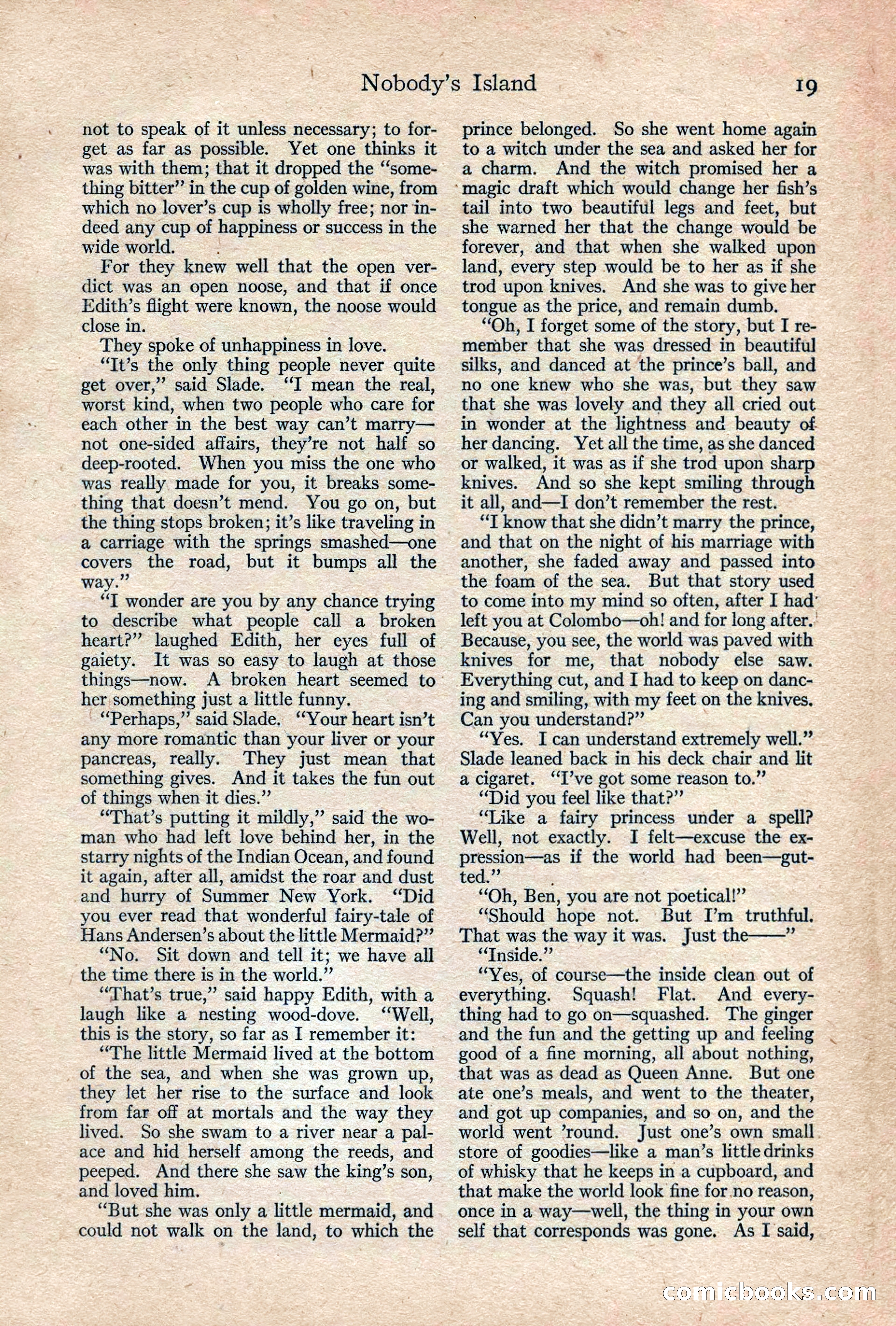
A restored page from Pulp Fiction, 1917. Page through the whole issue in the reader above.
📄 Transcribed text from this page (OCR, searchable)
Machine-transcribed from the original scan — historical spelling and the odd misread are preserved.
Nobody’s Island not to speak of it unless necessary; to for- get as far as possible. Yet one thinks it was with them; that it dropped the “some- thing bitter” in ‘the cup of golden wine, from which no lover’s cup is wholly free; nor in- deed any cup of happiness or success in the wide world. For they knew well that the open ver- dict was an open noose, and that if once Edith’s flight were known, the noose would close in. They spoke of unhappiness in love. “Tt’s the only thing people never quite get over,” said Slade. “I mean the real, worst kind, when two people who care for each other in the best way can’t marry— not one-sided affairs, they’re not half so deep-rooted. When you miss the one who was really made for you, it breaks some- thing that doesn’t mend. You go on, but the thing stops broken; it’s like traveling in a carriage with the springs smashed—one covers the road, but it bumps all the way.” “T wonder are you by any chance trying to describe what people call a_ broken heart?” laughed Edith, her eyes full of gaiety. It was so easy to laugh at those things—now. A broken heart seemed to’ her something just a little funny. ~ “Perhaps,” said Slade. ‘Your heart isn’t any more romantic than your liver or your pancreas, really. They just mean that something gives. And it takes the fun out of things when it dies.” “That’s putting it mildly,” said the wo- man who had left love behind her, in the starry nights of the Indian Ocean, and found it again, after all, amidst the roar and dust -and hurry of Summer New York. “Did you ever read that wonderful fairy-tale of Hans Andersen’s about the little Mermaid?” “No. Sit down and tell it; we have all the time there is in the world.” “That’s true,” said happy Edith, with a laugh like a nesting wood-dove. ‘‘Well, this is the story, so far as I remember it: “The little Mermaid lived at the bottom _of the sea, and when she was grown up, they let her rise to the surface and look from far off at mortals and the way they lived. So she swam to a river near a pal- ace and hid herself among the reeds, and peeped. And there she saw the king’s son, and loved him. “But she was only a little mermaid, and could not walk on the land, to which the 19 prince belonged. So she went home again to a witch under the sea and asked her for a charm. And the witch promised her a ‘magic draft which would change her fish’s tail into two beautiful legs and feet, but she warned her that the change would be forever, and that when she walked upon land, every step would be to her as if she trod upon knives. And she was to give her tongue as the price, and remain dumb. “Oh, I forget some of the story, but I re- member that she was dressed in beautiful silks, and danced at the prince’s ball, and no one knew who she was, but they Saw that she was lovely and they all cried out in wonder at the lightness and beauty of her dancing. Yet all the time, as she danced or walked, it was as if she trod upon sharp knives. it all, and—I don’t remember the rest. ae | know that she didn’t marry the prince, and that on the night of his marriage with another, she faded away and passed into the foam of the sea. But that story used to come into my mind so often, after I had’ left you at Colombo—oh! and for long after.. Because, you see, the world was paved with knives for me, that nobody else saw. And so she kept smiling through © Everything cut, and I had to keep on danc- — ing and smiling, with my feet on the knives, Can you understand?” “Yes. I can understand extremely well.” Slade leaned back in his deck chair and lit a cigaret. “I’ve got some reason to.” “Did you feel like that?” “Like a fairy princess under a spell? Well, not exactly. I felt—excuse the ex- pression—as if the world had been—gut- ted. 9) “Oh, Ben, you are not poetical!” “Should hope not. But I’m truthful. That was the way it was. Just the——” “Inside.” “Ves, of course—the inside clean out of everything. Squash! Flat. And every- thing had to go on—squashed. The ginger and the fun and the getting up and feeling good of a fine morning, all about nothing, that was as dead as Queen Anne. But one ate one’s meals, and went to the theater, and got up companies, and so on, and the world went ’round. Just one’s own small. store of goodies—like a man’s little drinks of whisky that he keeps in a cupboard, and that make the world look fine for.no reason, once in a way—well, the thing in your own self that corresponds was gone. As I said, (€) NOOLKES Si ANI (E@)